Graduate school of Medical Science and Engineering, Korea Advanced Institute of Science and Technology, Daejeon, Republic of Korea.
Department of Internal Medicine, Seoul National University College of Medicine, Seoul, Republic of Korea.
BMJ Open. 2020 Feb 10;10(2):e031608. doi: 10.1136/bmjopen-2019-031608.
Impact of sex and myocardial function on the obesity paradox in heart failure (HF) is unknown. We explored whether sex, myocardial function, and left ventricular (LV) geometry explains the protective association of body mass index (BMI) with mortality, and investigated whether metabolic health status affects this association.
A multicentre cohort study with patients with acute HF admitted from January 2009 to December 2016 with a median follow-up of 33.7 months.
Three tertiary hospitals.
A total of 2021 overweight-to-obese (OW) and 1543 normal-weight (NW) patients with acute HF.
The primary outcome was all-cause mortality. Patients were categorised as either OW (BMI≥23kg/m) or NW (BMI<23kg/m). BMI was used as both categorical and continuous variables. Clinical, laboratory and echocardiographic measures, including LV global longitudinal strain (LV-GLS), LV-ejection fraction, LV geometry, were obtained.
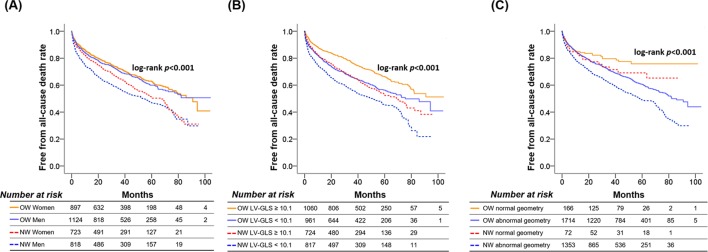
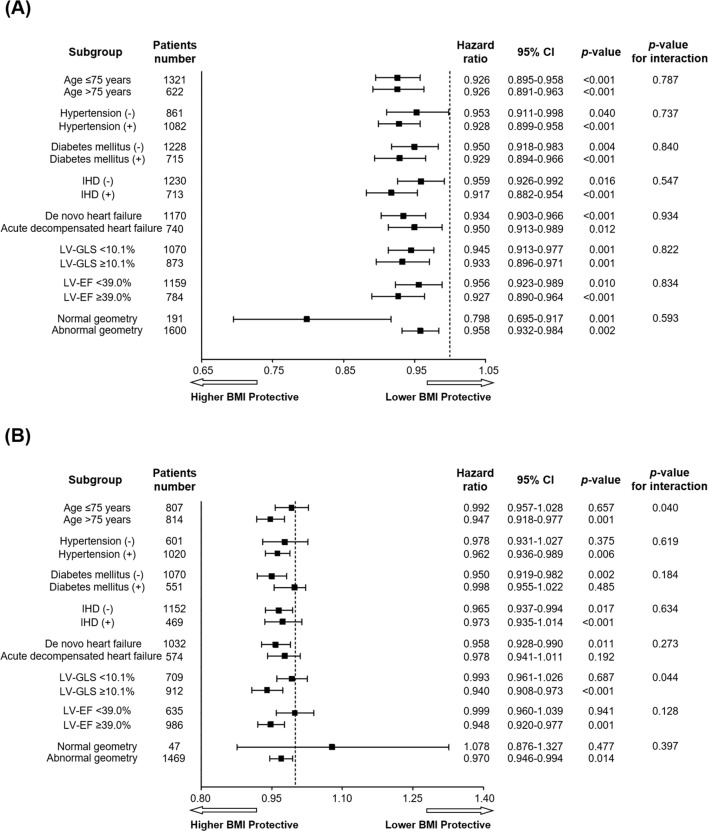
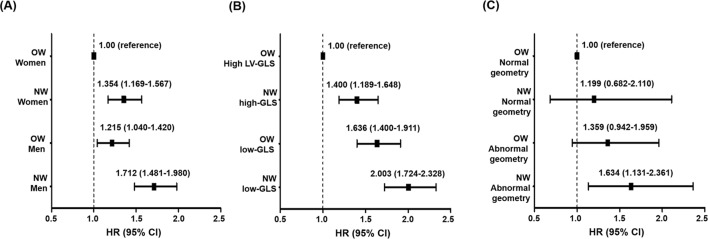
During the follow-up period, 1392 patients died (685 OW and 707 NW). BMI was significantly associated with mortality in univariate (HR=0.929 per kg/m, p<0.001) and multivariate analyses (HR=0.954 per kg/m, p<0.001). In multivariable fractional polynomials, higher BMIs were associated with lower mortality overall and in subgroups by sex, LV-GLS and LV geometry, with a steeper association in men (-interaction <0.001). In women, there were significant interactions of BMI with LV-GLS (p-interaction=0.044) and age (p-interaction=0.040) for mortality; the protective association of BMI with mortality was confined to subgroups with high LV-GLS (>10.1%) or elderly patients (≥75 years). In men, this association was found in all subgroups without significant interaction. Metabolically healthy obese patients had better survival than metabolically unhealthy obese patients (log-rank p<0.001).
In women, a significant interaction was observed between BMI and age or LV-GLS in association with mortality, suggesting that sex, ageing and myocardial dysfunction can affect the magnitude of the obesity paradox in HF. Metabolic health status provides prognostic information beyond obesity status.
Registry: ClinicalTrials.gov Number: NCT03513653 (https://clinicaltrials.gov/ct2/show/NCT03513653).
性别和心肌功能对心力衰竭(HF)中肥胖悖论的影响尚不清楚。我们探讨了性别、心肌功能和左心室(LV)几何形状是否可以解释体重指数(BMI)与死亡率之间的保护关联,并研究了代谢健康状况是否会影响这种关联。
一项多中心队列研究,纳入 2009 年 1 月至 2016 年 12 月期间因急性 HF 入院的患者,中位随访时间为 33.7 个月。
三家三级医院。
共纳入 2021 名超重至肥胖(OW)和 1543 名正常体重(NW)的急性 HF 患者。
主要结局为全因死亡率。患者分为超重(BMI≥23kg/m)或正常体重(BMI<23kg/m)。BMI 既作为分类变量又作为连续变量。获得了临床、实验室和超声心动图指标,包括 LV 整体纵向应变(LV-GLS)、LV 射血分数、LV 几何形状。
在随访期间,共有 1392 名患者死亡(OW 组 685 名,NW 组 707 名)。BMI 在单变量(每增加 1kg/m,HR=0.929,p<0.001)和多变量分析(每增加 1kg/m,HR=0.954,p<0.001)中均与死亡率显著相关。在多变量分数多项式中,较高的 BMI 与总体死亡率以及按性别、LV-GLS 和 LV 几何形状划分的亚组死亡率均呈负相关,且男性的相关性更强(-交互作用<0.001)。在女性中,BMI 与 LV-GLS(p 交互作用=0.044)和年龄(p 交互作用=0.040)之间存在显著的交互作用,BMI 与死亡率的保护关联仅限于 LV-GLS 较高(>10.1%)或年龄较大(≥75 岁)的亚组。在男性中,这种关联在没有显著交互作用的所有亚组中均存在。代谢健康的肥胖患者的生存状况优于代谢不健康的肥胖患者(log-rank p<0.001)。
在女性中,BMI 与年龄或 LV-GLS 之间的交互作用与死亡率相关,表明性别、衰老和心肌功能障碍可能影响 HF 中肥胖悖论的程度。代谢健康状况提供了比肥胖状况更具预后意义的信息。
ClinicalTrials.gov 编号:NCT03513653(https://clinicaltrials.gov/ct2/show/NCT03513653)。