Peking University People's Hospital and Peking University Institute of Hematology, Beijing Key Laboratory of Hematopoietic Stem Cell Transplantation, No. 11 South Street of Xizhimen, Xicheng District, Beijing, 100044, P.R. China.
Peking-Tsinghua Center for Life Sciences, Beijing, 100871, China.
Sci Rep. 2020 Feb 11;10(1):2367. doi: 10.1038/s41598-020-59417-1.
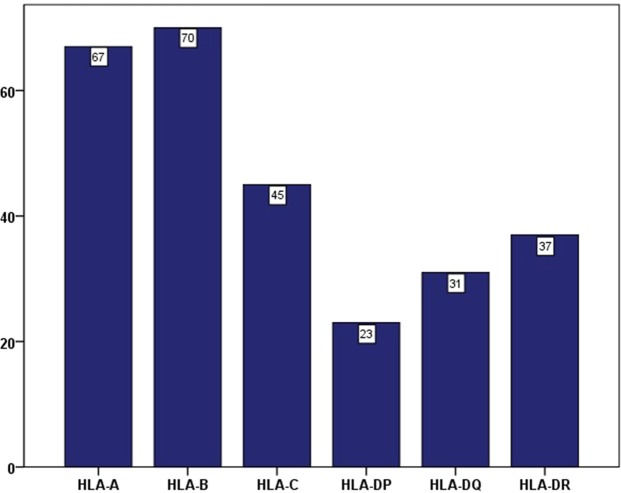
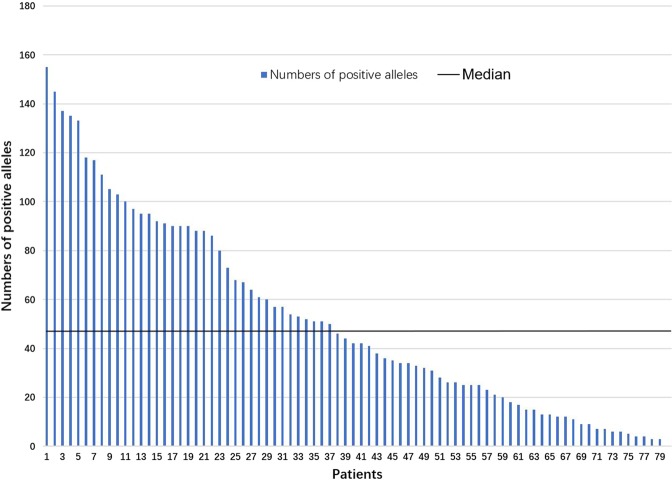
The effect of donor-specific anti-human leukocyte antigen (HLA) antibodies (DSAs) has been recognized as a factor in graft failure (GF) in patients who underwent umbilical cord blood transplantation (UBT), matched unrelated donor transplantation (MUDT), or haploidentical stem cell transplantation (haplo-SCT). Presently, we know little about the prevalence of and risk factors for having anti-HLA antibodies among older transplant candidates. Therefore, we analyzed 273 older patients with hematologic disease who were waiting for haplo-SCT. Among all patients, 73 (26.7%) patients had a positive panel-reactive antibody (PRA) result for class I, 38 (13.9%) for class II, and 32 (11.7%) for both. Multivariate analysis showed that females were at a higher risk for having a PRA result for class II (P = 0.001) and for having antibodies against HLA-C and HLA-DQ. Prior pregnancy was a risk factor for having a PRA result for class I (P < 0.001) and for having antibodies against HLA-A, HLA-B and HLA-DQ. Platelet transfusions were risk factors for the following: having a positive PRA result for class I (P = 0.014) and class II (P < 0.001); having antibodies against HLA-A, HLA-B, HLA-C, HLA-DP, HLA-DQ, and HLA-DR; and having higher mean fluorescence intensity (MFI) of PRA for class I (P = 0.042). In addition, previous total transfusions were at high risk for having higher numbers of antibodies to specific HLA loci (P = 0.005), and disease course (7.5 months or more) (P = 0.020) were related to higher MFI of PRAs for class I. Our findings indicated that female sex, prior pregnancy, platelet transfusions and disease courses are independent risk factors for older patients with hematologic disease for having anti-HLA antibodies, which could guide anti-HLA antibody monitoring and be helpful for donor selection.
供者特异性抗人类白细胞抗原(HLA)抗体(DSA)的作用已被认为是接受脐带血移植(UBT)、匹配无关供者移植(MUDT)或单倍体造血干细胞移植(haplo-SCT)的患者移植物失败(GF)的一个因素。目前,我们对老年移植候选者中存在抗 HLA 抗体的流行情况和危险因素知之甚少。因此,我们分析了 273 例等待单倍体 SCT 的血液病老年患者。在所有患者中,73 例(26.7%)患者 HLA Ⅰ类群体反应性抗体(PRA)阳性,38 例(13.9%)患者 HLA Ⅱ类 PRA 阳性,32 例(11.7%)患者两类 PRA 均阳性。多因素分析显示,女性 HLA Ⅱ类 PRA 阳性的风险更高(P = 0.001),且更易产生针对 HLA-C 和 HLA-DQ 的抗体。既往妊娠是 HLA Ⅰ类 PRA 阳性(P < 0.001)和针对 HLA-A、HLA-B 和 HLA-DQ 抗体产生的危险因素。血小板输注是 HLA Ⅰ类 PRA 阳性(P = 0.014)和 HLA Ⅱ类 PRA 阳性(P < 0.001)、针对 HLA-A、HLA-B、HLA-C、HLA-DP、HLA-DQ 和 HLA-DR 产生抗体、以及 HLA Ⅰ类 PRA 平均荧光强度(MFI)升高的危险因素(P = 0.042)。此外,既往全血输注与针对特定 HLA 位点的抗体数量增加(P = 0.005)和疾病进程(7.5 个月或更长时间)(P = 0.020)呈显著相关,与 HLA Ⅰ类 PRA 的 MFI 升高有关。我们的研究结果表明,女性、妊娠、血小板输注和疾病进程是血液病老年患者产生抗 HLA 抗体的独立危险因素,这有助于指导抗 HLA 抗体监测和供者选择。