Chen Dongjie, Zhao Yunan, Qiu Yanqin, Xiao Liying, He Huaqiang, Zheng Dongmei, Li Xiaoqin, Yu Xiaoli, Xu Nengluan, Hu Xinlan, Chen Falin, Li Hongru, Chen Yusheng
Shengli Clinical Medical College of Fujian Medical University, Fuzhou, China.
Clinical Microbiology Laboratory, Fujian Provincial Hospital, Fuzhou, China.
Front Microbiol. 2020 Jan 28;10:3159. doi: 10.3389/fmicb.2019.03159. eCollection 2019.
The increase in carbapenem-resistant (CRKP), especially the emergence of tigecycline-resistant (KP), is a serious public health concern. However, the underlying mechanism of tigecycline resistance is unclear. In this study, we evaluated the role of the CusS-CusR two-component system (TCS), which is associated with copper/silver resistance, in tigecycline resistance in CRKP.
Following the evolution of tigecycline-resistant KP, the minimum inhibitory concentrations of tigecycline were determined using the micro-broth dilution method. RNA sequencing and data analysis were performed to identify differentially expressed genes. Quantitative PCR (qPCR) was performed to verify the genes of interest. Genes associated with tigecycline resistance, such as , , and , were detected by PCR, and then mutants were confirmed by sequencing. Additionally, the efflux pump-associated genes , , , , and were also analyzed by qPCR. was deleted and complemented by the suicide vector pKO3-Km plasmid and pGEM-T-easy plasmid, respectively.
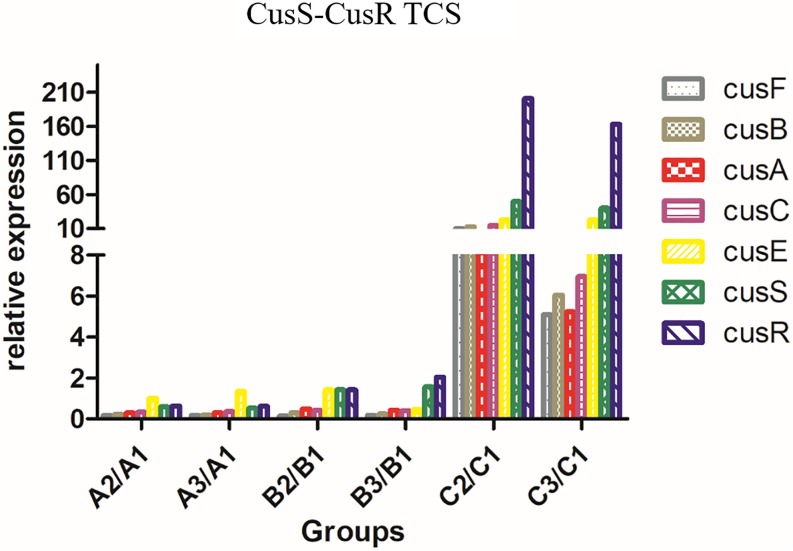
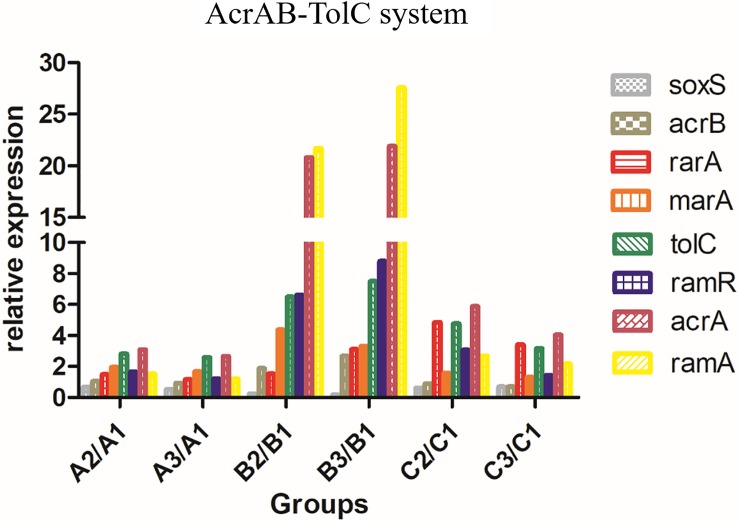
Nine strains of KP were evaluated in our study. Strains and were evolved from , , and were evolved from , and and were evolved from . The tigecycline minimum inhibitory concentration for , , and C1 was 0.5 μg/mL; that for , , and was 16.0 μg/mL; and that for , , and was 32.0 μg/mL. RNA-sequencing and qPCR confirmed that the differentially expressed genes , , , , , , and showed higher expression in and than in . Genes related to the efflux pump AcrAB-TolC showed higher expression in and than in . No mutants of , , or were detected. , , , , and did not show increased expression in any group. After deletion and complementation of cusR among C3, the MIC of tigecycline decreased to 4 μg/mL, and then recovered to 32 μg/mL. The expression of , correspondingly decreased and increased significantly.
In addition to its primary function in resistance to copper/silver, the CusS-CusR two-component system is associated with CRKP resistance to tigecycline.
耐碳青霉烯类肺炎克雷伯菌(CRKP)的增加,尤其是耐替加环素肺炎克雷伯菌(KP)的出现,是一个严重的公共卫生问题。然而,替加环素耐药的潜在机制尚不清楚。在本研究中,我们评估了与铜/银耐药相关的CusS-CusR双组分系统(TCS)在CRKP对替加环素耐药中的作用。
在耐替加环素肺炎克雷伯菌进化后,采用微量肉汤稀释法测定替加环素的最低抑菌浓度。进行RNA测序和数据分析以鉴定差异表达基因。进行定量PCR(qPCR)以验证感兴趣的基因。通过PCR检测与替加环素耐药相关的基因,如 、 和 ,然后通过测序确认突变体。此外,还通过qPCR分析了与外排泵相关的基因 、 、 、 和 。 分别用自杀载体pKO3-Km质粒和pGEM-T-easy质粒缺失和互补。
本研究评估了9株肺炎克雷伯菌。菌株 和 由 进化而来, 、 和 由 进化而来, 、 和 由 进化而来。 、 和C1的替加环素最低抑菌浓度为0.5μg/mL; 、 和 的为16.0μg/mL; 、 和 的为32.0μg/mL。RNA测序和qPCR证实,差异表达基因 、 、 、 、 、 和 在 和 中的表达高于 。与外排泵AcrAB-TolC相关的基因在 和 中的表达高于 。未检测到 、 或 的突变体。 、 、 、 和 在任何组中均未显示表达增加。在C3中缺失和互补cusR后,替加环素的MIC降至4μg/mL,然后恢复至32μg/mL。 、 的表达相应地显著下降和增加。
除了其对铜/银耐药的主要功能外,CusS-CusR双组分系统还与CRKP对替加环素的耐药相关。