Department of Clinical Immunology, Aarhus University Hospital, Aarhus, Denmark.
Department of Infectious Diseases, Aarhus University Hospital, Aarhus, Denmark.
Front Immunol. 2020 Jan 27;10:3022. doi: 10.3389/fimmu.2019.03022. eCollection 2019.
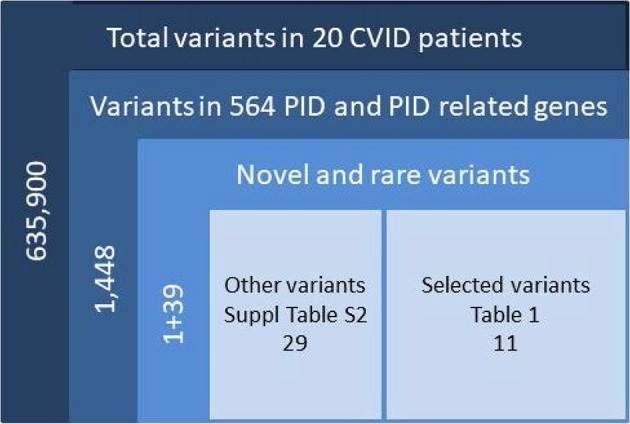
Common variable immunodeficiency (CVID) is a primary immunodeficiency characterized by recurrent bacterial infections and defined by reduced levels of IgG, IgA, and/or IgM, insufficient response to polysaccharide vaccination, and an abnormal B-cell immunophenotype with a significantly reduced fraction of isotype-switched memory B cells. In addition to this infectious phenotype, at least one third of the patients experience autoimmune, autoinflammatory, granulomatous, and/or malignant complications. The very heterogeneous presentation strongly suggests a collection of different disease entities with somewhat different pathogeneses and most likely diverse genetic etiologies. Major progress has been made during recent years with the advent and introduction of next-generation sequencing, initially for research purposes, but more recently in clinical practice. In the present study, we performed whole exome sequencing on 20 CVID patients with autoimmunity, autoinflammation, and/or malignancy from the Danish CVID cohort with the aim to identify gene variants with a certain, possible, or potential disease-causing role in CVID. Through bioinformatics analyses, we identified variants with possible/probable disease-causing potential in nine of the patients. Of these, three patients had four variants in three different genes classified as likely pathogenic (, and ), whereas in six patients, we identified seven variants of possible pathogenic potential classified as variants of unknown significance (, and ). In the remaining 11 patients, we did not identify possible genetic causes. Genetic findings were correlated to clinical disease presentation, clinical immunological phenotype, and disease complications. We suggest that the variants identified in the present work should lay the ground for future studies to functionally validate their disease-causing potential and to investigate at the mechanistic and molecular level their precise role in CVID pathogenesis. Overall, we believe that the present work contributes important new insights into the genetic basis of CVID and particular in the subset of CVID patients with a complex phenotype involving not only infection, but also autoimmunity, autoinflammation, and malignancy.
普通变异型免疫缺陷症(CVID)是一种以反复细菌感染为特征的原发性免疫缺陷症,其特点是 IgG、IgA 和/或 IgM 水平降低、对多糖疫苗接种无足够反应以及异常的 B 细胞免疫表型,其中同种型转换的记忆 B 细胞比例明显降低。除了这种感染表型外,至少有三分之一的患者会出现自身免疫、自身炎症、肉芽肿和/或恶性并发症。这种非常异质的表现强烈提示存在一系列不同的疾病实体,它们具有不同的发病机制,并且很可能具有不同的遗传病因。近年来,随着下一代测序技术的出现和应用,在研究目的的基础上,更广泛地应用于临床实践,取得了重大进展。在本研究中,我们对来自丹麦 CVID 队列的 20 名患有自身免疫、自身炎症和/或恶性肿瘤的 CVID 患者进行了全外显子组测序,旨在鉴定具有特定、可能或潜在疾病致病作用的基因变异。通过生物信息学分析,我们在 9 名患者中发现了具有可能/可能致病潜力的变异。其中,3 名患者在 3 个不同基因中有 4 个变异被归类为可能致病性(、和),而在 6 名患者中,我们发现了 7 个可能致病性的变异被归类为意义不明的变异(、和)。在其余 11 名患者中,我们没有发现可能的遗传原因。遗传发现与临床疾病表现、临床免疫学表型和疾病并发症相关。我们建议,本研究中鉴定的变异应作为未来研究的基础,以功能验证其致病潜力,并在机制和分子水平上研究其在 CVID 发病机制中的精确作用。总体而言,我们认为本研究为 CVID 的遗传基础,特别是涉及感染、自身免疫、自身炎症和恶性肿瘤的复杂表型的 CVID 患者亚组的遗传基础提供了重要的新见解。