Zhang Sai, Johnson Jay S, Qiao Mu, Trottier Nathalie L
1Department of Animal Science, Michigan State University, East Lansing, 48824 USA.
2USDA-ARS Livestock Behavior Research Unit, West Lafayette, 47907 USA.
J Anim Sci Biotechnol. 2020 Feb 7;11:4. doi: 10.1186/s40104-019-0414-x. eCollection 2020.
The study objective was to test the hypothesis that 1) lowering dietary crude protein (CP) increases dietary energetic efficiency and reduces metabolic heat associated with lactation, and 2) excessive dietary leucine (Leu) supplementation in a low CP diet decreases dietary energetic efficiency and increases metabolic heat associated with lactation.
Fifty-four lactating multiparous Yorkshire sows were allotted to 1 of 3 isocaloric diets (10.80 MJ/kg net energy): 1) control (CON; 18.75% CP), 2) reduced CP with a near ideal or optimal AA profile (OPT; 13.75% CP) and 3) diet OPT with excessive Leu (OPTLEU; 14.25% CP). Sow body weight and backfat were recorded on day 1 and 21 of lactation and piglets were weighed on day 1, 4, 8, 14, 18, and 21 of lactation. Energy balance was measured on sows during early (day 4 to 8) and peak (day 14 to18) lactation, and milk was sampled on day 8 and 18.
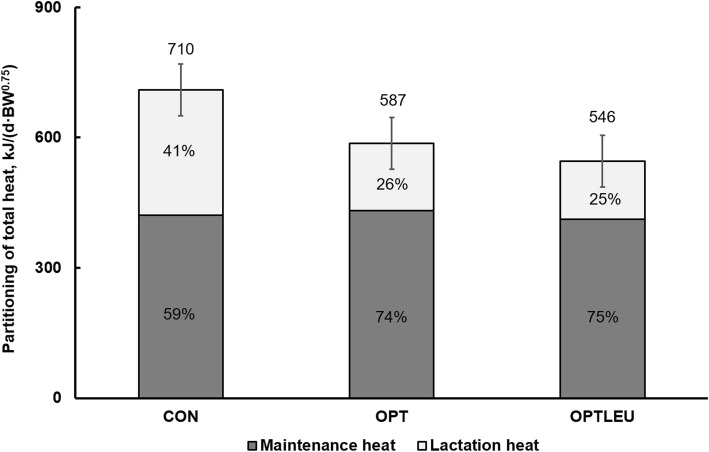
Over 21-day lactation, sows fed OPT lost body weight and body lipid ( < 0.05). In peak lactation, sows fed OPT had higher milk energy output ( < 0.05) than CON. Sows fed OPTLEU tended ( = 0.07) to have less milk energy output than OPT and did not differ from CON. Maternal energy retention was lower ( < 0.05) in OPT and OPTLEU compared to CON sows, and did not differ between OPTLEU and OPT sows. Sows fed OPT had higher ( < 0.05) apparent energy efficiency for milk production compared to CON. Heat production associated with lactation was lower ( < 0.05) or tended to be lower ( = 0.082), respectively, in OPT and OPTLEU compared to CON sows.
The OPT diet, in peak lactation, improved dietary energy utilization for lactation due to less urinary energy and metabolic heat loss, and triggered dietary energy deposition into milk at the expense of maternal lipid mobilization. Leucine supplementation above requirement may reduce dietary energy utilization for lactation by decreasing the energy partitioning towards milk, partially explaining the effectiveness of OPT diet over CON diets.
本研究的目的是验证以下假设:1)降低日粮粗蛋白(CP)可提高日粮能量效率并减少与泌乳相关的代谢热;2)在低CP日粮中过量添加亮氨酸(Leu)会降低日粮能量效率并增加与泌乳相关的代谢热。
将54头经产泌乳约克夏母猪分配到3种等热量日粮(净能10.80 MJ/kg)中的1种:1)对照组(CON;18.75% CP),2)粗蛋白降低但氨基酸组成接近理想或最佳水平的日粮(OPT;13.75% CP),3)添加过量亮氨酸的OPT日粮(OPTLEU;14.25% CP)。在泌乳第1天和第21天记录母猪体重和背膘厚,并在泌乳第1、4、8、14、18和21天对仔猪称重。在泌乳早期(第4至8天)和高峰期(第14至18天)测量母猪的能量平衡,并在第8天和第18天采集乳汁样本。
在21天的泌乳期内,饲喂OPT日粮的母猪体重和体脂减少(P<0.05)。在泌乳高峰期,饲喂OPT日粮的母猪乳汁能量输出高于CON组(P<0.05)。饲喂OPTLEU日粮的母猪乳汁能量输出比OPT组低(P=0.07),与CON组无差异。与CON组母猪相比,OPT组和OPTLEU组母猪的母体能量保留较低(P<0.05),OPTLEU组和OPT组母猪之间无差异。与CON组相比,饲喂OPT日粮的母猪产奶的表观能量效率更高(P<0.05)。与CON组母猪相比,OPT组和OPTLEU组与泌乳相关的产热分别较低(P<0.05)或趋于较低(P=0.082)。
在泌乳高峰期,OPT日粮减少了尿液能量和代谢热损失,提高了日粮用于泌乳的能量利用率,并促使日粮能量以母体脂肪动员为代价沉积到乳汁中。超过需要量添加亮氨酸可能会通过减少能量向乳汁的分配而降低日粮用于泌乳的能量利用率,这部分解释了OPT日粮比CON日粮更有效的原因。