Yim Willa Wen-You, Mizushima Noboru
Department of Biochemistry and Molecular Biology, Graduate School and Faculty of Medicine, The University of Tokyo, Tokyo, 113-0033 Japan.
Cell Discov. 2020 Feb 11;6:6. doi: 10.1038/s41421-020-0141-7. eCollection 2020.
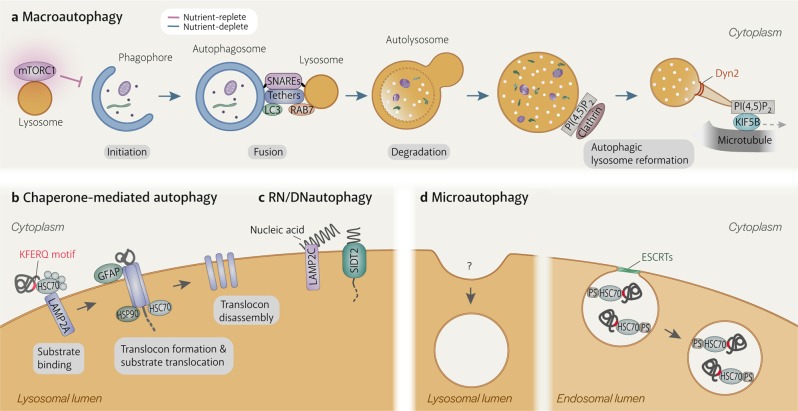
Autophagy is a major intracellular degradation system that derives its degradative abilities from the lysosome. The most well-studied form of autophagy is macroautophagy, which delivers cytoplasmic material to lysosomes via the double-membraned autophagosome. Other forms of autophagy, namely chaperone-mediated autophagy and microautophagy, occur directly on the lysosome. Besides providing the means for degradation, lysosomes are also involved in autophagy regulation and can become substrates of autophagy when damaged. During autophagy, they exhibit notable changes, including increased acidification, enhanced enzymatic activity, and perinuclear localization. Despite their importance to autophagy, details on autophagy-specific regulation of lysosomes remain relatively scarce. This review aims to provide a summary of current understanding on the behaviour of lysosomes during autophagy and outline unexplored areas of autophagy-specific lysosome research.
自噬是一种主要的细胞内降解系统,其降解能力源自溶酶体。研究最为深入的自噬形式是巨自噬,它通过双膜自噬体将细胞质物质输送到溶酶体。其他形式的自噬,即伴侣介导的自噬和微自噬,直接发生在溶酶体上。除了提供降解手段外,溶酶体还参与自噬调节,并且在受损时可成为自噬的底物。在自噬过程中,它们表现出显著变化,包括酸化增加、酶活性增强和核周定位。尽管它们对自噬很重要,但关于溶酶体自噬特异性调节的细节仍然相对较少。本综述旨在总结目前对自噬过程中溶酶体行为的理解,并概述自噬特异性溶酶体研究中未探索的领域。