E2S UPPA, INRAE, NUMEA, Université de Pau et des Pays de l'Adour, 64310 Saint-Pée-sur-Nivelle, France.
UR1037 Laboratory of Fish Physiology and Genomics, Campus de Beaulieu, INRAE, F-35042 Rennes, France.
Cells. 2022 Jun 16;11(12):1945. doi: 10.3390/cells11121945.
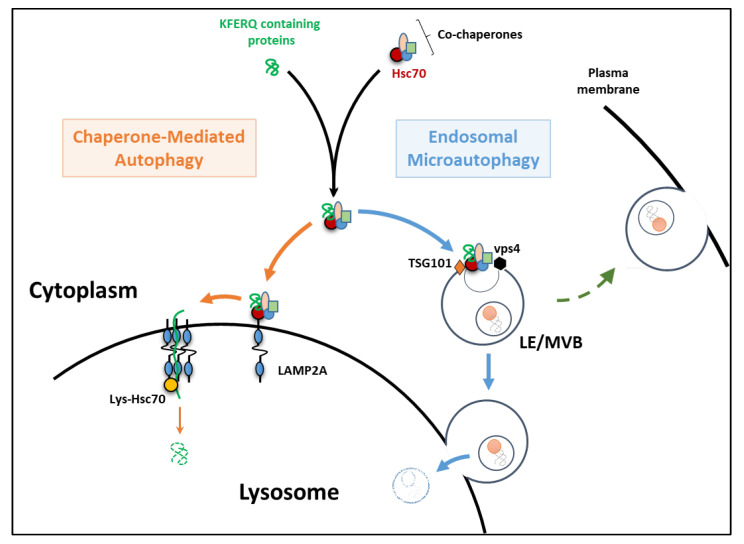
Autophagy is a pleiotropic and evolutionarily conserved process in eukaryotes that encompasses different types of mechanisms by which cells deliver cytoplasmic constituents to the lysosome for degradation. Interestingly, in mammals, two different and specialized autophagic pathways, (i) the chaperone-mediated autophagy (CMA) and (ii) the endosomal microautophagy (eMI), both rely on the use of the same cytosolic chaperone HSPA8 (also known as HSC70) for targeting specific substrates to the lysosome. However, this is not true for all organisms, and differences exist between species with respect to the coexistence of these two autophagic routes. In this paper, we present an in-depth analysis of the evolutionary history of the main components of CMA and eMI and discuss how the observed discrepancies between species may contribute to improving our knowledge of these two functions and their interplays.
自噬是真核生物中一种多效且进化保守的过程,包含细胞将细胞质成分递送至溶酶体进行降解的不同机制类型。有趣的是,在哺乳动物中,两种不同且特化的自噬途径(i)伴侣介导的自噬(CMA)和(ii)内体微自噬(eMI),均依赖于使用相同的胞质伴侣 HSPA8(也称为 HSC70)将特定底物靶向溶酶体。然而,并非所有生物体都是如此,并且在这两种自噬途径共存方面,物种之间存在差异。在本文中,我们对 CMA 和 eMI 的主要成分的进化历史进行了深入分析,并讨论了物种之间观察到的差异如何有助于提高我们对这两种功能及其相互作用的认识。