Wang Jiangfeng, Luo Jurui, Jin Kairui, Wang Xuanyi, Yang Zhaozhi, Ma Jinli, Mei Xin, Wang Xiaofang, Zhou Zhirui, Yu Xiaoli, Chen Xingxing, Guo Xiaomao
Department of Radiation Oncology, Fudan University Shanghai Cancer Center, Shanghai, China.
Department of Oncology, Shanghai Medical College, Fudan University, Shanghai, China.
Cancer Med. 2020 Apr;9(7):2427-2434. doi: 10.1002/cam4.2904. Epub 2020 Feb 12.
To investigate the impact of biological subtypes in locoregional recurrence in Chinese breast cancer patients receiving postmastectomy radiotherapy (PMRT).
About 583 patients who received postmastectomy radiation between 2010 and 2012 were retrospectively analyzed. According to immunohistochemical staining profile, patients were classified into: Luminal A-like, Luminal B-like, HER2-positive, and triple-negative breast cancer (TNBC). Local and regional recurrence (LRR) cumulative incidences were calculated by competing risks methodology and the power of prognostic factors was examined by Gray's test and the test of Fine and Gray.
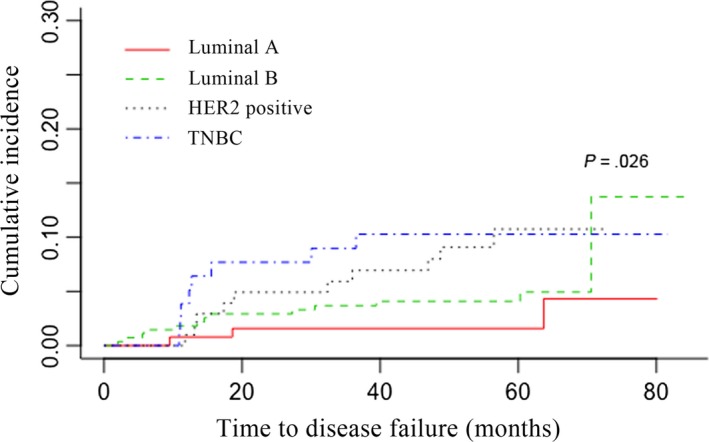
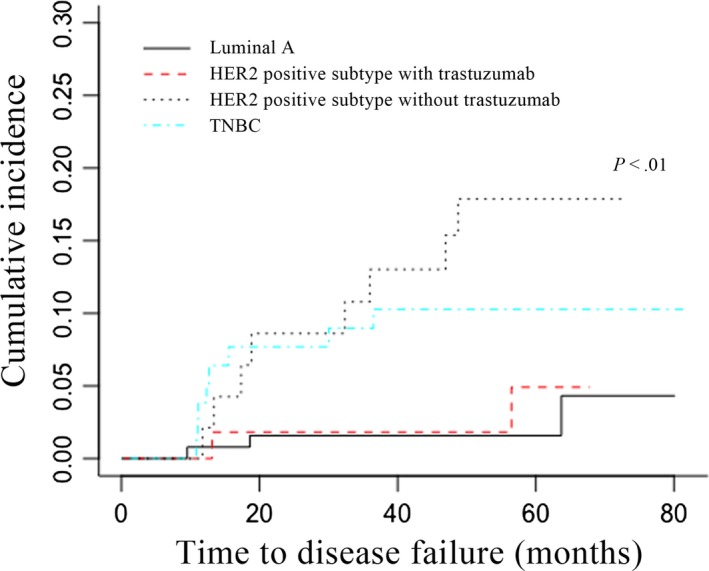
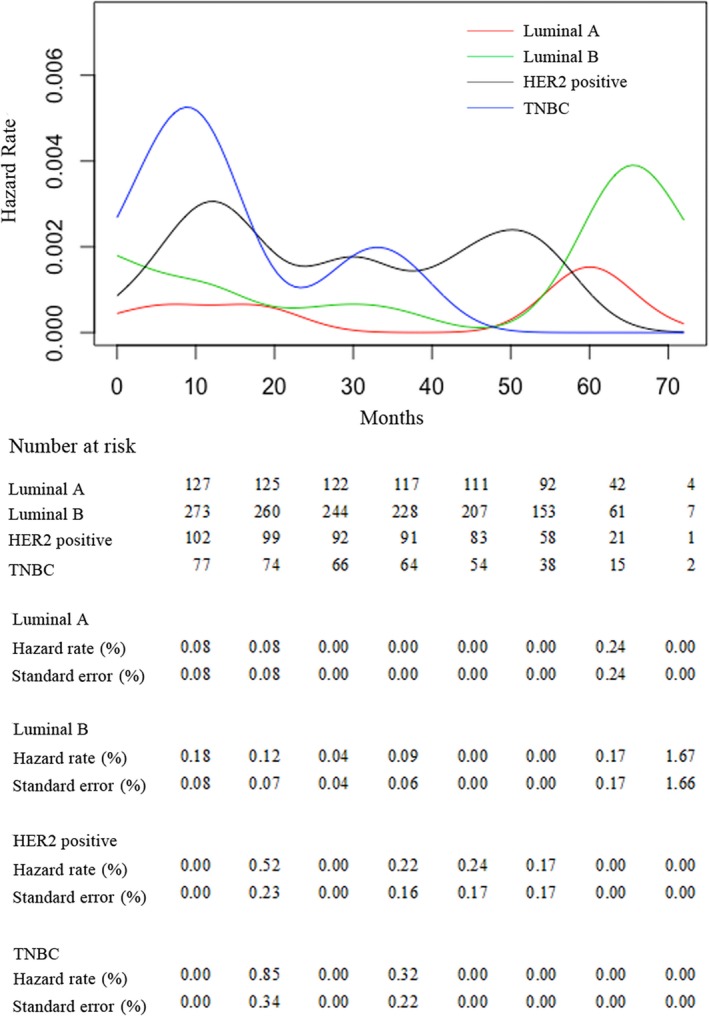
The median follow-up was 70.9 months. About 34 LRR events occurred. For Luminal A, Luminal B, HER2-positive, and TNBC patients, the 5-year LRR cumulative incidence rates were 1.57%, 4.09%, 10.74%, and 10.28%. Compared with Luminal A, HER2-positive subtype and TNBC had a significant increased risk of LRR (HR was 5.034 and 5.188, respectively). In univariate analysis, predictive factors for higher LRR were HER2-positive subtype (HR = 4.43, P < .05), TNBC (HR = 4.70, P < .05), and pN3 (HR = 5.83, P < .05). In the multivariate model, HER2-positive subtype (HR = 5.034, P < .05), TNBC (HR = 5.188, P < .05), and pN3 (HR = 9.607, P < .01) were independent predictors of LRR. LRR without trastuzumab was similar to that of TNBC (without vs TNBC, 17.88% vs 10.28%, P > .05) in HER2-positive subtype patients, while LRR with trastuzumab was approximate to Luminal A (with vs Luminal A, P > .05). Additionally, endocrine therapy also significantly reduced LRR incidence in the luminal subtype cohort (without vs with therapy, 6.25% vs 2.89%, HR = 0.365, P < .1).
Biological subtype was a prognostic factor of LRR in the PMRT setting among Chinese breast cancer patients.
探讨生物学亚型对接受乳房切除术后放疗(PMRT)的中国乳腺癌患者局部区域复发的影响。
回顾性分析了2010年至2012年间接受乳房切除术后放疗的约583例患者。根据免疫组化染色结果,患者被分为:Luminal A样、Luminal B样、HER2阳性和三阴性乳腺癌(TNBC)。采用竞争风险法计算局部和区域复发(LRR)的累积发生率,并通过Gray检验以及Fine和Gray检验来检验预后因素的效力。
中位随访时间为70.9个月。共发生约34例LRR事件。对于Luminal A、Luminal B、HER2阳性和TNBC患者,5年LRR累积发生率分别为1.57%、4.09%、10.74%和10.28%。与Luminal A相比,HER2阳性亚型和TNBC的LRR风险显著增加(HR分别为5.034和5.188)。单因素分析中,LRR较高的预测因素为HER2阳性亚型(HR = 4.43,P <.05)、TNBC(HR = 4.70,P <.05)和pN3(HR = 5.83,P <.05)。在多因素模型中,HER2阳性亚型(HR = 5.034,P <.05)、TNBC(HR = 5.188,P <.05)和pN3(HR = 9.607,P <.01)是LRR的独立预测因素。在HER2阳性亚型患者中,未使用曲妥珠单抗时的LRR与TNBC相似(未使用vs TNBC,17.88% vs 10.28%,P >.05),而使用曲妥珠单抗时的LRR与Luminal A相近(使用vs Luminal A,P >.05)。此外,内分泌治疗也显著降低了Luminal亚型队列中的LRR发生率(未治疗vs治疗,6.25% vs 2.89%,HR = 0.365,P <.1)。
生物学亚型是接受PMRT的中国乳腺癌患者LRR的一个预后因素。