Department of Population Health, NYU Grossman School of Medicine, New York (Dr Marmor, Dr Shao, Ms Wang, Dr Alexander), Department of Environmental Medicine, NYU Grossman School of Medicine, New York, New York (Dr Marmor, Dr Shao, Ms Wang, Dr Reibman), Department of Medicine, NYU Grossman School of Medicine, New York, New York (Dr Marmor, Dr Cotrina, Dr Wilkenfeld, Dr Reibman), Department of Neurology, NYU Grossman School of Medicine, New York, New York (Dr Thawani, Dr Alexander, Dr Wong), Department of Neurology, Thomas Jefferson University Hospital, Philadelphia, Pennsylvania (Dr Wong), UCSF/Fresno and University Neurology Associates, Fresno, California (Dr Stecker), Division of Occupational and Environmental Medicine, Department of Medicine, NYU Winthrop Hospital, Mineola, New York (Dr Wilkenfeld) and Department of Internal Medicine, Strelitz Diabetes Center, Eastern Virginia Medical School, Norfolk, Virginia (Ms Vinik, Dr Vinik).
J Occup Environ Med. 2020 Apr;62(4):307-316. doi: 10.1097/JOM.0000000000001828.
To investigate whether paresthesia of the lower extremities following exposure to the World Trade Center (WTC) disaster was associated with signs of neuropathy, metabolic abnormalities, or neurotoxin exposures.
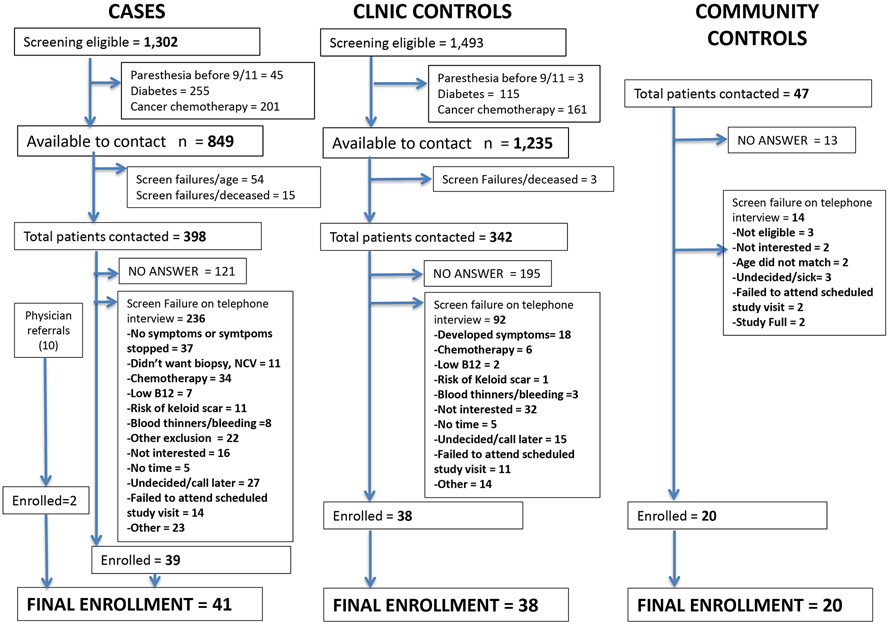
Case-control study comparing WTC-exposed paresthesia cases with "clinic controls" (WTC-exposed subjects without paresthesias), and "community controls" (WTC-unexposed persons).
Neurological histories and examination findings were significantly worse in cases than controls. Intraepidermal nerve fiber densities were below normal in 47% of cases and sural to radial sensory nerve amplitude ratios were less than 0.4 in 29.4%. Neurologic abnormalities were uncommon among WTC-unexposed community controls. Metabolic conditions and neurotoxin exposures did not differ among groups.
Paresthesias among WTC-exposed individuals were associated with signs of neuropathy, small and large fiber disease. The data support WTC-related exposures as risk factors for neuropathy, and do not support non-WTC etiologies.
研究暴露于世界贸易中心(WTC)灾难后下肢感觉异常是否与神经病变的迹象、代谢异常或神经毒素暴露有关。
病例对照研究比较 WTC 暴露后感觉异常病例与“诊所对照”(WTC 暴露但无感觉异常的受试者)和“社区对照”(未暴露于 WTC 的人员)。
病例的神经病史和检查结果明显差于对照组。47%的病例表皮内神经纤维密度低于正常,29.4%的病例腓肠神经至桡神经感觉神经幅度比小于 0.4。WTC 未暴露的社区对照组中神经异常不常见。代谢状况和神经毒素暴露在各组之间无差异。
暴露于 WTC 的个体的感觉异常与神经病变的迹象、小纤维和大纤维疾病有关。数据支持 WTC 相关暴露是神经病变的危险因素,不支持非 WTC 病因。