Faculty of Sport and Health Sciences, University of Jyväskylä, Jyväskylä, FINLAND.
Institute for Molecular Medicine Finland, Helsinki, FINLAND.
Med Sci Sports Exerc. 2020 Jul;52(7):1518-1524. doi: 10.1249/MSS.0000000000002290.
Polygenic risk scores (PRS) summarize genome-wide genotype data into a single variable that produces an individual-level risk score for genetic liability. PRS has been used for prediction of chronic diseases and some risk factors. As PRS has been studied less for physical activity (PA), we constructed PRS for PA and studied how much variation in PA can be explained by this PRS in independent population samples.
We calculated PRS for self-reported and objectively measured PA using UK Biobank genome-wide association study summary statistics, and analyzed how much of the variation in self-reported (MET-hours per day) and measured (steps and moderate-to-vigorous PA minutes per day) PA could be accounted for by the PRS in the Finnish Twin Cohorts (FTC; N = 759-11,528) and the Northern Finland Birth Cohort 1966 (NFBC1966; N = 3263-4061). Objective measurement of PA was done with wrist-worn accelerometer in UK Biobank and NFBC1966 studies, and with hip-worn accelerometer in the FTC.
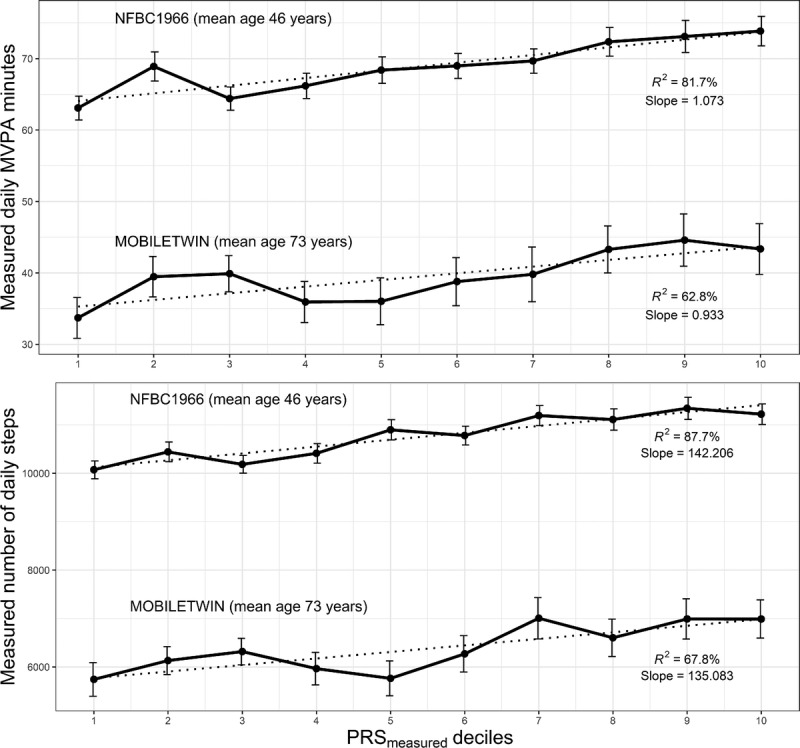
The PRS accounted from 0.07% to 1.44% of the variation (R) in the self-reported and objectively measured PA volumes (P value range = 0.023 to <0.0001) in the FTC and NFBC1966. For both self-reported and objectively measured PA, individuals in the highest PRS deciles had significantly (11%-28%) higher PA volumes compared with the lowest PRS deciles (P value range = 0.017 to <0.0001).
PA is a multifactorial phenotype, and the PRS constructed based on UK Biobank results accounted for statistically significant but overall small proportion of the variation in PA in the Finnish cohorts. Using identical methods to assess PA and including less common and rare variants in the construction of PRS may increase the proportion of PA explained by the PRS.
多基因风险评分(PRS)将全基因组基因型数据汇总为一个单一变量,为遗传易感性产生个体水平的风险评分。PRS 已被用于预测慢性疾病和一些风险因素。由于 PRS 对体力活动(PA)的研究较少,我们构建了 PA 的 PRS,并在独立的人群样本中研究了该 PRS 可以解释 PA 变异的多少。
我们使用英国生物库全基因组关联研究汇总统计数据计算了自我报告和客观测量 PA 的 PRS,并分析了 PRS 可以解释自我报告(每天代谢当量小时)和测量(每天步数和中到剧烈 PA 分钟)PA 变异的多少在芬兰双胞胎队列(FTC;N=759-11528)和 1966 年芬兰北部出生队列(NFBC1966;N=3263-4061)中。PA 的客观测量是在英国生物库和 NFBC1966 研究中使用腕戴加速度计进行的,在 FTC 中使用髋戴加速度计进行的。
PRS 解释了 FTC 和 NFBC1966 中自我报告和客观测量的 PA 量的 0.07%至 1.44%的变异(R)(P 值范围=0.023 至 <0.0001)。对于自我报告和客观测量的 PA,PRS 最高十分位数的个体的 PA 量明显(11%-28%)高于 PRS 最低十分位数的个体(P 值范围=0.017 至 <0.0001)。
PA 是一种多因素表型,基于英国生物库结果构建的 PRS 解释了芬兰队列中 PA 变异的统计学上显著但总体较小的比例。使用相同的方法评估 PA 并在 PRS 的构建中包含较少见和罕见的变异可能会增加 PRS 解释的 PA 比例。