Department of Biotechnology, Chemistry and Pharmacy, University of Siena, Via A., 53100, Siena, Italy.
Toscana Life Sciences Foundation, Siena, Italy.
Orphanet J Rare Dis. 2020 Feb 12;15(1):46. doi: 10.1186/s13023-020-1305-0.
Alkaptonuria (AKU) is an ultra-rare autosomal recessive disease caused by a mutation in the homogentisate 1,2-dioxygenase (HGD) gene. One of the main obstacles in studying AKU, and other ultra-rare diseases, is the lack of a standardized methodology to assess disease severity or response to treatment. Quality of Life scores (QoL) are a reliable way to monitor patients' clinical condition and health status. QoL scores allow to monitor the evolution of diseases and assess the suitability of treatments by taking into account patients' symptoms, general health status and care satisfaction. However, more comprehensive tools to study a complex and multi-systemic disease like AKU are needed. In this study, a Machine Learning (ML) approach was implemented with the aim to perform a prediction of QoL scores based on clinical data deposited in the ApreciseKUre, an AKU- dedicated database.
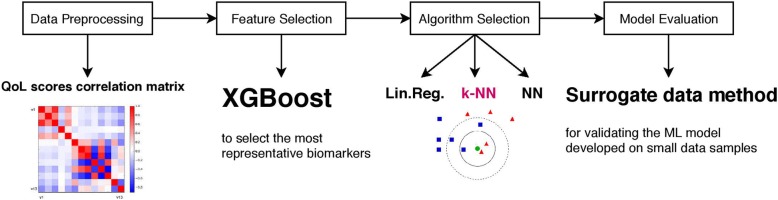
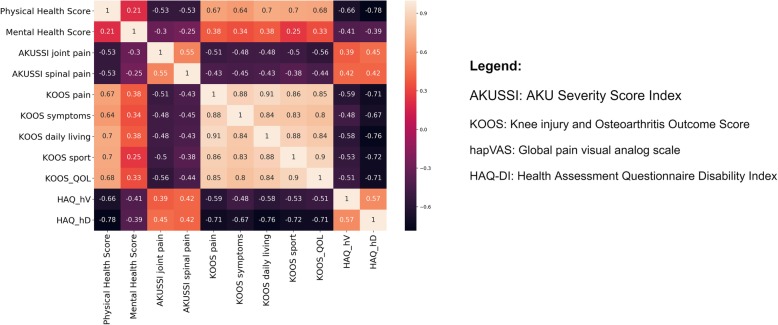
Data derived from 129 AKU patients have been firstly examined through a preliminary statistical analysis (Pearson correlation coefficient) to measure the linear correlation between 11 QoL scores. The variable importance in QoL scores prediction of 110 ApreciseKUre biomarkers has been then calculated using XGBoost, with K-nearest neighbours algorithm (k-NN) approach. Due to the limited number of data available, this model has been validated using surrogate data analysis.
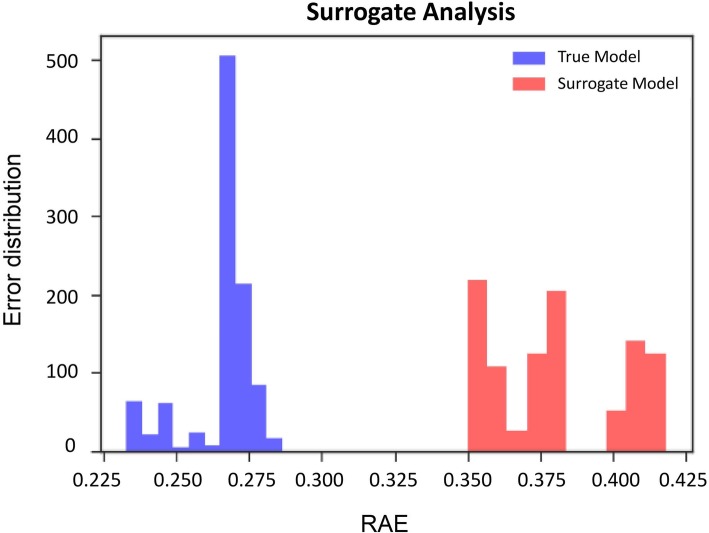
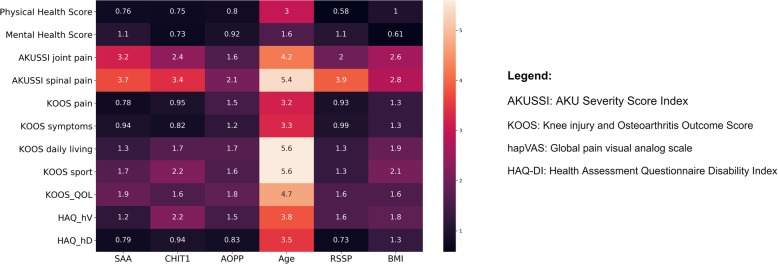
We identified a direct correlation of 6 (age, Serum Amyloid A, Chitotriosidase, Advanced Oxidation Protein Products, S-thiolated proteins and Body Mass Index) out of 110 biomarkers with the QoL health status, in particular with the KOOS (Knee injury and Osteoarthritis Outcome Score) symptoms (Relative Absolute Error (RAE) 0.25). The error distribution of surrogate-model (RAE 0.38) was unequivocally higher than the true-model one (RAE of 0.25), confirming the consistency of our dataset. Our data showed that inflammation, oxidative stress, amyloidosis and lifestyle of patients correlates with the QoL scores for physical status, while no correlation between the biomarkers and patients' mental health was present (RAE 1.1).
This proof of principle study for rare diseases confirms the importance of database, allowing data management and analysis, which can be used to predict more effective treatments.
尿黑酸尿症(AKU)是一种由 HOMOGENTISATE 1,2-双加氧酶(HGD)基因突变引起的罕见常染色体隐性疾病。研究 AKU 和其他罕见疾病的主要障碍之一是缺乏评估疾病严重程度或治疗反应的标准化方法。生活质量评分(QoL)是监测患者临床状况和健康状况的可靠方法。QoL 评分可以通过考虑患者的症状、一般健康状况和护理满意度来监测疾病的演变并评估治疗的适用性。然而,需要更全面的工具来研究 AKU 等复杂的多系统疾病。在这项研究中,实施了机器学习(ML)方法,旨在基于存储在 AKU 专用数据库 ApreciseKUre 中的临床数据预测 QoL 评分。
首先通过初步统计分析(皮尔逊相关系数)检查来自 129 名 AKU 患者的数据,以测量 11 个 QoL 评分之间的线性相关性。然后使用 XGBoost 计算 110 个 ApreciseKUre 生物标志物对 QoL 评分预测的变量重要性,并使用 K-最近邻算法(k-NN)方法。由于可用数据数量有限,因此使用替代数据分析验证了该模型。
我们确定了 6 个(年龄、血清淀粉样蛋白 A、壳三糖苷酶、高级氧化蛋白产物、S-硫代蛋白和体重指数)生物标志物与 QoL 健康状况直接相关,特别是与 KOOS(膝关节损伤和骨关节炎结果评分)症状相关(相对绝对误差(RAE)0.25)。替代模型(RAE 0.38)的误差分布明显高于真实模型(RAE 0.25),这证实了我们数据集的一致性。我们的数据表明,患者的炎症、氧化应激、淀粉样变性和生活方式与身体状况的 QoL 评分相关,而生物标志物与患者的心理健康之间不存在相关性(RAE 1.1)。
这项罕见疾病的原理验证研究证实了数据库的重要性,数据库允许进行数据管理和分析,可用于预测更有效的治疗方法。