Health Management Research Center, Baqiyatallah University of Medical Sciences, Tehran, Iran.
Research Center for Prevention of Oral and Dental Diseases, Baqiyatallah University of Medical Sciences, Tehran, Iran.
BMJ Open. 2020 Feb 12;10(2):e028257. doi: 10.1136/bmjopen-2018-028257.
To explore the causes and consequences of non-urgent visits to emergency departments in Iran and then suggest solutions from the healthcare providers' viewpoint.
Qualitative descriptive study with in-depth, open-ended, and semistructured interviews, which were inductively analysed using qualitative content analysis.
A territorial, educational and military hospital in Iran.
Eleven healthcare providers including eight nurses, two emergency medicine specialists and one emergency medicine resident.
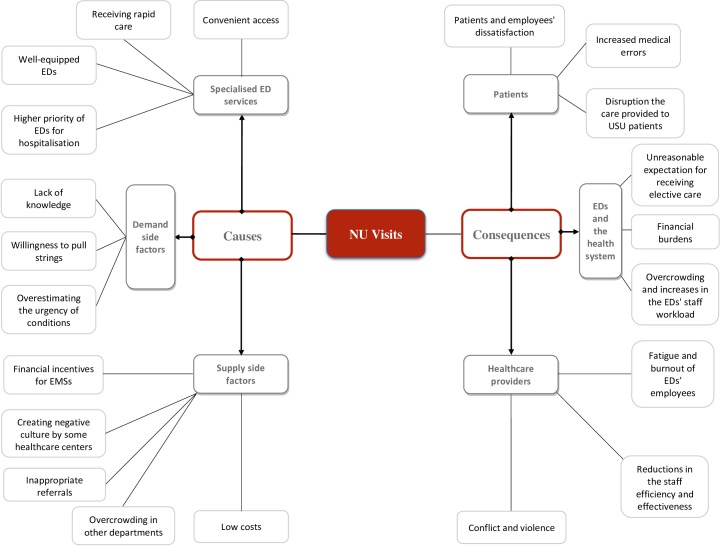
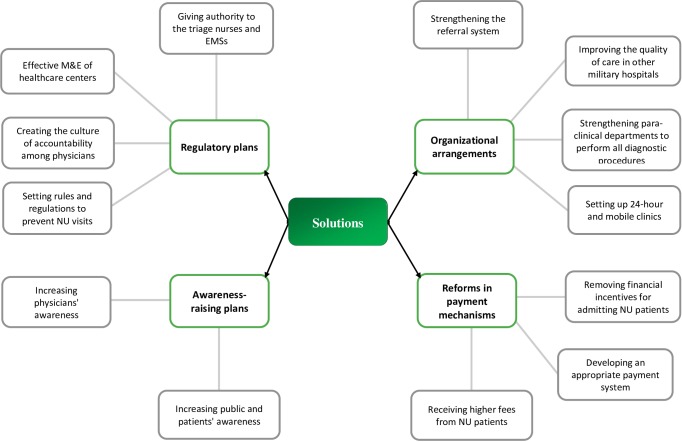
Three overarching themes of causes and consequences of non-urgent visits to the emergency department in addition to four suggested solutions were identified. The causes have encompassed the specialised services in emergency department, demand-side factors, and supply-side factors. The consequences have been categorised into three overarching themes including the negative consequences on patients, healthcare providers and emergency departments as well as the health system in general. The possible solutions for limiting and controlling non-urgent visits also involved regulatory plans, awareness-raising plans, reforms in payment mechanisms, and organisational arrangements.
We highlighted the need for special attention to the appropriate use of emergency departments in Iran as a middle-income country. According to the complex nature of emergency departments and in order to control and prevent non-urgent visits, it can be suggested that policy-makers should design and implement a combination of the possible solutions.
探讨伊朗非紧急就诊急诊科的原因和后果,并从医疗服务提供者的角度提出解决方案。
定性描述性研究,采用深入、开放式和半结构化访谈,采用定性内容分析进行归纳分析。
伊朗的一个地区、教育和军事医院。
11 名医疗服务提供者,包括 8 名护士、2 名急诊医学专家和 1 名急诊医学住院医师。
确定了急诊科非紧急就诊的三个主要原因和后果主题,以及四个建议的解决方案。原因包括急诊科的专科服务、需求方因素和供应方因素。后果分为三个主题,包括对患者、医疗服务提供者和急诊科以及整个卫生系统的负面影响。限制和控制非紧急就诊的可能解决方案还包括监管计划、提高认识计划、支付机制改革和组织安排。
我们强调需要特别关注伊朗作为中等收入国家急诊科的合理使用。根据急诊科的复杂性,并为了控制和预防非紧急就诊,建议决策者设计和实施可能的解决方案的组合。