O'Keeffe Colin, Mason Suzanne, Jacques Richard, Nicholl Jon
Centre for Urgent and Emergency Care (CURE), School of Health and Related Research (ScHARR), University of Sheffield, Sheffield, United Kingdom.
PLoS One. 2018 Feb 23;13(2):e0192855. doi: 10.1371/journal.pone.0192855. eCollection 2018.
The pressures of patient demand on emergency departments (EDs) continue to be reported worldwide, with an associated negative impact on ED crowding and waiting times. It has also been reported that a proportion of attendances to EDs in different international systems could be managed in settings such as primary care. This study used routine ED data to define, measure and profile non-urgent ED attendances that were suitable for management in alternative, non-emergency settings.
We undertook a retrospective analysis of three years of Hospital Episode and Statistics Accident Emergency (HES A&E) data for one large region in England, United Kingdom (April 1st 2011 to March 31st 2014). Data was collected on all adult (>16 years) ED attendances from each of the 19 EDs in the region. A validated process based definition of non-urgent attendance was refined for this study and applied to the data. Using summary statistics non-urgent attenders were examined by variables hypothesised to influence them as follows: age at arrival, time of day and day of week and mode of arrival. Odds ratios were calculated to compare non-urgent attenders between groups.
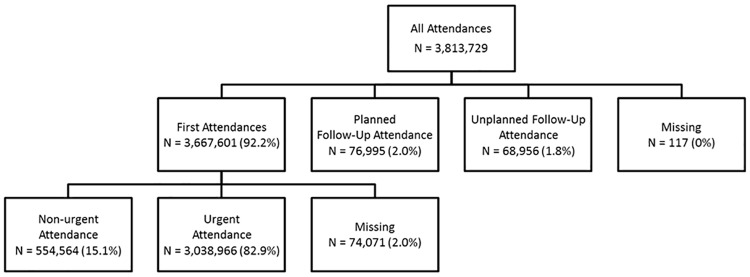
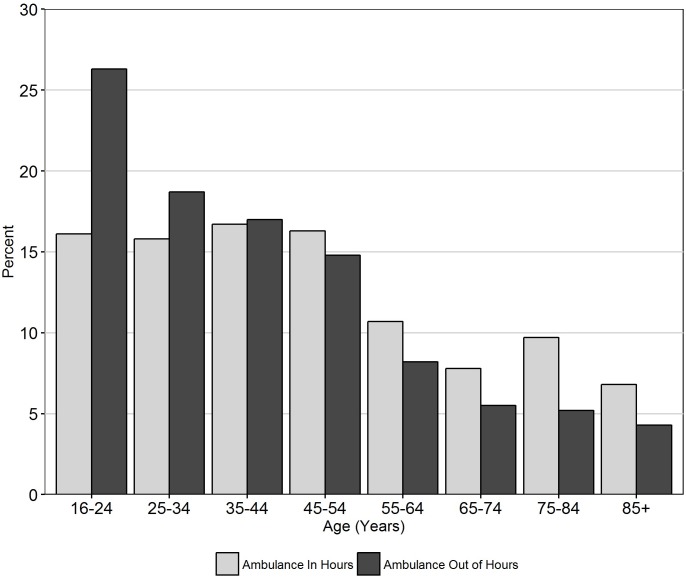
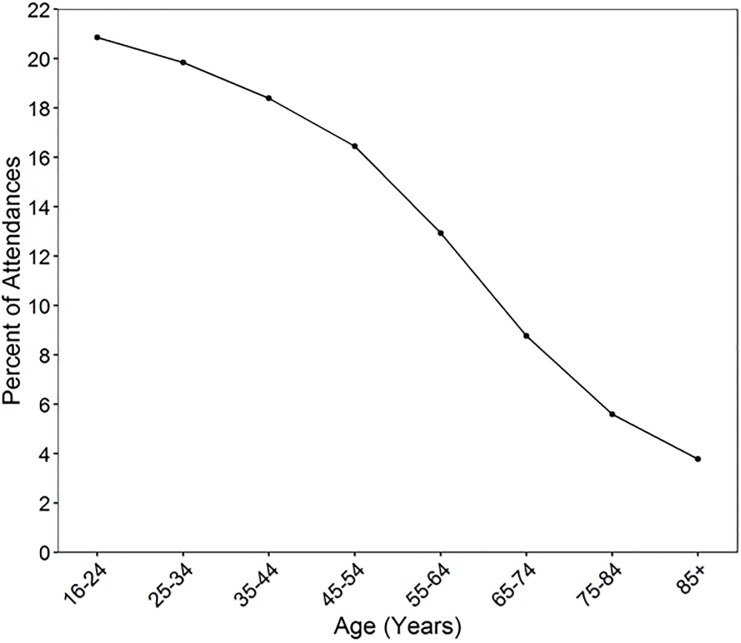
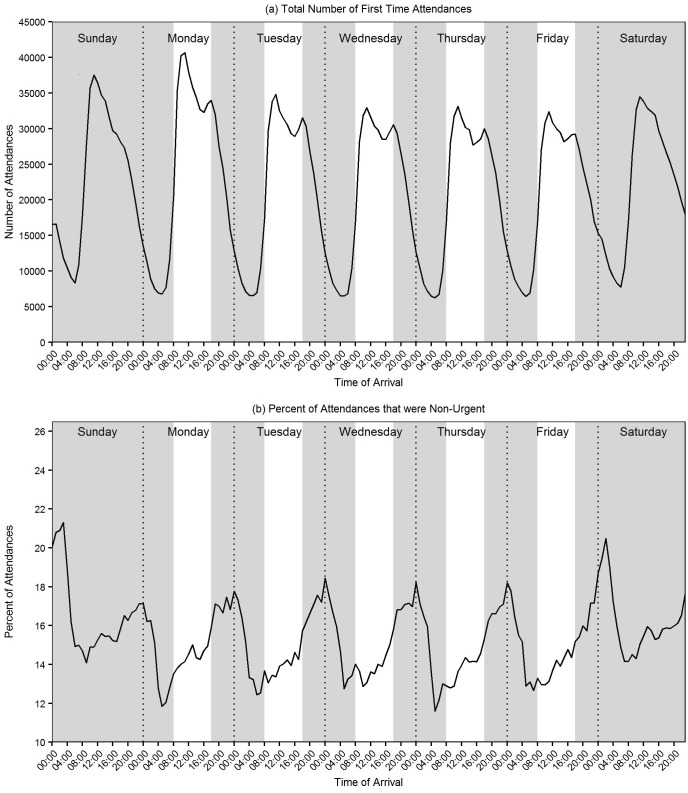
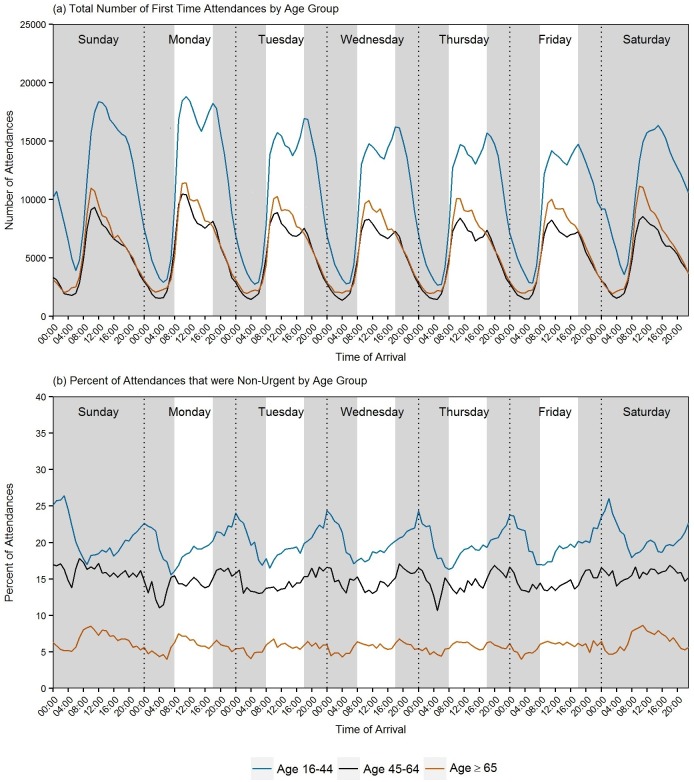
There were 3,667,601 first time attendances to EDs, of which 554,564 were defined as non-urgent (15.1%). Non-urgent attendances were significantly more likely to present out of hours than in hours (OR = 1.19, 95% CI: 1.18 to 1.20, P<0.001). The odds of a non-urgent attendance were significantly higher for younger patients (aged 16-44) compared to those aged 45-64 (odds ratio: 1.42, 95% CI: 1.41 to 1.43, P<0.001) and the over 65's (odds ratio: 3.81, 95% CI: 3.78 to 3.85, P<0.001). Younger patients were significantly more likely to attend non-urgently out of hours compared to the 45-64's (OR = 1.24, 95% CI: 1.22 to 1.25, P<0.001) and the 65+'s (OR = 1.38, 95% CI: 1.35 to 1.40, P<0.001). 110,605/554,564 (19.9%) of the non-urgent attendances arrived by ambulance, increasing significantly out of hours versus in hours (OR = 2.12, 95% CI: 2.09 to 2.15, P<0.001).
Younger adults are significantly more likely as older counterparts to use the ED to obtain healthcare that could be provided in a less urgent setting and also more likely to do this out of hours. Alternative services are required to manage non-urgent demand, currently being borne by the ED and the ambulance service, particularly in out of hours.
全球范围内仍不断有报道称急诊部门面临患者需求的压力,这对急诊部门的拥挤状况和候诊时间产生了负面影响。也有报道称,在不同的国际医疗体系中,部分前往急诊部门就诊的患者可以在基层医疗等场所得到治疗。本研究利用急诊部门的常规数据来定义、衡量和描述适合在其他非紧急场所进行治疗的非紧急急诊就诊情况。
我们对英国英格兰一个大区域三年(2011年4月1日至2014年3月31日)的医院事件统计与事故急诊(HES A&E)数据进行了回顾性分析。收集了该区域19个急诊部门所有成年(>16岁)患者的急诊就诊数据。本研究对基于流程的非紧急就诊的有效定义进行了完善,并将其应用于数据。使用汇总统计数据,通过假设会影响非紧急就诊者的变量对其进行分析,这些变量如下:到达时的年龄、一天中的时间、一周中的日期以及到达方式。计算比值比以比较不同组之间的非紧急就诊者。
急诊部门首次就诊人数为3,667,601人,其中554,564人被定义为非紧急就诊(15.1%)。非紧急就诊者在非工作时间就诊的可能性显著高于工作时间(比值比 = 1.19,95%置信区间:1.18至1.20,P<0.001)。与45 - 64岁患者相比,16 - 44岁的年轻患者非紧急就诊的几率显著更高(比值比:1.42,95%置信区间:1.41至1.43,P<0.001),65岁及以上患者的几率更高(比值比:3.81,95%置信区间:3.78至3.85,P<0.001)。与45 - 64岁患者(比值比 = 1.24,95%置信区间:1.22至1.25,P<0.001)和65岁及以上患者(比值比 = 1.38,95%置信区间:1.35至1.40,P<0.001)相比,年轻患者在非工作时间非紧急就诊的可能性显著更高。554,564例非紧急就诊者中有110,605例(19.9%)通过救护车送达,非工作时间通过救护车送达的比例显著高于工作时间(比值比 = 2.12,95%置信区间:2.09至2.15,P<0.001)。
与年长者相比,年轻人更有可能利用急诊部门来获取在不那么紧急的情况下也能提供的医疗服务,而且更有可能在非工作时间这样做。需要替代性服务来管理目前由急诊部门和救护车服务承担的非紧急需求,尤其是在非工作时间。