Functional Neurology Research Group, Departments of Neurology and Psychiatry, Massachusetts General Hospital, Harvard Medical School, Boston, MA, USA.
Athinoula A. Martinos Center for Biomedical Imaging, Massachusetts General Hospital, Harvard Medical School, Charlestown, MA, USA.
Mol Psychiatry. 2021 Aug;26(8):3817-3828. doi: 10.1038/s41380-020-0665-0. Epub 2020 Feb 12.
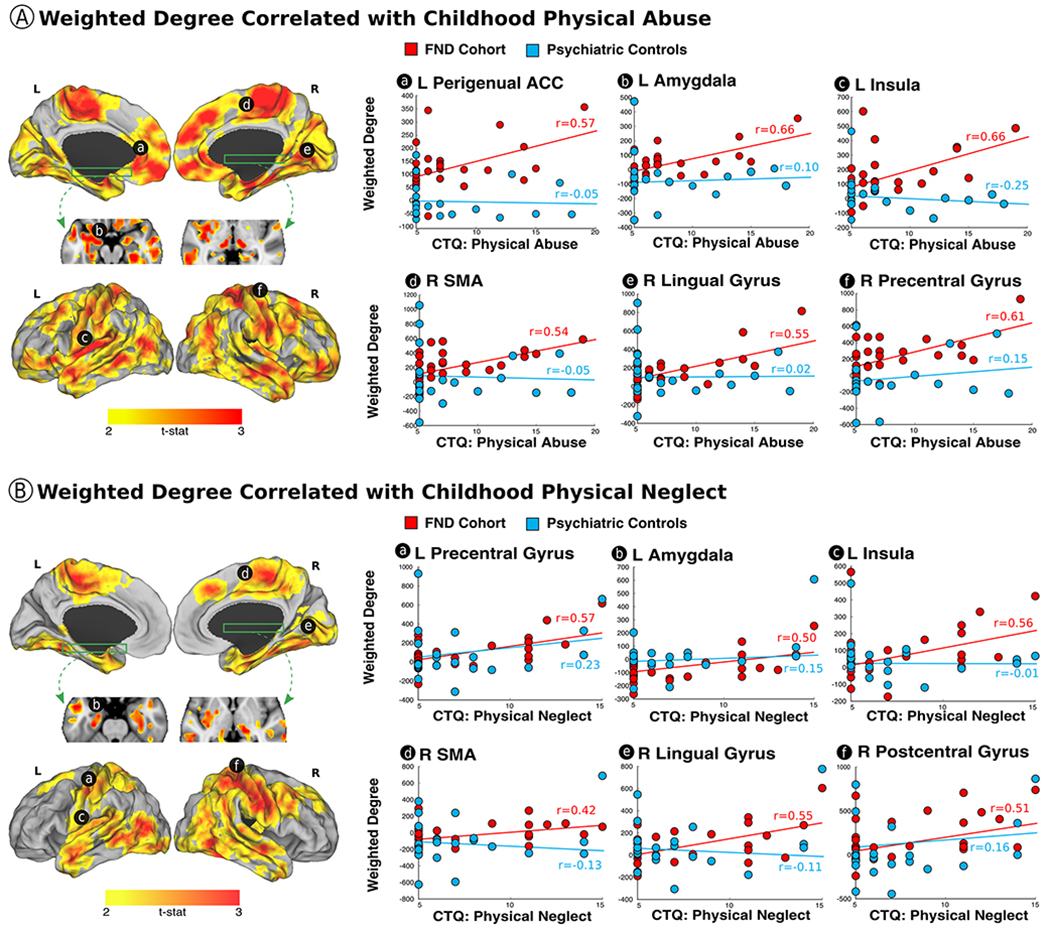
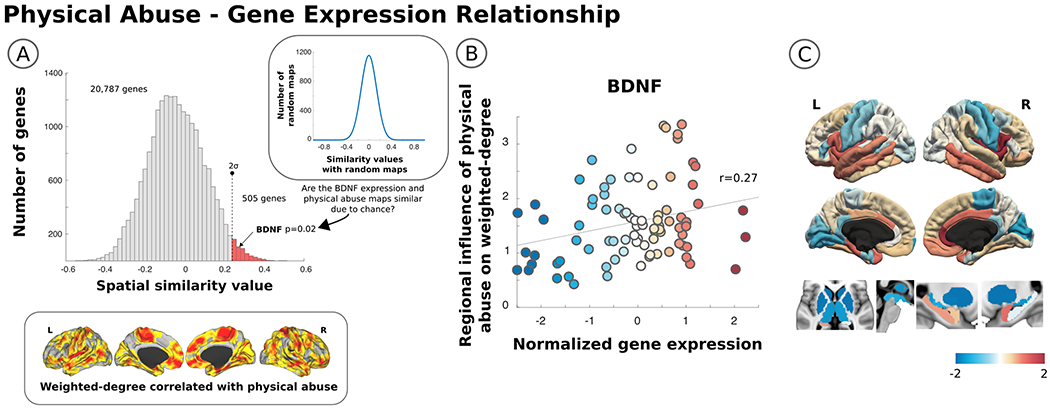
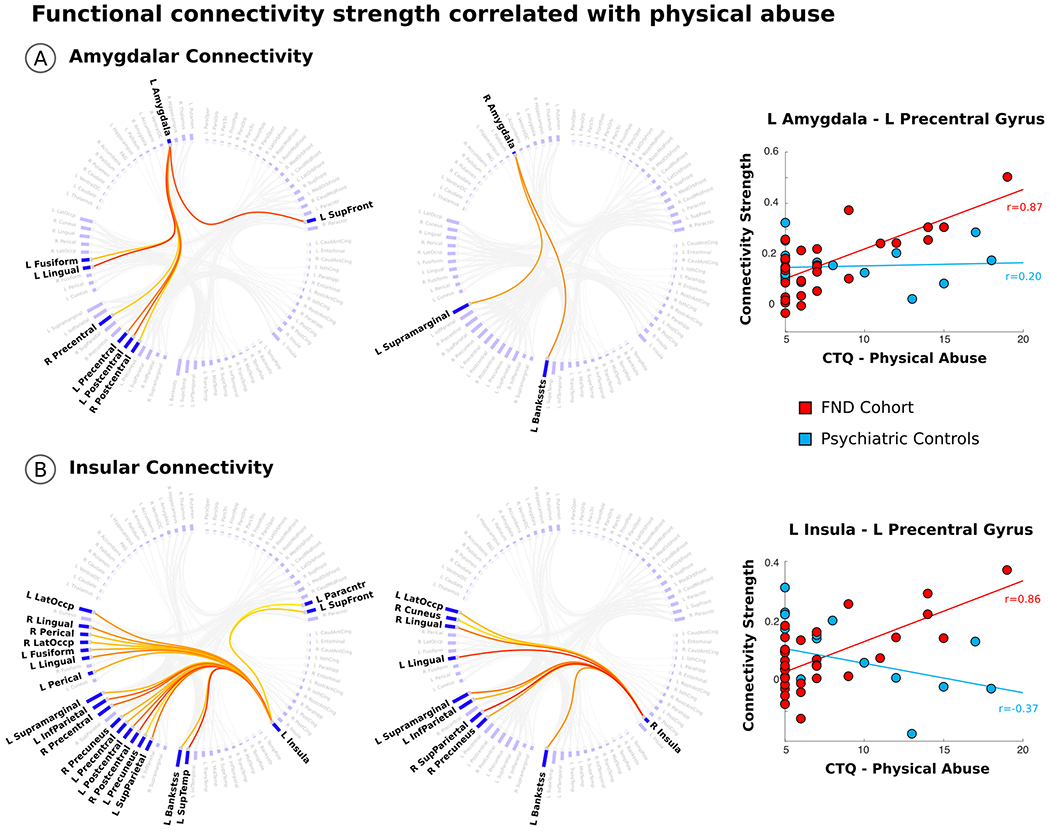
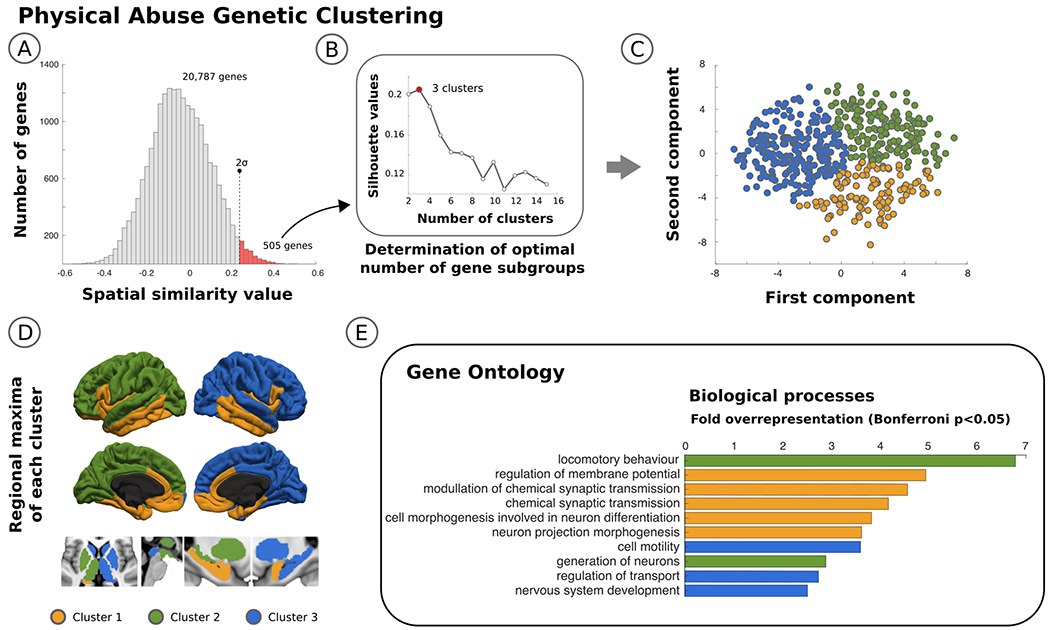
Functional neurological (conversion) disorder (FND) is a neuropsychiatric condition whereby individuals present with sensorimotor symptoms incompatible with other neurological disorders. Early-life maltreatment (ELM) is a risk factor for developing FND, yet few studies have investigated brain network-trauma relationships in this population. In this neuroimaging-gene expression study, we used two graph theory approaches to elucidate ELM subtype effects on resting-state functional connectivity architecture in 30 patients with motor FND. Twenty-one individuals with comparable depression, anxiety, and ELM scores were used as psychiatric controls. Thereafter, we compared trauma endophenotypes in FND with regional differences in transcriptional gene expression as measured by the Allen Human Brain Atlas (AHBA). In FND patients only, we found that early-life physical abuse severity, and to a lesser extent physical neglect, correlated with corticolimbic weighted-degree functional connectivity. Connectivity profiles influenced by physical abuse occurred in limbic (amygdalar-hippocampal), paralimbic (cingulo-insular and ventromedial prefrontal), and cognitive control (ventrolateral prefrontal) areas, as well as in sensorimotor and visual cortices. These findings held adjusting for individual differences in depression/anxiety, PTSD, and motor phenotypes. In FND, physical abuse also correlated with amygdala and insula coupling to motor cortices. In exploratory analyses, physical abuse correlated connectivity maps overlapped with the AHBA spatial expression of three gene clusters: (i) neuronal morphogenesis and synaptic transmission genes in limbic/paralimbic areas; (ii) locomotory behavior and neuronal generation genes in left-lateralized structures; and (iii) nervous system development and cell motility genes in right-lateralized structures. These circuit-specific architectural profiles related to individual differences in childhood physical abuse burden advance our understanding of the pathophysiology of FND.
功能性神经(转换)障碍(FND)是一种神经精神疾病,其特征是个体出现与其他神经障碍不一致的感觉运动症状。早期生活虐待(ELM)是发生 FND 的危险因素,但很少有研究调查该人群中的大脑网络-创伤关系。在这项神经影像学-基因表达研究中,我们使用了两种图论方法来阐明 ELM 亚型对 30 名运动 FND 患者静息状态功能连接结构的影响。21 名具有相似抑郁、焦虑和 ELM 评分的个体被用作精神科对照。此后,我们比较了 FND 中的创伤表型与通过艾伦人类大脑图谱(AHBA)测量的转录基因表达的区域差异。仅在 FND 患者中,我们发现早期生活身体虐待的严重程度,以及在较小程度上身体忽视,与皮质边缘加权度功能连接相关。受身体虐待影响的连接模式发生在边缘(杏仁核-海马)、边缘旁(扣带-岛叶和腹内侧前额叶)和认知控制(腹外侧前额叶)区域,以及感觉运动和视觉皮层。这些发现通过调整抑郁/焦虑、创伤后应激障碍和运动表型的个体差异得到维持。在 FND 中,身体虐待还与杏仁核和岛叶与运动皮层的耦合相关。在探索性分析中,身体虐待与连接图的相关性重叠与 AHBA 空间表达的三个基因簇相关:(i)在边缘/边缘旁区域的神经元形态发生和突触传递基因;(ii)在左侧化结构中的运动行为和神经元生成基因;以及(iii)在右侧化结构中的神经系统发育和细胞运动基因。这些与个体差异中童年身体虐待负担相关的特定回路结构特征提高了我们对 FND 病理生理学的理解。