Division of Hematology and Oncology, Department of Medicine, University of Pennsylvania Perelman School of Medicine, Philadelphia, PA, USA.
Invitae, San Francisco, CA, USA.
Genet Med. 2020 May;22(5):840-846. doi: 10.1038/s41436-020-0753-1. Epub 2020 Feb 13.
CTNNA1 is a potential diffuse gastric cancer risk gene, however CTNNA1 testing on multigene panel testing (MGPT) remains unstudied.
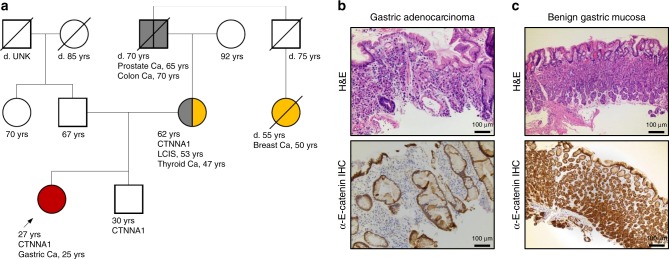
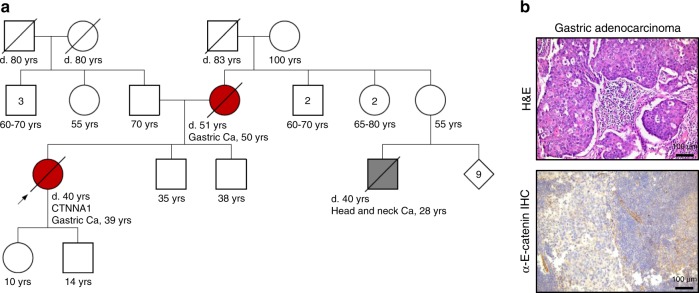
De-identified data from 151,425 individuals who underwent CTNNA1 testing at a commercial laboratory between October 2015 and July 2019 were reviewed. Tissue α-E-catenin immunohistochemistry was performed on CTNNA1 c.1351C>T (p.Arg451*) carriers.
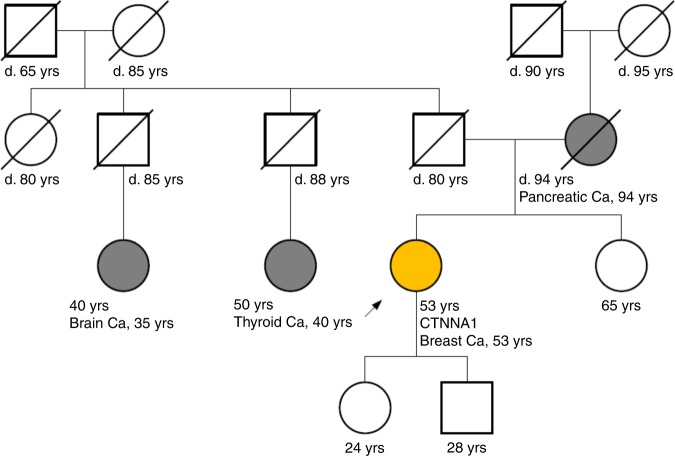
Fifty-two individuals (0.03% tested) had CTNNA1 loss-of-function (LOF) variants and 1057 individuals (0.7% tested) had a total of 302 distinct missense variants of uncertain significance. Detailed history was available on 33 CTNNA1 LOF carriers, with 21 unique CTNNA1 LOF variants. Four (12%) individuals had diffuse gastric cancer and 22 (67%) had breast cancer. Six (21%) and 24 (83%) of the 29 families reported a history of gastric or breast cancer, respectively. The CTNNA1 c.1351C>T nonsense variant was identified in three separate families with early-onset diffuse gastric cancer or breast cancer. Immunohistochemistry showed decreased α-E-catenin expression in gastric cancers.
CTNNA1 LOF variants are detected on MGPT with a majority of these individuals having gastric or breast cancer. The overall risk of gastric cancer for CTNNA1 LOF carriers may be lower than expected. Given the uncertain phenotype and penetrance, management of individuals with CTNNA1 LOF variants remains challenging.
CTNNA1 是一种潜在的弥漫性胃癌风险基因,然而 CTNNA1 在多基因panel 检测(MGPT)中的检测仍未被研究。
对 2015 年 10 月至 2019 年 7 月在商业实验室接受 CTNNA1 检测的 151425 名个体的匿名数据进行了回顾性分析。对 CTNNA1 c.1351C>T(p.Arg451*)携带者进行组织 α-E-连环蛋白免疫组织化学检测。
52 名个体(0.03%检测)携带 CTNNA1 功能丧失(LOF)变体,1057 名个体(0.7%检测)携带总共 302 种不同的意义未明的错义变体。33 名 CTNNA1 LOF 携带者的详细病史可用,其中 21 名携带独特的 CTNNA1 LOF 变体。4 名(12%)个体患有弥漫性胃癌,22 名(67%)个体患有乳腺癌。29 个家族中有 6 个(21%)和 24 个(83%)分别报告了胃癌或乳腺癌的家族史。三个独立的家族携带 CTNNA1 c.1351C>T 无义变体,这些家族均患有早发性弥漫性胃癌或乳腺癌。免疫组织化学显示胃癌中 α-E-连环蛋白表达减少。
MGPT 检测到 CTNNA1 LOF 变体,其中大多数个体患有胃癌或乳腺癌。CTNNA1 LOF 携带者患胃癌的总体风险可能低于预期。鉴于不确定的表型和外显率,管理 CTNNA1 LOF 变体的个体仍然具有挑战性。