de Souza Helen Paredes, de Oliveira Wanessa Tenório Gonçalves Holanda, Dos Santos Jefferson Pereira Caldas, Toledo João Paulo, Ferreira Isis Polianna Silva, de Sousa Esashika Suely Nilsa Guedes, de Lima Tatiane Fernandes Portal, de Sousa Delácio Amanda
Instituto Nacional de Câncer José Alencar Gomes da Silva (INCA) Instituto Nacional de Câncer José Alencar Gomes da Silva (INCA) Rio de Janeiro (RJ) Brasil Instituto Nacional de Câncer José Alencar Gomes da Silva (INCA), Rio de Janeiro (RJ), Brasil.
Ministério da Saúde Departamento de Imunização e Doenças Transmissíveis Brasília (DF) Brasil Ministério da Saúde, Departamento de Imunização e Doenças Transmissíveis, Brasília (DF), Brasil.
Rev Panam Salud Publica. 2020 Feb 10;44:e10. doi: 10.26633/RPSP.2020.10. eCollection 2020.
To present a method to identify critical areas for selected infectious and parasitic diseases for the purpose of health surveillance and to analyze the association between these critical areas and poverty indicators in Brazil.
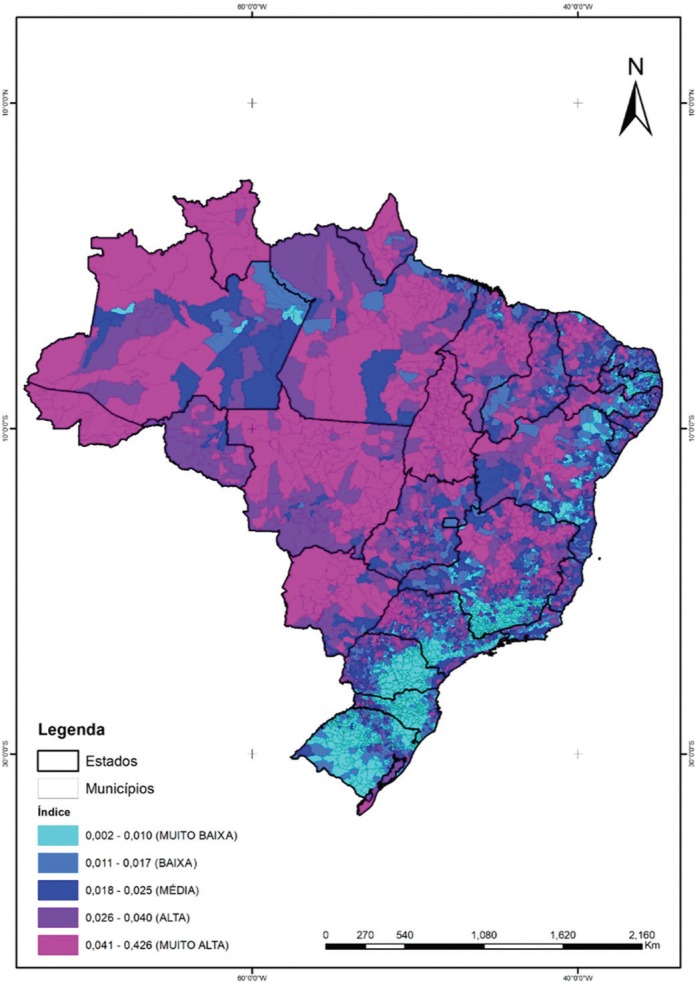
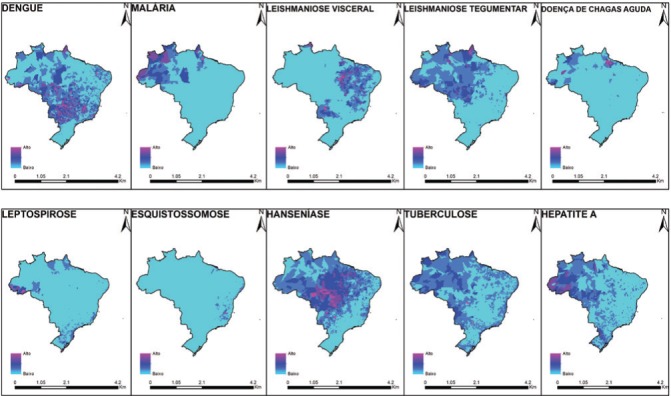
The following incidence rates were mapped: dengue, acute Chagas disease, schistosomiasis, Hansen's disease, hepatitis A, cutaneous leishmaniasis, visceral leishmaniasis, leptospirosis, malaria, and tuberculosis. The analyses were performed for the period from 2010 to 2017 based on a synthetic indicator calculated as the mean of mean incidence coefficients for each disorder, normalized by the mean and standard deviation during the period of analysis. A 2014 population estimate was used. The calculated coefficients were stratified for classification of municipalities into very high, high, medium, low, or very low criticality according to each disorder. Indicators expressing several socioeconomic dimensions and space segregation in Brazilian municipalities were also selected and tested regarding their association with the transmission of the diseases under study.
The indicator showed that 40.5% of Brazilian municipalities had high criticality for the diseases of interest, especially in the North, parts of the Northeast, and Midwest. Indicators "proportion of poverty," "garbage in surroundings," and "families headed by women" increased the chance of higher criticality for the diseases. The indicator "adequate sewer system" was a potential protection factor.
The technique used was adequate to guide surveillance actions in the country and allows articulation between local surveillance efforts and other sectors to resolve health problems caused by infectious and parasitic diseases and associated factors.
提出一种为健康监测确定选定传染病和寄生虫病关键区域的方法,并分析巴西这些关键区域与贫困指标之间的关联。
绘制了以下发病率地图:登革热、急性恰加斯病、血吸虫病、汉森病、甲型肝炎、皮肤利什曼病、内脏利什曼病、钩端螺旋体病、疟疾和结核病。分析基于2010年至2017年期间进行,采用的综合指标是每种疾病平均发病率系数的平均值,并根据分析期间的均值和标准差进行标准化。使用了2014年的人口估计数。根据每种疾病,将计算出的系数分层,以便将各市分为极高、高、中、低或极低关键度。还选择并测试了表示巴西各市若干社会经济层面和空间隔离的指标,以了解它们与所研究疾病传播之间的关联。
该指标显示,40.5%的巴西市镇对所关注疾病具有高关键度,特别是在北部、东北部部分地区和中西部。“贫困比例”“周边垃圾”和“女性为户主的家庭”等指标增加了疾病关键度较高的可能性。“下水道系统完善”这一指标是一个潜在的保护因素。
所采用的技术足以指导该国的监测行动,并有助于地方监测工作与其他部门之间的协作,以解决由传染病和寄生虫病及相关因素引起的健康问题。