Irish Meningitis and Sepsis Reference Laboratory, Children's Health Ireland, Dublin, Ireland.
Department of Microbiology, Royal College of Surgeons in Ireland, Dublin, Ireland.
PLoS One. 2020 Feb 13;15(2):e0228629. doi: 10.1371/journal.pone.0228629. eCollection 2020.
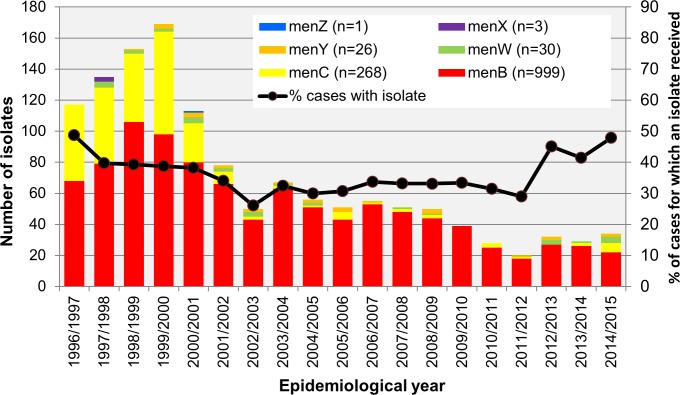
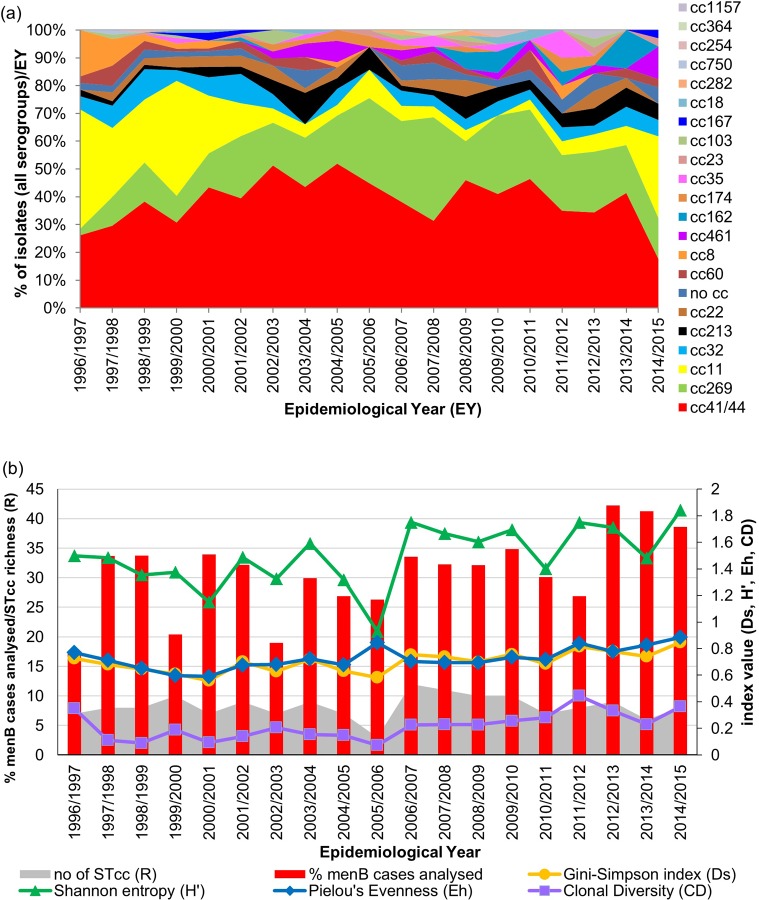
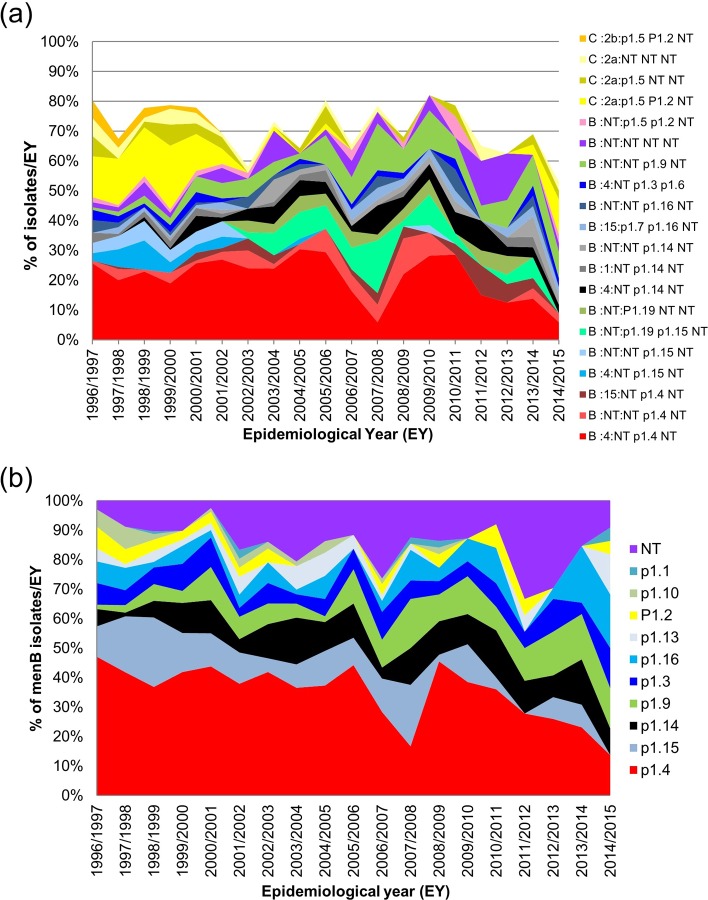
This study examined the capsular phenotype and genotype of invasive meningococcal disease (IMD)-associated Neisseria meningitidis recovered in the Republic of Ireland (RoI) between 1996 and 2015. This time period encompasses both pre- (when IMD was hyperendemic in the RoI) and post- meningococcal serogroup C conjugate (MCC) vaccine introduction. In total, 1327 isolates representing over one-third of all laboratory-confirmed cases of IMD diagnosed each epidemiological year (EY), were characterised. Serogroups B (menB) and C (menC) predominated throughout, although their relative abundance changed; with an initial increase in the proportion of menC in the late 1990s followed by their dramatic reduction post-MCC vaccine implementation and a concomitant dominance of menB, despite an overall decline in IMD incidence. While the increase in menC was associated with expansion of specific clonal-complexes (cc), cc11 and cc8; the dominance of menB was not. There was considerable variation in menB-associated cc with declines in cc41/44 and cc32, and increases in cc269 and cc461, contributing to a significant increase in the clonal diversity of menB isolates over the study. This increase in diversity was also displayed among the serosubtyping data, with significant declines in proportions of menB isolates expressing p1.4 and p1.15 antigens. These data highlight the changing diversity of IMD-associated meningococci since 1996 in the RoI and emphasise the need for on-going surveillance particularly in view of the recent introduction of a menB vaccine.
本研究调查了 1996 年至 2015 年间在爱尔兰共和国(RoI)发现的侵袭性脑膜炎球菌病(IMD)相关脑膜炎奈瑟菌的荚膜表型和基因型。这一时期涵盖了 IMD 在 RoI 高度流行(pre-)和脑膜炎球菌 C 群结合疫苗(MCC)引入(post-)之前和之后。总共有 1327 株分离株代表了每年流行病学(EY)确诊的 IMD 实验室确诊病例的三分之一以上,对其进行了特征描述。血清组 B(menB)和 C(menC)一直占主导地位,尽管它们的相对丰度发生了变化;最初 menC 的比例在 90 年代末增加,随后在 MCC 疫苗实施后急剧减少,menB 占据主导地位,尽管 IMD 发病率总体下降。虽然 menC 的增加与特定克隆复合体(cc)的扩展有关,如 cc11 和 cc8;但 menB 的主导地位并非如此。menB 相关的 cc 存在相当大的差异,cc41/44 和 cc32 减少,cc269 和 cc461 增加,导致 menB 分离株的克隆多样性在研究期间显著增加。这种多样性的增加也在血清分型数据中表现出来,menB 分离株表达 p1.4 和 p1.15 抗原的比例显著下降。这些数据强调了自 1996 年以来,RoI 中与 IMD 相关的脑膜炎球菌多样性的变化,并强调了持续监测的必要性,特别是考虑到最近引入了 menB 疫苗。