Division of Viral Diseases, National Center for Immunization and Respiratory Diseases, National Center for Emerging and Zoonotic Infectious Diseases, Centers for Disease Control and Prevention, Atlanta, Georgia, United States of America.
Contracting Agency to the Division of Viral Diseases, IHRC, Inc., Centers for Disease Control and Prevention, Atlanta, Georgia, United States of America.
PLoS One. 2020 Feb 13;15(2):e0228671. doi: 10.1371/journal.pone.0228671. eCollection 2020.
Acute flaccid myelitis (AFM) is a severe illness similar to paralytic poliomyelitis. It is unclear how frequently AFM occurred in U.S. children after poliovirus elimination. In 2014, an AFM cluster was identified in Colorado, prompting passive US surveillance that yielded 120 AFM cases of unconfirmed etiology. Subsequently, increased reports were received in 2016 and 2018. To help inform investigations on causality of the recent AFM outbreaks, our objective was to determine how frequently AFM had occurred before 2014, and if 2014 cases had different characteristics.
We conducted a retrospective study covering 2005-2014 at 5 pediatric centers in 3 U.S. regions. Possible AFM cases aged ≤18 years were identified by searching discharge ICD-9 codes and spinal cord MRI reports (>37,000). Neuroradiologists assessed MR images, and medical charts were reviewed; possible cases were classified as AFM, not AFM, or indeterminate.
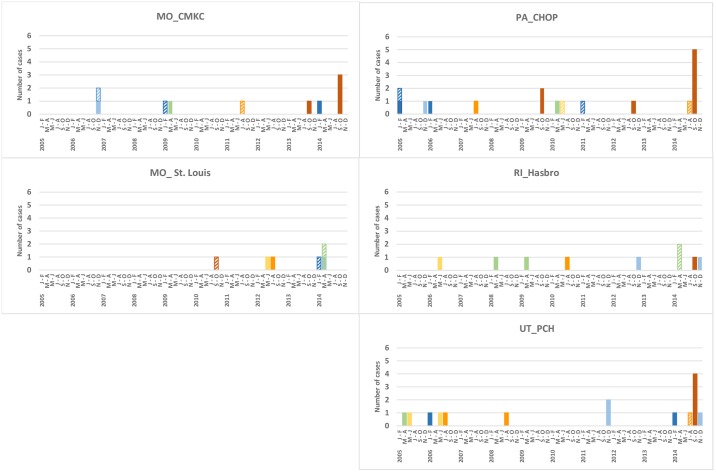
At 5 sites combined, 26 AFM cases were identified from 2005-2013 (average annual number, 3 [2.4 cases/100,000 pediatric hospitalizations]) and 18 from 2014 (12.6 cases/100,000 hospitalizations; Poisson exact p<0.0001). A cluster of 13 cases was identified in September-October 2014 (temporal scan p = 0.0001). No other temporal or seasonal trend was observed. Compared with cases from January 2005-July 2014 (n = 29), cases from August-December 2014 (n = 15) were younger (p = 0.002), more frequently had a preceding respiratory/febrile illness (p = 0.03), had only upper extremities involved (p = 0.008), and had upper extremity monoplegia (p = 0.03). The cases had higher WBC counts in cerebrospinal fluid (p = 0.013).
Our data support emergence of AFM in 2014 in the United States, and those cases demonstrated distinctive features compared with preceding sporadic cases.
急性弛缓性脊髓炎(AFM)是一种类似于麻痹性脊髓灰质炎的严重疾病。在小儿麻痹症消除后,美国儿童中 AFM 的发病率尚不清楚。2014 年,科罗拉多州发现了一起 AFM 聚集性病例,促使美国进行了被动监测,发现了 120 例病因未明的 AFM 病例。随后,2016 年和 2018 年收到的报告有所增加。为了帮助了解最近 AFM 暴发的因果关系,我们的目的是确定 2014 年之前 AFM 的发病率如何,以及 2014 年的病例是否具有不同的特征。
我们在 3 个美国地区的 5 个儿科中心进行了一项回顾性研究,时间范围为 2005-2014 年。通过搜索 ICD-9 编码和脊髓 MRI 报告(超过 37000 份),确定了年龄≤18 岁的可能 AFM 病例。神经放射科医生评估了 MRI 图像,并对病历进行了审查;可能的病例被分为 AFM、非 AFM 或不确定。
在 5 个地点的合并数据中,2005-2013 年共发现 26 例 AFM 病例(平均每年 3 例[每 100000 例儿科住院患者 2.4 例]),2014 年发现 18 例(每 100000 例住院患者 12.6 例;泊松精确检验 p<0.0001)。2014 年 9 月至 10 月发现了 13 例病例的聚集(时间扫描 p = 0.0001)。未观察到其他时间或季节性趋势。与 2005 年 1 月至 2014 年 7 月(n = 29)的病例相比,2014 年 8 月至 12 月(n = 15)的病例更年轻(p = 0.002),更常伴有前驱呼吸道/发热性疾病(p = 0.03),仅累及上肢(p = 0.008),且上肢单瘫(p = 0.03)。这些病例的脑脊液白细胞计数更高(p = 0.013)。
我们的数据支持 2014 年美国 AFM 的出现,与之前的散发病例相比,这些病例表现出不同的特征。