Renal Division, Department of Medicine, Peking University First Hospital, Beijing, People's Republic of China.
Institute of Nephrology, Peking University, Beijing, People's Republic of China.
Ren Fail. 2020 Nov;42(1):166-172. doi: 10.1080/0886022X.2020.1726385.
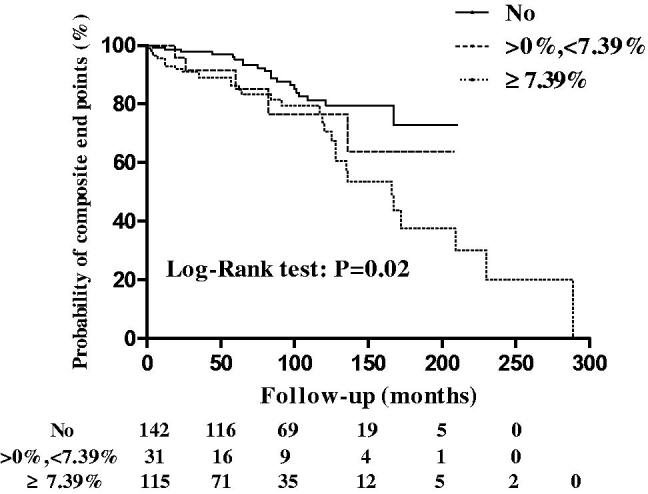
This study analyzed the associations of different crescents' fraction and clinical features in a Chinese lupus nephritis cohort based on the 2018 revision of ISN/RPS classification system. A total of 288 lupus nephritis patients with complete clinicopathological data and well follow-up was enrolled. The fraction of glomeruli with cellular or fibrocellular crescents based on the new system was reevaluated. The association between crescents fractions and the outcomes were further analyzed. The median follow-up period was 76.5 months. Cellular or fibrocellular crescents were present in 146 (50.7%) of the total individuals. The percentage of crescents were significantly associated with severe clinical renal injury indices and other renal pathological parameter. According to the survival receiver operating characteristic (survival ROC) curve, the optimal cutoff level of cellular or fibrocellular crescents for predicting the composite events was 7.39%. By multivariable Cox hazard analysis, the presence of crescents was predictive of survival from the composite events with a hazard ratio [HR] of 2.5 (95% CI 1.190-5.431; = .02). Furthermore, when we used absent, present in less than 7.39% of glomeruli, and present in greater than or equal to 7.39% of glomeruli as cutoffs in all the patients, a gradation appeared, with adjusted HRs of 2.9 (95% CI 1.326-6.313; = .008) for crescents in greater than or equal to 7.39% of glomeruli, in reference to no crescents. We proposed that the crescents were not uncommon and had important clinical significance in lupus nephritis. The cutoff point of crescents as prognosticator might be nearly 7.39%.
这项研究基于 2018 年 ISN/RPS 分类系统修订版,分析了中国狼疮肾炎队列中不同新月体比例与临床特征的关系。共纳入 288 例具有完整临床病理资料和良好随访的狼疮肾炎患者。根据新系统重新评估基于肾小球细胞性或纤维细胞性新月体的比例。进一步分析新月体比例与结局的关系。中位随访时间为 76.5 个月。在总共 146 名(50.7%)个体中存在细胞性或纤维细胞性新月体。新月体比例与严重临床肾脏损伤指标和其他肾脏病理参数显著相关。根据生存接受者操作特征(survival ROC)曲线,细胞性或纤维细胞性新月体预测复合事件的最佳截断值为 7.39%。多变量 Cox 风险分析显示,新月体的存在与复合事件的生存相关,风险比(HR)为 2.5(95%可信区间 1.190-5.431;P=0.02)。此外,当我们将所有患者的无新月体、新月体少于 7.39%的肾小球和新月体大于或等于 7.39%的肾小球作为截断值时,出现了梯度,新月体大于或等于 7.39%的肾小球的调整 HR 为 2.9(95%可信区间 1.326-6.313;P=0.008),与无新月体相比。我们提出新月体并不少见,在狼疮肾炎中有重要的临床意义。新月体作为预后标志物的截断点可能接近 7.39%。