Zhou Qimin, Bauden Monika, Andersson Roland, Hu Dingyuan, Marko-Varga György, Xu Jianfeng, Sasor Agata, Dai Hua, Pawłowski Krzysztof, Said Hilmersson Katarzyna, Chen Xi, Ansari Daniel
The Eye Hospital, School of Ophthalmology and Optometry, Wenzhou Medical University, Wenzhou, Zhejiang, China.
Department of Surgery, Clinical Sciences Lund, Lund University and Skåne University Hospital, 221 85, Lund, Sweden.
J Transl Med. 2020 Feb 13;18(1):77. doi: 10.1186/s12967-020-02254-7.
Pancreatic cancer is a major cause of cancer-related mortality. The identification of effective biomarkers is essential in order to improve management of the disease. Yes-associated protein 1 (YAP1) is a downstream effector of the Hippo pathway, a signal transduction system implicated in tissue repair and regeneration, as well as tumorigenesis. Here we evaluate the biomarker potential of YAP1 in pancreatic cancer tissue.
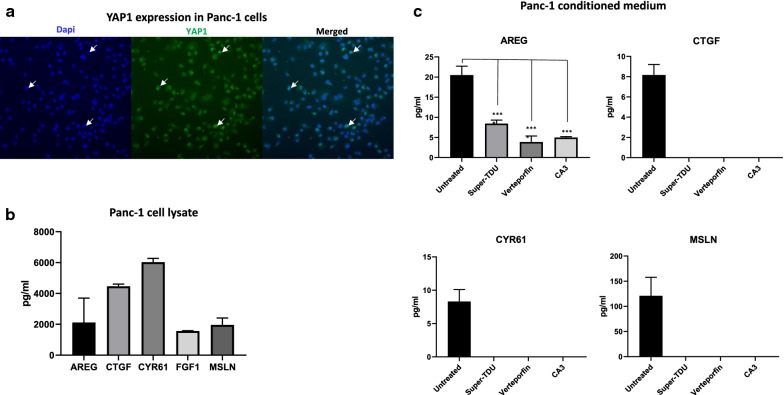
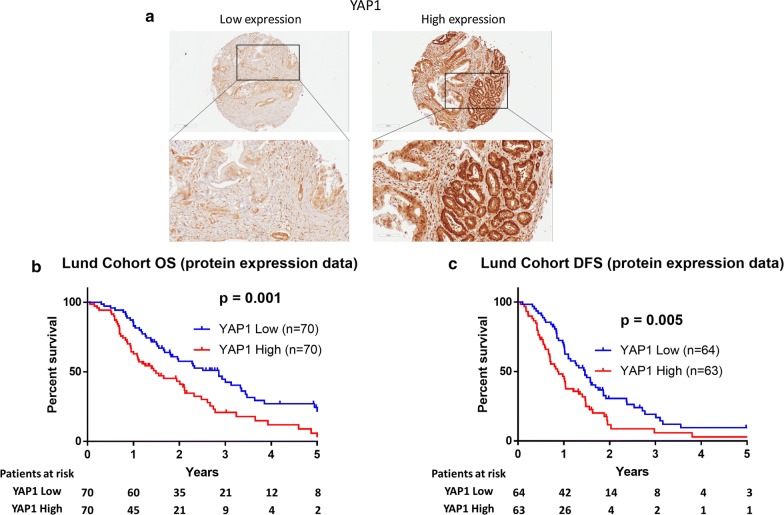
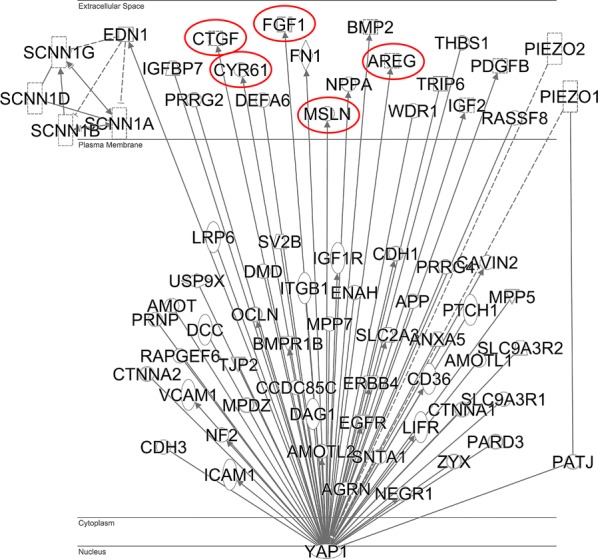
YAP1 was selected as a possible biomarker for pancreatic cancer from global protein sequencing of fresh frozen pancreatic cancer tissue samples and normal pancreas controls. The prognostic utility of YAP1 was evaluated using mRNA expression data from 176 pancreatic cancer patients in The Cancer Genome Atlas (TCGA), as well as protein expression data from immunohistochemistry analysis of a local tissue microarray (TMA) cohort comprising 140 pancreatic cancer patients. Ingenuity Pathway Analysis was applied to outline the interaction network for YAP1 in connection to the pancreatic tumor microenvironment. The expression of YAP1 target gene products was evaluated after treatment of the pancreatic cancer cell line Panc-1 with three substances interrupting YAP-TEAD interaction, including Super-TDU, Verteporfin and CA3.
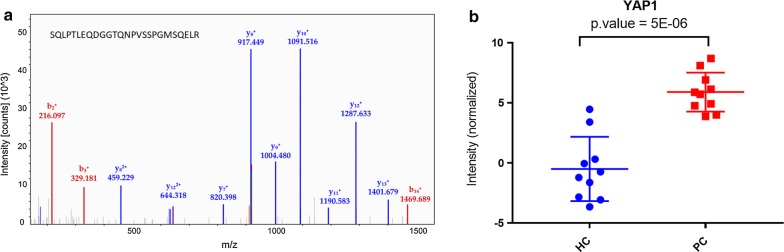
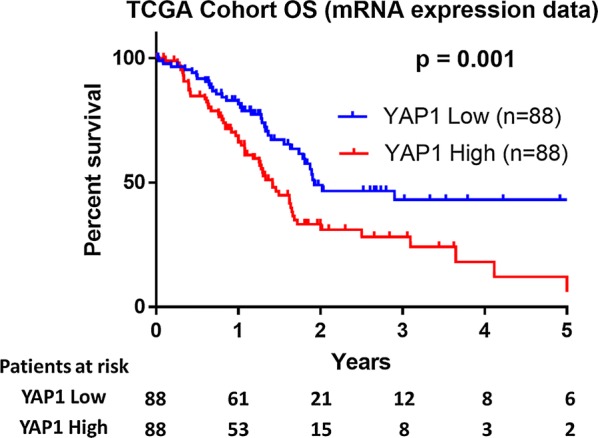
Mass spectrometry based proteomics showed that YAP1 is the top upregulated protein in pancreatic cancer tissue when compared to normal controls (log2 fold change 6.4; p = 5E-06). Prognostic analysis of YAP1 demonstrated a significant correlation between mRNA expression level data and reduced overall survival (p = 0.001). In addition, TMA and immunohistochemistry analysis suggested that YAP1 protein expression is an independent predictor of poor overall survival [hazard ratio (HR) 1.870, 95% confidence interval (CI) 1.224-2.855, p = 0.004], as well as reduced disease-free survival (HR 1.950, 95% CI 1.299-2.927, p = 0.001). Bioinformatic analyses coupled with in vitro assays indicated that YAP1 is involved in the transcriptional control of target genes, associated with extracellular matrix remodeling, which could be modified by selected substances disrupting the YAP1-TEAD interaction.
Our findings indicate that YAP1 is an important prognostic biomarker for pancreatic cancer and may play a regulatory role in the remodeling of the extracellular matrix.
胰腺癌是癌症相关死亡的主要原因。识别有效的生物标志物对于改善该疾病的管理至关重要。Yes相关蛋白1(YAP1)是Hippo信号通路的下游效应因子,该信号转导系统与组织修复、再生以及肿瘤发生有关。在此,我们评估YAP1在胰腺癌组织中的生物标志物潜力。
从新鲜冷冻的胰腺癌组织样本和正常胰腺对照的全蛋白质测序中,选择YAP1作为胰腺癌的潜在生物标志物。使用来自癌症基因组图谱(TCGA)中176例胰腺癌患者的mRNA表达数据,以及来自包含140例胰腺癌患者的局部组织微阵列(TMA)队列免疫组织化学分析的蛋白质表达数据,评估YAP1的预后效用。应用 Ingenuity 通路分析来勾勒YAP1与胰腺肿瘤微环境相关的相互作用网络。用三种干扰YAP-TEAD相互作用的物质(包括Super-TDU、维替泊芬和CA3)处理胰腺癌细胞系Panc-1后,评估YAP1靶基因产物的表达。
基于质谱的蛋白质组学表明,与正常对照相比,YAP1是胰腺癌组织中上调最明显的蛋白质(log2倍数变化6.4;p = 5E-06)。YAP1的预后分析表明,mRNA表达水平数据与总生存期缩短之间存在显著相关性(p = 0.001)。此外,TMA和免疫组织化学分析表明,YAP1蛋白表达是总生存期差的独立预测因子[风险比(HR)1.870,95%置信区间(CI)1.224-2.855,p = 0.004],也是无病生存期缩短的独立预测因子(HR 1.950,95%CI 1.299-2.927,p = 0.001)。生物信息学分析与体外试验表明,YAP1参与靶基因的转录调控,与细胞外基质重塑相关,这可被破坏YAP1-TEAD相互作用的特定物质所改变。
我们的研究结果表明YAP1是胰腺癌的重要预后生物标志物,并且可能在细胞外基质重塑中发挥调节作用。