Zhang Leon Li-Min, Zhou Guodong, Zhou Guoqing, Lee Hung-Kay, Zhao Ni, Prezhdo Oleg V, Mak Thomas C W
Department of Chemistry and Center of Novel Functional Molecules , The Chinese University of Hong Kong , Hong Kong SAR , People's Republic of China . Email:
Department of Electronic Engineering , The Chinese University of Hong Kong , Hong Kong SAR , People's Republic of China.
Chem Sci. 2019 Sep 7;10(43):10122-10128. doi: 10.1039/c9sc03455b. eCollection 2019 Nov 21.
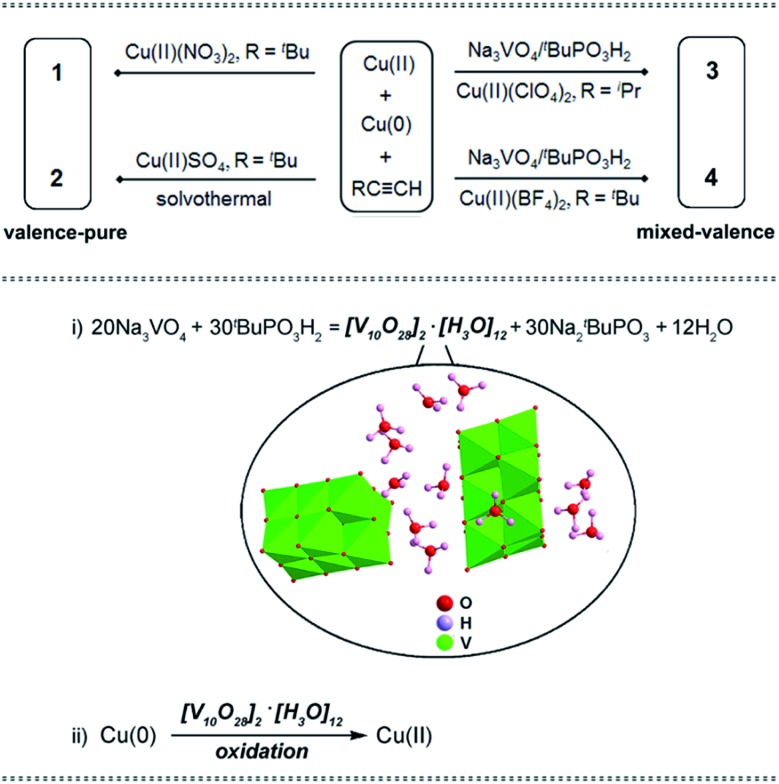
We report herein that copper alkynyl nanoclusters show metal-core dependent properties a charge-transfer mechanism, which enables new understanding of their structure-property relationship. Initially, nanoclusters and bearing respective Cu(i) () and Cu(i) () cores were prepared and revealed to display near-infrared (NIR) photoluminescence mainly from the mixed alkynyl → Cu(i) ligand-to-metal charge transfer (LMCT) and cluster-centered transition, and they further exhibit thermally activated delayed fluorescence (TADF). Subsequently, a vanadate-induced oxidative approach to generate a nucleating Cu(ii) cation led to assembly of and featuring respective [Cu(ii)O]@Cu(i) () and {[Cu(ii)O]·[VO]}@Cu(i) () cores. While interstitial occupancy of Cu(ii) triggers inter-valence charge-transfer (IVCT) from Cu(i) to Cu(ii) to quench the photoluminescence of and , such a process facilitates charge mobility to render them semiconductive. Overall, metal-core modification results in an interplay between charge-transfer processes to switch TADF to semiconductivity, which underpins an unusual structure-property correlation for designed synthesis of metal nanoclusters with unique properties and functions.
我们在此报告,炔基铜纳米团簇表现出与金属核相关的性质——一种电荷转移机制,这使得人们对其结构-性质关系有了新的理解。最初,制备了分别带有Cu(i)()和Cu(i)()核的纳米团簇和,发现它们主要通过混合炔基→Cu(i)配体到金属的电荷转移(LMCT)和团簇中心跃迁显示近红外(NIR)光致发光,并且它们进一步表现出热激活延迟荧光(TADF)。随后,一种钒酸盐诱导的氧化方法生成了一个成核的Cu(ii)阳离子,导致了分别具有[Cu(ii)O]@Cu(i)()和{[Cu(ii)O]·[VO]}@Cu(i)()核的和的组装。虽然Cu(ii)的间隙占据引发了从Cu(i)到Cu(ii)的价间电荷转移(IVCT),从而淬灭了和的光致发光,但这样的过程促进了电荷迁移,使其成为半导体。总体而言,金属核修饰导致了电荷转移过程之间的相互作用,从而将TADF转变为半导体性质,这为设计合成具有独特性质和功能的金属纳米团簇提供了一种不同寻常的结构-性质相关性。