Park Kyungsoo
Department of Pharmacology, Yonsei University College of Medicine, Seoul 03722, Korea.
Transl Clin Pharmacol. 2019 Jun;27(2):59-63. doi: 10.12793/tcp.2019.27.2.59. Epub 2019 Jun 28.
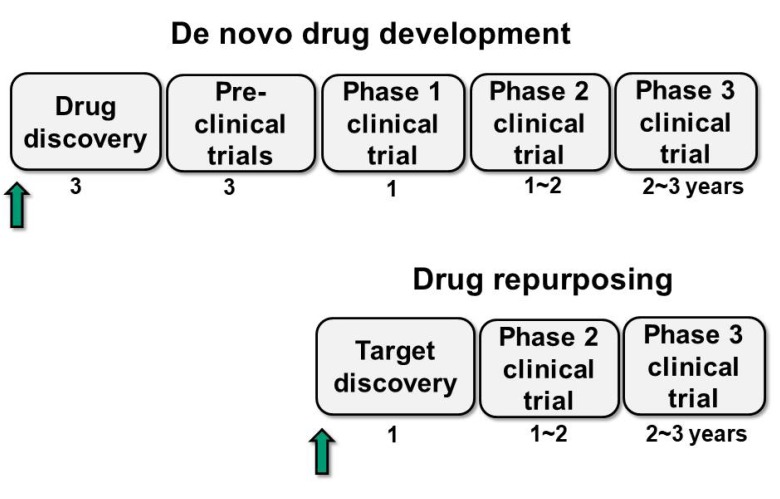
Although sciences and technology have progressed rapidly, de novo drug development has been a costly and time-consuming process over the past decades. In view of these circumstances, 'drug repurposing' (or 'drug repositioning') has appeared as an alternative tool to accelerate drug development process by seeking new indications for already approved drugs rather than discovering de novo drug compounds, nowadays accounting for 30% of newly marked drugs in the U.S. In the meantime, the explosive and large-scale growth of molecular, genomic and phenotypic data of pharmacological compounds is enabling the development of new area of drug repurposing called computational drug repurposing. This review provides an overview of recent progress in the area of computational drug repurposing. First, it summarizes available repositioning strategies, followed by computational methods commonly used. Then, it describes validation techniques for repurposing studies. Finally, it concludes by discussing the remaining challenges in computational repurposing.
尽管科学技术发展迅速,但在过去几十年里,新药研发一直是一个成本高昂且耗时的过程。鉴于这些情况,“药物重新利用”(或“药物重新定位”)作为一种替代工具应运而生,通过为已获批药物寻找新适应症而非从头发现新的药物化合物来加速药物研发进程,如今在美国新上市药物中占比达30%。与此同时,药理化合物的分子、基因组和表型数据呈爆发式大规模增长,催生了一个名为计算药物重新利用的药物重新利用新领域。本文综述了计算药物重新利用领域的最新进展。首先,总结了可用的重新利用策略,接着介绍了常用的计算方法。然后,描述了重新利用研究的验证技术。最后,通过讨论计算重新利用中尚存的挑战得出结论。