Regnante Jeanne M, Richie Nicole, Fashoyin-Aje Lola, Hall Laura Lee, Highsmith Quita, Louis J'Aimee, Turner Kenneth, Hoover Spencer, Lee Simon Craddock, González Evelyn, Williams Erin, Adams Homer, Obasaju Coleman, Sargeant Ify, Spinner Jovonni, Reddick Christopher, Gandee Marianne, Geday Madeline, Dang Julie, Watson Rayneisha, Chen Moon S
Center for Sustainable Health Care Quality and Equity, 1201 15th Street, NW, Suite 340, Washington, DC, 20005, USA.
Genentech, 1 DNA Way, South San Francisco, 94080, USA.
Contemp Clin Trials Commun. 2020 Jan 22;17:100532. doi: 10.1016/j.conctc.2020.100532. eCollection 2020 Mar.
Study populations in clinical research must reflect US changing demographics, especially with the rise of precision medicine. However, racial and ethnic minority groups (REMGs) have low rates of participation in cancer clinical trials.
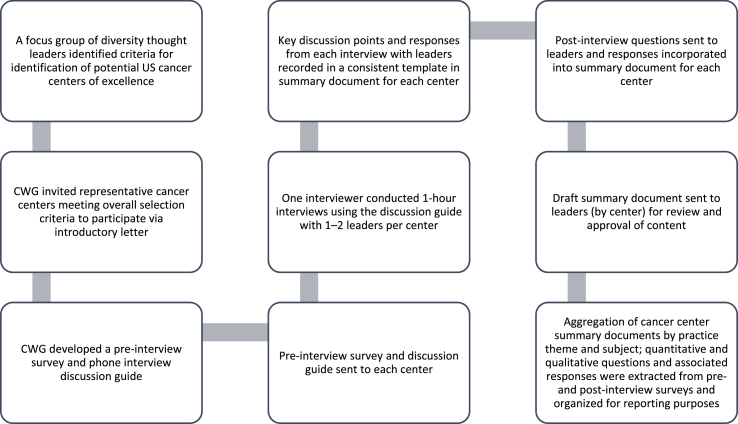
Criteria were developed to identify cancer centers able to accrue a higher than average proportion of REMGs into clinical trials. Comprehensive interviews were conducted with leaders of these cancer centers to identify operational strategies contributing to enhanced accrual of REMGs.
Eight US cancer centers reported a REMG accrual rate range in cancer research between 10 and 50% in a 12-month reporting period and met other criteria for inclusion. Fourteen leaders participated in this assessment. Key findings were that centers: had a metric collection and reporting approach; routinely captured race and ethnicity data within databases accessible to research staff; had operational standards to support access and inclusion; developed practices to facilitate sustained patient participation during clinical trials; had strategies to decrease recruitment time and optimize clinical study design; and identified low-resource strategies for REMG accrual. There was also a clear commitment to establish processes that support the patient's provider as the key influencer of patient recruitment into clinical trials.
We have identified operational practices that facilitate increased inclusion of REMGs in cancer trials. In order to establish a sustainable cancer center inclusion research strategy, it is valuable to include an operational framework that is informed by leading US cancer centers of excellence.
临床研究中的研究人群必须反映美国不断变化的人口结构,尤其是在精准医学兴起的情况下。然而,种族和少数族裔群体(REMGs)参与癌症临床试验的比例较低。
制定了标准,以识别能够使REMGs参与临床试验的比例高于平均水平的癌症中心。对这些癌症中心的负责人进行了全面访谈,以确定有助于提高REMGs参与率的运营策略。
8家美国癌症中心报告称,在12个月的报告期内,癌症研究中REMGs的参与率在10%至50%之间,并符合其他纳入标准。14位负责人参与了此次评估。主要发现是,这些中心:采用了指标收集和报告方法;在研究人员可访问的数据库中常规收集种族和族裔数据;有支持准入和纳入的运营标准;制定了促进患者在临床试验期间持续参与的做法;有减少招募时间和优化临床研究设计的策略;并确定了针对REMGs参与的低资源策略。此外,还明确承诺建立支持患者医疗服务提供者作为临床试验患者招募关键影响因素的流程。
我们已经确定了有助于提高REMGs在癌症试验中参与率的运营做法。为了建立可持续的癌症中心纳入研究策略,纳入一个由美国领先的优秀癌症中心提供信息的运营框架是很有价值的。