Department of Pathology, Erasmus MC Cancer Institute Rotterdam, The Netherlands.
Division of Molecular Pathology, The Netherlands Cancer Institute, Amsterdam, The Netherlands.
Mol Oncol. 2020 Apr;14(4):671-685. doi: 10.1002/1878-0261.12650. Epub 2020 Mar 5.
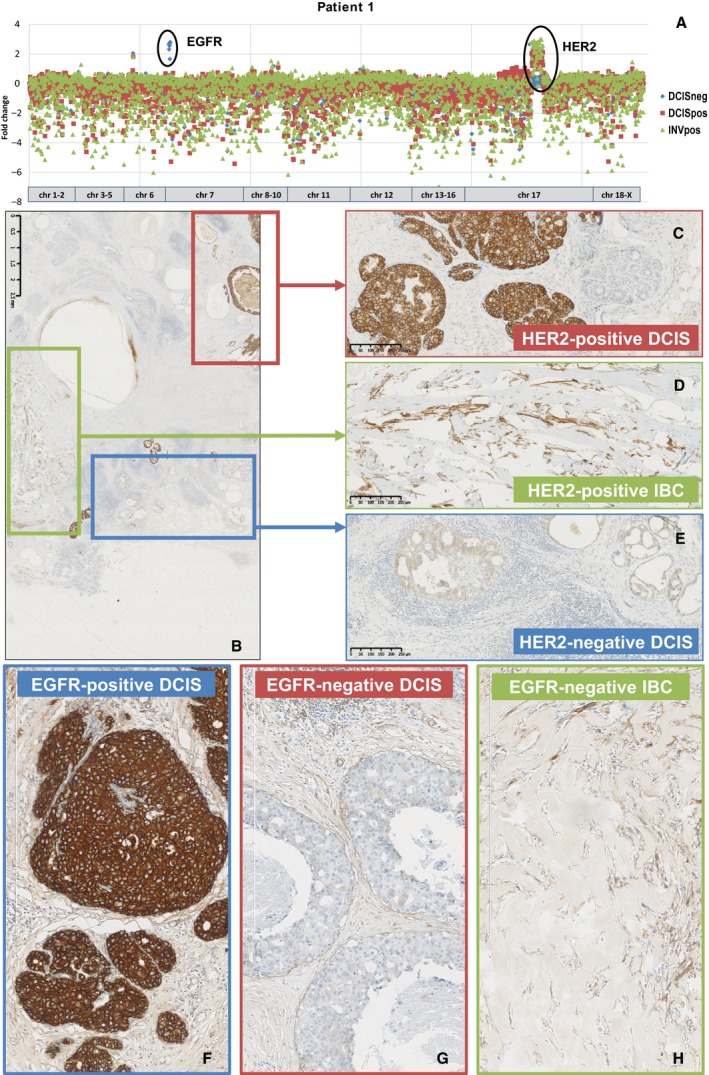
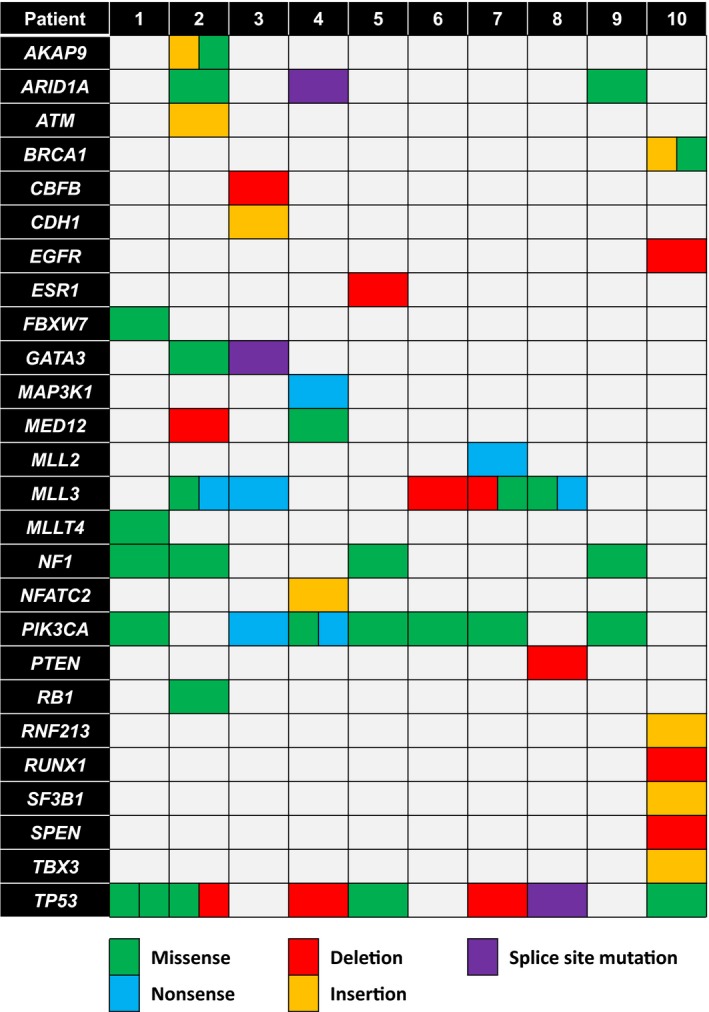
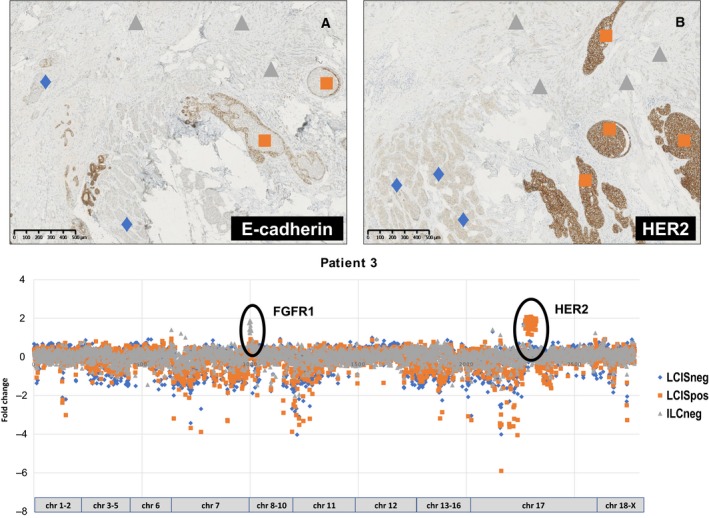
Intratumour heterogeneity fuels carcinogenesis and allows circumventing specific targeted therapies. HER2 gene amplification is associated with poor outcome in invasive breast cancer. Heterogeneous HER2 amplification has been described in 5-41% of breast cancers. Here, we investigated the genetic differences between HER2-positive and HER2-negative admixed breast cancer components. We performed an in-depth analysis to explore the potential heterogeneity in the somatic mutational landscape of each individual tumour component. Formalin-fixed, paraffin-embedded breast cancer tissue of ten patients with at least one HER2-negative and at least one HER2-positive component was microdissected. Targeted next-generation sequencing was performed using a customized 53-gene panel. Somatic mutations and copy number variations were analysed. Overall, the tumours showed a heterogeneous distribution of 12 deletions, 9 insertions, 32 missense variants and 7 nonsense variants in 26 different genes, which are (likely) pathogenic. Three splice site alterations were identified. One patient had an EGFR copy number gain restricted to a HER2-negative in situ component, resulting in EGFR protein overexpression. Two patients had FGFR1 copy number gains in at least one tumour component. Two patients had an 8q24 gain in at least one tumour component, resulting in a copy number increase in MYC and PVT1. One patient had a CCND1 copy number gain restricted to a HER2-negative tumour component. No common alternative drivers were identified in the HER2-negative tumour components. This series of 10 breast cancers with heterogeneous HER2 gene amplification illustrates that HER2 positivity is not an unconditional prerequisite for the maintenance of tumour growth. Many other molecular aberrations are likely to act as alternative or collaborative drivers. This study demonstrates that breast carcinogenesis is a dynamically evolving process characterized by a versatile somatic mutational profile, of which some genetic aberrations will be crucial for cancer progression, and others will be mere 'passenger' molecular anomalies.
肿瘤内异质性促进致癌作用,并允许绕过特定的靶向治疗。HER2 基因扩增与浸润性乳腺癌的不良预后相关。在 5-41%的乳腺癌中已经描述了异质性 HER2 扩增。在这里,我们研究了 HER2 阳性和 HER2 阴性混合乳腺癌成分之间的遗传差异。我们进行了深入分析,以探索每个肿瘤成分的体细胞突变景观的潜在异质性。对至少有一个 HER2 阴性和至少一个 HER2 阳性成分的十个患者的福尔马林固定、石蜡包埋的乳腺癌组织进行了显微解剖。使用定制的 53 基因面板进行靶向下一代测序。分析了体细胞突变和拷贝数变异。总体而言,肿瘤显示出 26 个不同基因中 12 个缺失、9 个插入、32 个错义变体和 7 个无义变体的异质性分布,这些变体(可能)是致病性的。鉴定了三个剪接位点改变。一名患者的 HER2 阴性原位成分中存在 EGFR 拷贝数增加,导致 EGFR 蛋白过表达。两名患者在至少一个肿瘤成分中存在 FGFR1 拷贝数增加。两名患者在至少一个肿瘤成分中存在 8q24 获得,导致 MYC 和 PVT1 的拷贝数增加。一名患者的 HER2 阴性肿瘤成分中存在 CCND1 拷贝数增加。在 HER2 阴性肿瘤成分中未发现共同的替代驱动基因。这一系列 10 例具有异质性 HER2 基因扩增的乳腺癌表明,HER2 阳性不是维持肿瘤生长的无条件前提。许多其他分子异常很可能作为替代或协同驱动因素。这项研究表明,乳腺癌发生是一个动态进化的过程,其特征是具有多样化的体细胞突变谱,其中一些遗传异常对于癌症进展至关重要,而其他异常则仅仅是“乘客”分子异常。