Department of Medical Oncology, The Affiliated Hospital of Qingdao University, Qingdao University, Qingdao, China.
Thorac Cancer. 2020 Apr;11(4):851-866. doi: 10.1111/1759-7714.13298. Epub 2020 Feb 14.
Lung cancer is the most common cause of cancer-related death among all human cancers and the five-year survival rates are only 23%. The precise molecular mechanisms of non-small cell lung cancer (NSCLC) are still unknown. The aim of this study was to identify and validate the key genes with prognostic value in lung tumorigenesis.
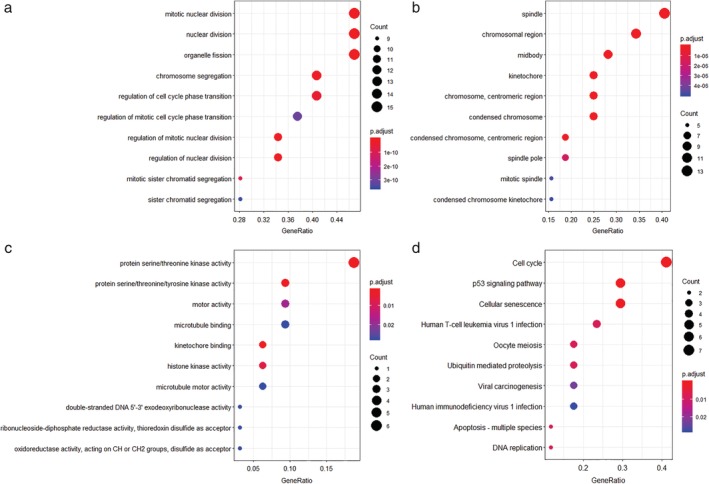
Four GEO datasets were obtained from the Gene Expression Omnibus (GEO) database. Common differentially expressed genes (DEGs) were selected for Kyoto Encyclopedia of Genes and Genomes pathway analysis and Gene Ontology enrichment analysis. Protein-protein interaction (PPI) networks were constructed using the STRING database and visualized by Cytoscape software and Molecular Complex Detection (MCODE) were utilized to PPI network to pick out meaningful DEGs. Hub genes, filtered from the CytoHubba, were validated using the Gene Expression Profiling Interactive Analysis database. The expressions and prognostic values of hub genes were carried out through Gene Expression Profiling Interactive Analysis (GEPIA) and Kaplan-Meier plotter. Finally, quantitative PCR and the Oncomine database were used to verify the differences in the expression of hub genes in lung cancer cells and tissues.
A total of 121 DEGs (49 upregulated and 72 downregulated) were identified from four datasets. The PPI network was established with 121 nodes and 588 protein pairs. Finally, AURKA, KIAA0101, CDC20, MKI67, CHEK1, HJURP, and OIP5 were selected by Cytohubba, and they all correlated with worse overall survival (OS) in NSCLC.
The results showed that AURKA, KIAA0101, CDC20, MKI67, CHEK1, HJURP, and OIP5 may be critical genes in the development and prognosis of NSCLC.
Our results indicated that AURKA, KIAA0101, CDC20, MKI67, CHEK1, HJURP, and OIP5 may be critical genes in the development and prognosis of NSCLC. Our methods showed a new way to explore the key genes in cancer development.
肺癌是所有人类癌症中导致癌症相关死亡的最常见原因,其五年生存率仅为 23%。非小细胞肺癌(NSCLC)的确切分子机制尚不清楚。本研究旨在鉴定和验证与肺肿瘤发生相关的具有预后价值的关键基因。
从基因表达综合数据库(GEO)中获取了四个 GEO 数据集。选择常见的差异表达基因(DEGs)进行京都基因与基因组百科全书通路分析和基因本体论富集分析。使用 STRING 数据库构建蛋白质-蛋白质相互作用(PPI)网络,并通过 Cytoscape 软件可视化,使用分子复合物检测(MCODE)从 PPI 网络中提取有意义的 DEGs。从 CytoHubba 中筛选出枢纽基因,并使用基因表达谱交互分析数据库进行验证。通过基因表达谱交互分析(GEPIA)和 Kaplan-Meier 绘图器进行枢纽基因的表达和预后价值分析。最后,使用定量 PCR 和 Oncomine 数据库验证枢纽基因在肺癌细胞和组织中的表达差异。
从四个数据集中共鉴定出 121 个 DEGs(49 个上调和 72 个下调)。建立了包含 121 个节点和 588 个蛋白质对的 PPI 网络。最后,Cytohubba 筛选出 AURKA、KIAA0101、CDC20、MKI67、CHEK1、HJURP 和 OIP5,它们都与 NSCLC 的总生存期(OS)较差相关。
结果表明,AURKA、KIAA0101、CDC20、MKI67、CHEK1、HJURP 和 OIP5 可能是 NSCLC 发生和预后的关键基因。
我们的结果表明,AURKA、KIAA0101、CDC20、MKI67、CHEK1、HJURP 和 OIP5 可能是 NSCLC 发生和预后的关键基因。我们的方法为探索癌症发展中的关键基因提供了一种新方法。