Keller Johannes G, Peijnenburg Willie, Werle Kai, Landsiedel Robert, Wohlleben Wendel
BASF SE, Dept. Experimental Toxicology and Ecology and Dept. Advanced Materials Research, 67056 Ludwigshafen, Germany.
Institute of Pharmacy, Faculty of Biology, Chemistry & Pharmacy, Freie Universität Berlin, 14195 Berlin, Germany.
Nanomaterials (Basel). 2020 Feb 12;10(2):311. doi: 10.3390/nano10020311.
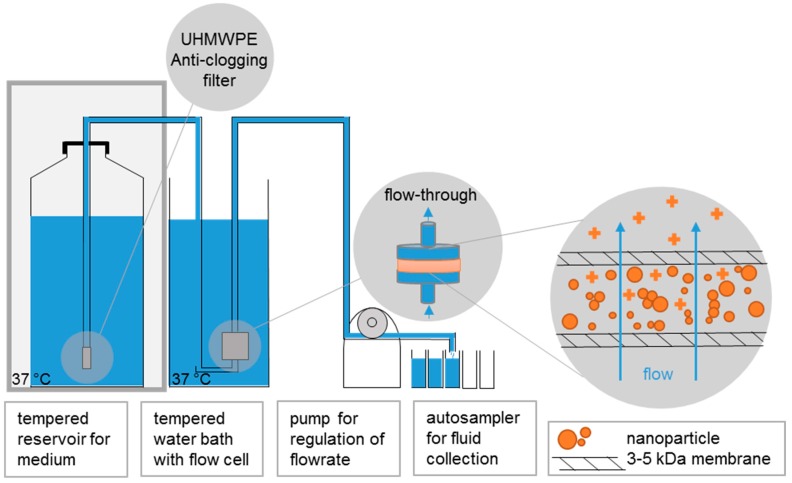
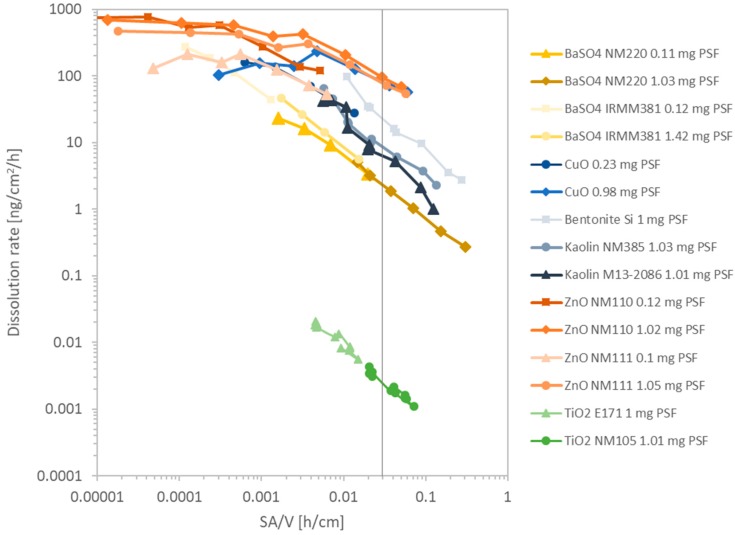
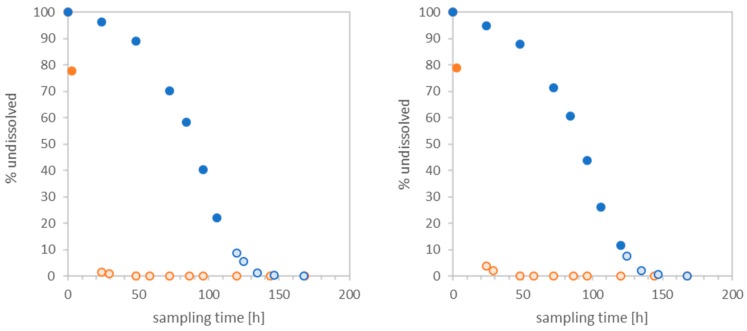
Dissolution rates of nanomaterials can be decisive for acute in vivo toxicity (via the released ions) and for biopersistence (of the remaining particles). Continuous flow systems (CFSs) can screen for both aspects, but operational parameters need to be adjusted to the specific physiological compartment, including local metal ion saturation. CFSs have two adjustable parameters: the volume flow-rate and the initial particle loading. Here we explore the pulmonary lysosomal dissolution of nanomaterials containing the metals Al, Ba, Zn, Cu over a wide range of volume flow-rates in a single experiment. We identify the ratio of particle surface area (SA) per volume flow-rate (SA/V) as critical parameter that superimposes all dissolution rates of the same material. Three complementary benchmark materials-ZnO (quick dissolution), TiO (very slow dissolution), and BaSO (partial dissolution)-consistently identify the SA/V range of 0.01 to 0.03 h/μm as predictive for lysosomal pulmonary biodissolution. We then apply the identified method to compare against non-nanoforms of the same substances and test aluminosilicates. For BaSO and TiO, we find high similarity of the dissolution rates of their respective nanoform and non-nanoform, governed by the local ion solubility limit at relevant SA/V ranges. For aluminosilicates, we find high similarity of the dissolution rates of two Kaolin nanoforms but significant dissimilarity against Bentonite despite the similar composition.
纳米材料的溶解速率对于急性体内毒性(通过释放的离子)和生物持久性(剩余颗粒的)可能具有决定性作用。连续流动系统(CFSs)可以对这两个方面进行筛选,但操作参数需要根据特定的生理隔室进行调整,包括局部金属离子饱和度。CFSs有两个可调节参数:体积流速和初始颗粒负载量。在此,我们在单个实验中,在很宽的体积流速范围内,探究了含有金属铝、钡、锌、铜的纳米材料在肺溶酶体中的溶解情况。我们确定了每体积流速的颗粒表面积(SA)之比(SA/V)为关键参数,该参数叠加了同一种材料的所有溶解速率。三种互补的基准材料——氧化锌(快速溶解)、二氧化钛(非常缓慢溶解)和硫酸钡(部分溶解)——一致地确定SA/V范围为0.01至0.03 h/μm可预测肺溶酶体生物溶解情况。然后,我们应用所确定的方法,将其与相同物质的非纳米形式进行比较,并测试铝硅酸盐。对于硫酸钡和二氧化钛,我们发现在相关SA/V范围内,它们各自的纳米形式和非纳米形式的溶解速率高度相似,这由局部离子溶解度极限决定。对于铝硅酸盐,我们发现两种高岭土纳米形式的溶解速率高度相似,但与膨润土相比,尽管组成相似,溶解速率却存在显著差异。