Arbeitskreis Prozessanalytik, Gesellschaft Deutscher Chemiker, 60486, Frankfurt am Main, Germany.
Daiichi Sankyo Europe GmbH, 81379, Munich, Germany.
Anal Bioanal Chem. 2020 Apr;412(9):2027-2035. doi: 10.1007/s00216-020-02420-2. Epub 2020 Feb 15.
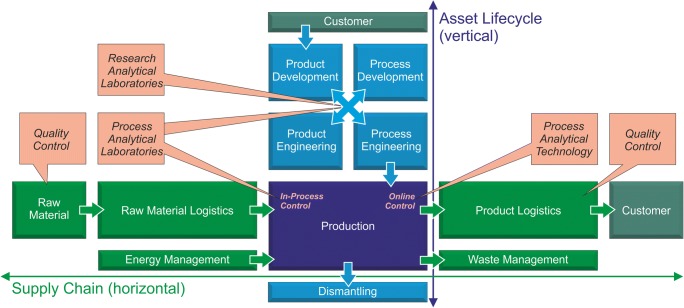
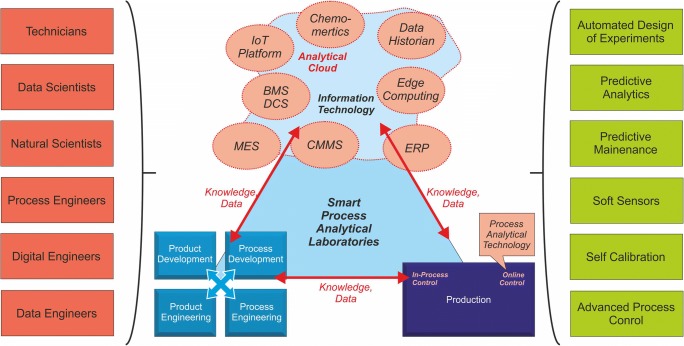
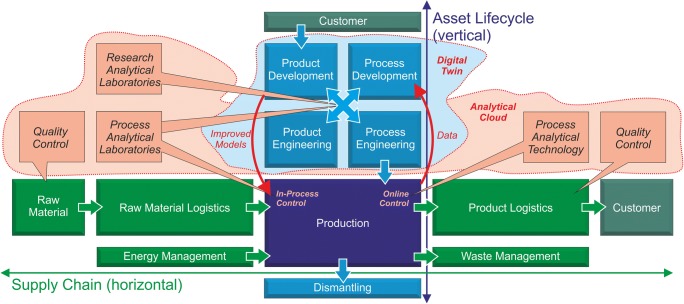
The competitiveness of the chemical and pharmaceutical industry is based on ensuring the required product quality while making optimum use of plants, raw materials, and energy. In this context, effective process control using reliable chemical process analytics secures global competitiveness. The setup of those control strategies often originate in process development but need to be transferable along the whole product life cycle. In this series of two contributions, we want to present a combined view on the future of PAT (process analytical technology), which is projected in smart labs (part 1) and smart sensors (part 2). In laboratories and pilot plants, offline chemical analytical methods are frequently used, where inline methods are also used in production. Here, a transferability from process development to the process in operation would be desirable. This can be obtained by establishing PAT methods for production already during process development or scale-up. However, the current PAT (Bakeev 2005, Org Process Res 19:3-62; Simon et al. 2015, Org Process Res Dev 19:3-62) must become more flexible and smarter. This can be achieved by introducing digitalization-based knowledge management, so that knowledge from product development enables and accelerates the integration of PAT. Conversely, knowledge from the production process will also contribute to product and process development. This contribution describes the future role of the laboratory and develops requirements therefrom. In part 2, we examine the future functionality as well as the ingredients of a smart sensor aiming to eventually fuel full PAT functionality-also within process development or scale-up facilities (Eifert et al. 2020, Anal Bioanal Chem).
化学和制药行业的竞争力基于在优化利用工厂、原材料和能源的同时确保所需的产品质量。在这种情况下,使用可靠的化学过程分析进行有效的过程控制可以确保全球竞争力。这些控制策略的设置通常源自于工艺开发,但需要沿着整个产品生命周期进行可转移。在这两篇文章中,我们想对 PAT(过程分析技术)的未来提出一个综合的看法,这在智能实验室(第 1 部分)和智能传感器(第 2 部分)中有所体现。在实验室和中试工厂中,通常使用离线化学分析方法,而在生产中也使用在线方法。在这里,从工艺开发到运行中的工艺进行可转移是理想的。这可以通过在工艺开发或放大阶段就为生产建立 PAT 方法来实现。然而,当前的 PAT(Bakeev 2005,Org Process Res 19:3-62;Simon 等人,2015,Org Process Res Dev 19:3-62)必须变得更加灵活和智能化。这可以通过引入基于数字化的知识管理来实现,以便产品开发的知识能够支持和加速 PAT 的集成。相反,生产过程中的知识也将有助于产品和工艺的开发。本贡献描述了实验室的未来角色,并从中提出了要求。在第 2 部分中,我们研究了未来的功能以及智能传感器的组成部分,以期最终实现全 PAT 功能-也在工艺开发或放大设施中(Eifert 等人,2020,Anal Bioanal Chem)。