Disdier Clémence, Stonestreet Barbara S
Department of Pediatrics, Women & Infants Hospital of Rhode Island, The Alpert Medical School of Brown University, Providence, RI, USA.
J Neurosci Res. 2020 Jul;98(7):1468-1484. doi: 10.1002/jnr.24590. Epub 2020 Feb 14.
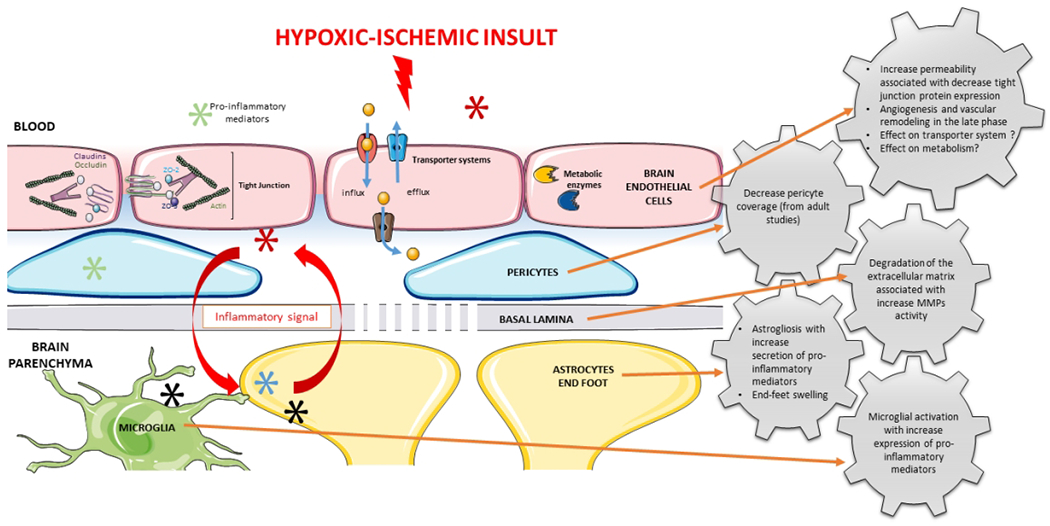
Perinatal hypoxic-ischemic (HI)-related brain injury is an important cause of morbidity and long-standing disability in newborns. The only currently approved therapeutic strategy available to reduce brain injury in the newborn is hypothermia. Therapeutic hypothermia can only be used to treat HI encephalopathy in full-term infants and survivors remain at high risk for a wide spectrum of neurodevelopmental abnormalities as a result of residual brain injury. Therefore, there is an urgent need for adjunctive therapeutic strategies. Inflammation and neurovascular damage are important factors that contribute to the pathophysiology of HI-related brain injury and represent exciting potential targets for therapeutic intervention. In this review, we address the role of each component of the neurovascular unit (NVU) in the pathophysiology of HI-related injury in the neonatal brain. Disruption of the blood-brain barrier (BBB) observed in the early hours after an HI-related event is associated with a response at the basal lamina level, which comprises astrocytes, pericytes, and immune cells, all of which could affect BBB function to further exacerbate parenchymal injury. Future research is required to determine potential drugs that could prevent or attenuate neurovascular damage and/or augment repair. However, some studies have reported beneficial effects of hypothermia, erythropoietin, stem cell therapy, anti-cytokine therapy and metformin in ameliorating several different facets of damage to the NVU after HI-related brain injury in the perinatal period.
围产期缺氧缺血(HI)相关脑损伤是新生儿发病和长期残疾的重要原因。目前唯一被批准用于减轻新生儿脑损伤的治疗策略是低温治疗。低温治疗仅可用于治疗足月儿的HI脑病,且由于残留脑损伤,幸存者仍面临广泛神经发育异常的高风险。因此,迫切需要辅助治疗策略。炎症和神经血管损伤是导致HI相关脑损伤病理生理过程的重要因素,也是治疗干预的潜在靶点。在这篇综述中,我们阐述了神经血管单元(NVU)各组成部分在新生儿脑HI相关损伤病理生理过程中的作用。HI相关事件发生后数小时内观察到的血脑屏障(BBB)破坏与基底膜水平的反应有关,基底膜由星形胶质细胞、周细胞和免疫细胞组成,所有这些细胞都可能影响BBB功能,从而进一步加重实质损伤。未来需要开展研究以确定能够预防或减轻神经血管损伤和/或促进修复的潜在药物。然而,一些研究报道了低温治疗、促红细胞生成素、干细胞治疗、抗细胞因子治疗和二甲双胍在改善围产期HI相关脑损伤后NVU损伤的几个不同方面具有有益作用。