Jiang Yaling, Zhou Xuedong, Cheng Lei, Li Mingyun
State Key Laboratory of Oral Diseases, National Clinical Research Center for Oral Diseases, West China Hospital of Stomatology, Sichuan University, Chengdu, China.
Department of Operative Dentistry and Endodontics, West China Hospital of Stomatology, Sichuan University, Chengdu, China.
Front Microbiol. 2020 Jan 29;11:66. doi: 10.3389/fmicb.2020.00066. eCollection 2020.
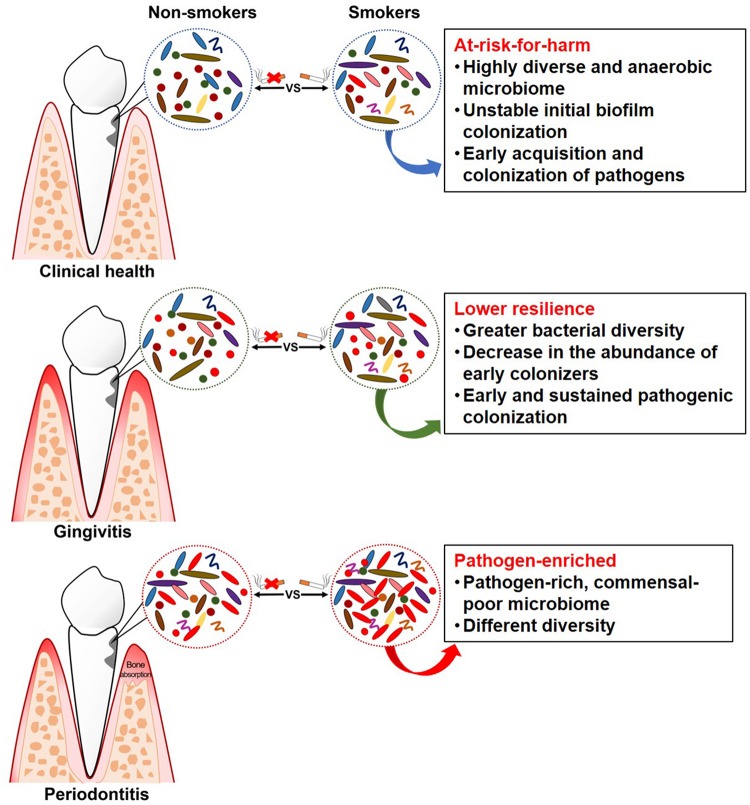
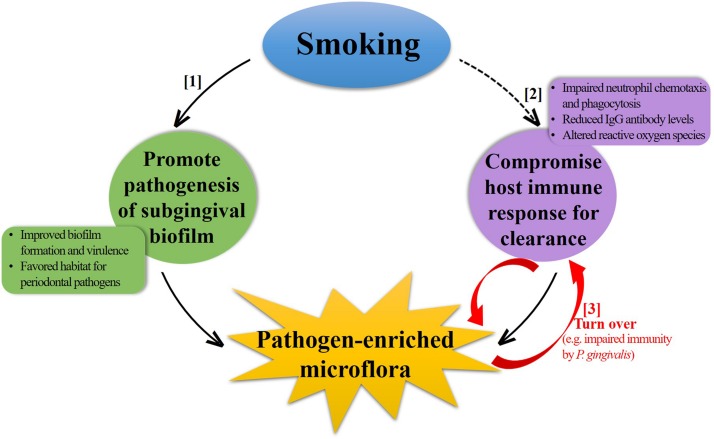
Periodontal disease is one of the most common diseases of the oral cavity affecting up to 90% of the worldwide population. Smoking has been identified as a major risk factor in the development and progression of periodontal disease. It is essential to assess the influence of smoking on subgingival microflora that is the principal etiological factor of the disease to clarify the contribution of smoking to periodontal disease. Therefore, this article reviews the current research findings regarding the impact of smoking on subgingival microflora and discusses several potential mechanisms. Cultivation-based and targeted molecular approaches yield controversial results in determining the presence or absence of smoking-induced differences in the prevalence or levels of certain periodontal pathogens, such as the "red complex." However, substantial changes in the subgingival microflora of smokers, regardless of their periodontal condition (clinical health, gingivitis, or periodontitis), have been demonstrated in recent microbiome studies. Available literature suggests that smoking facilitates early acquisition and colonization of periodontal pathogens, resulting in an "at-risk-for-harm" subgingival microbial community in the healthy periodontium. In periodontal diseases, the subgingival microflora in smokers is characterized by a pathogen-enriched community with lower resilience compared to that in non-smokers, which increases the difficulty of treatment. Biological changes in key pathogens, such as , together with the ineffective host immune response for clearance, might contribute to alterations in the subgingival microflora in smokers. Nonetheless, further studies are necessary to provide solid evidence for the underlying mechanisms.
牙周病是最常见的口腔疾病之一,全球高达90%的人口受其影响。吸烟已被确认为牙周病发生和发展的主要危险因素。评估吸烟对龈下微生物群(该疾病的主要病因)的影响,对于阐明吸烟对牙周病的作用至关重要。因此,本文综述了目前关于吸烟对龈下微生物群影响的研究结果,并探讨了几种潜在机制。基于培养和靶向分子方法在确定某些牙周病原体(如“红色复合体”)的患病率或水平上是否存在吸烟诱导的差异时,得出了相互矛盾的结果。然而,最近的微生物组研究表明,无论吸烟者的牙周状况(临床健康、牙龈炎或牙周炎)如何,其龈下微生物群都有显著变化。现有文献表明,吸烟促进牙周病原体的早期获取和定植,导致健康牙周组织中出现“有害风险”的龈下微生物群落。在牙周病中,吸烟者的龈下微生物群的特征是病原体丰富的群落,与非吸烟者相比,其恢复力较低,这增加了治疗的难度。关键病原体的生物学变化,如 ,加上宿主清除病原体的免疫反应无效,可能导致吸烟者龈下微生物群的改变。尽管如此,仍需进一步研究以提供关于潜在机制的确凿证据。