Graduate School of Agricultural Science, Kobe University, 1-1 Rokkodai, Nada, Kobe 657-8501, Japan.
Graduate School of Technology, Industrial and Social Sciences, Tokushima University, Tokushima 770-8503, Japan.
Sci Adv. 2019 Dec 18;5(12):eaax9067. doi: 10.1126/sciadv.aax9067. eCollection 2019 Dec.
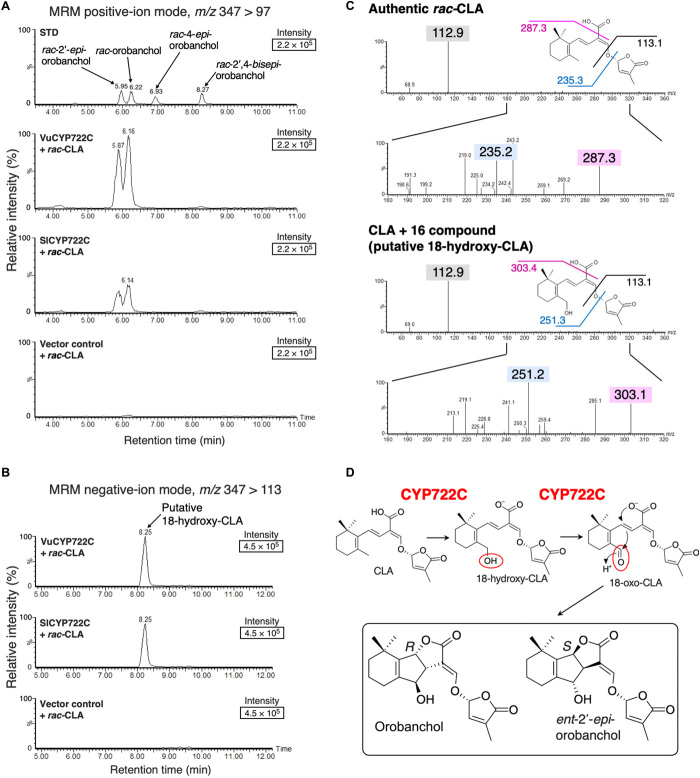
Strigolactones (SLs) are carotenoid-derived phytohormones and rhizosphere signaling molecules for arbuscular mycorrhizal fungi and root parasitic weeds. Why and how plants produce diverse SLs are unknown. Here, cytochrome P450 CYP722C is identified as a key enzyme that catalyzes the reaction of BC-ring closure leading to orobanchol, the most prevalent canonical SL. The direct conversion of carlactonoic acid to orobanchol without passing through 4-deoxyorobanchol is catalyzed by the recombinant enzyme. By knocking out the gene in tomato plants, orobanchol was undetectable in the root exudates, whereas the architecture of the knockout and wild-type plants was comparable. These findings add to our understanding of the function of the diverse SLs in plants and suggest the potential of these compounds to generate crops with greater resistance to infection by noxious root parasitic weeds.
独脚金内酯(SLs)是类胡萝卜素衍生的植物激素和根际信号分子,可被丛枝菌根真菌和根寄生杂草识别。植物产生不同 SLs 的原因和方式尚不清楚。在这里,细胞色素 P450 CYP722C 被鉴定为一种关键酶,可催化 BC 环闭合反应,生成最常见的典型 SL 独脚金醇。重组酶直接催化将 carlactonoic 酸转化为独脚金醇,而无需经过 4-脱氧独脚金醇。通过敲除番茄植物中的基因,在根分泌物中无法检测到独脚金醇,而敲除和野生型植物的结构是可比的。这些发现增加了我们对植物中不同 SLs 功能的理解,并表明这些化合物有可能产生对有害根寄生杂草感染具有更高抗性的作物。