Azibani Feriel, Pfeffer Tobias J, Ricke-Hoch Melanie, Dowling Wentzel, Pietzsch Stefan, Briton Olivia, Baard Johann, Abou Moulig Valeska, König Tobias, Berliner Dominik, Libhaber Elena, Schlothauer Stella, Anthony John, Lichtinghagen Ralf, Bauersachs Johann, Sliwa Karen, Hilfiker-Kleiner Denise
Hatter Institute for Cardiovascular Research in Africa, Department of Medicine, Faculty of Health Sciences, Groote Schuur Hospital, University of Cape Town, 1 Anzio Road, Bag X3 7935, bservatory, Cape Town, South Africa.
Department of Cardiology and Angiology, MHH, Hannover Medical School, Carl-Neuberg-Str. 1, D-30625, Hannover, Germany.
ESC Heart Fail. 2020 Apr;7(2):512-522. doi: 10.1002/ehf2.12553. Epub 2020 Feb 17.
This study aims to compare the clinical course of peripartum cardiomyopathy (PPCM) cohorts from Germany (G-PPCM) and South Africa (SA-PPCM) with fibrosis-related markers to get insights into novel pathomechanisms of PPCM.
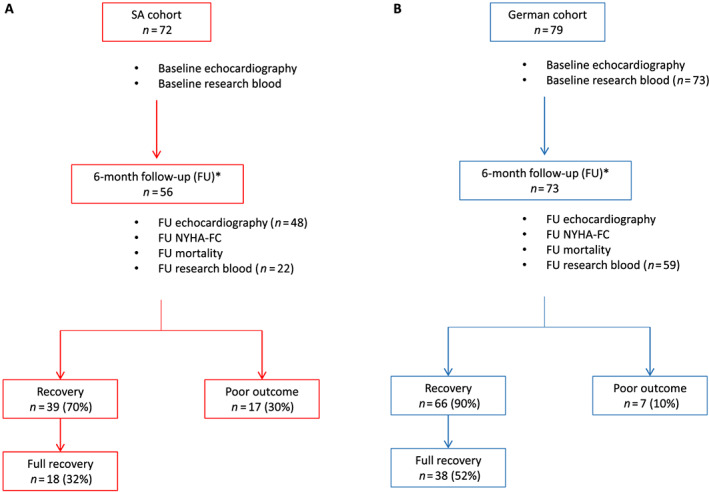
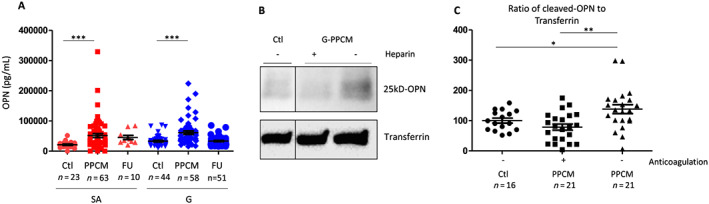
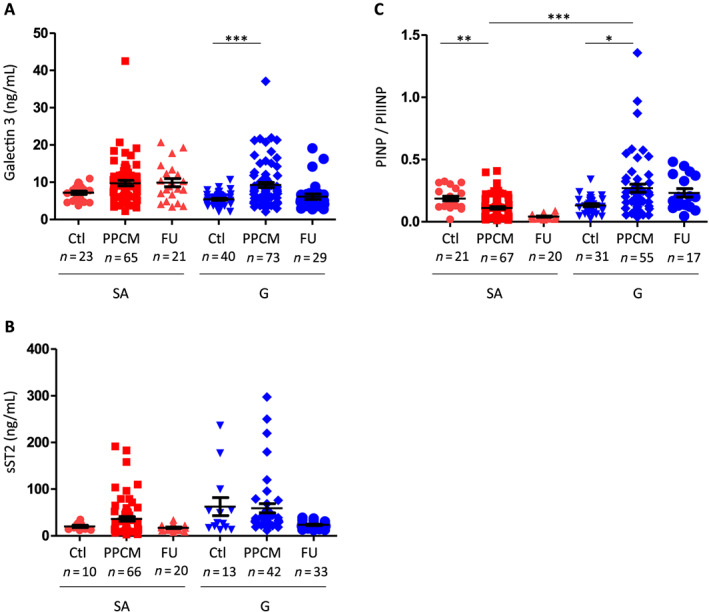
G-PPCM (n = 79) and SA-PPCM (n = 72) patients and healthy pregnancy-matched women from Germany (n = 56) and South Africa (n = 40) were enrolled. Circulating levels of procollagen type-I (PINP) and type-III (PIIINP) N-terminal propeptides, soluble ST2, galectin-3, and full-length and cleaved osteopontin (OPN) were measured at diagnosis (baseline) and 6 months of follow-up. Both cohorts received standard heart failure therapy while anticoagulation therapy was applied in 100% of G-PPCM but only in 7% of SA-PPCM patients. In G-PPCM patients, baseline left ventricular ejection fraction (LVEF) was lower, and outcome was better (baseline LVEF, 24 ± 8%, full recovery: 52%, mortality: 0%) compared with SA-PPCM patients (baseline LVEF: 30 ± 9%, full recovery: 32%, mortality: 11%; P < 0.05). At baseline, PINP/PIIINP ratio was lower in SA-PPCM and higher in G-PPCM compared with respective controls, whereas total OPN was elevated in both collectives. Cleaved OPN, which increases PIIINP levels, is generated by thrombin and was reduced in patients receiving anticoagulation therapy. High baseline galectin-3, soluble ST2, and OPN levels were associated with poor outcome in all PPCM patients.
SA-PPCM patients displayed a more profibrotic biomarker profile, which was associated with a less favourable outcome despite better cardiac function at baseline, compared with G-PPCM patients. Use of bromocriptine and anticoagulation therapy in G-PPCM may counteract fibrosis and may in part be responsible for their better outcome.
本研究旨在比较德国围产期心肌病(G-PPCM)队列和南非围产期心肌病(SA-PPCM)队列与纤维化相关标志物的临床病程,以深入了解围产期心肌病的新发病机制。
纳入G-PPCM患者(n = 79)、SA-PPCM患者(n = 72)以及来自德国(n = 56)和南非(n = 40)与妊娠匹配的健康女性。在诊断时(基线)和随访6个月时测量I型前胶原(PINP)和III型前胶原(PIIINP)N端前肽、可溶性ST2、半乳糖凝集素-3以及全长和裂解型骨桥蛋白(OPN)的循环水平。两个队列均接受标准心力衰竭治疗,100%的G-PPCM患者接受抗凝治疗,而SA-PPCM患者中仅7%接受抗凝治疗。与SA-PPCM患者相比,G-PPCM患者基线左心室射血分数(LVEF)较低,但预后较好(基线LVEF:24±8%,完全恢复:52%,死亡率:0%)(SA-PPCM患者基线LVEF:30±9%,完全恢复:32%,死亡率:11%;P<0.05)。基线时,与各自对照组相比,SA-PPCM中PINP/PIIINP比值较低,G-PPCM中该比值较高,而两个队列中总OPN均升高。由凝血酶产生的裂解型OPN可增加PIIINP水平,接受抗凝治疗的患者中其水平降低。所有围产期心肌病患者中,高基线半乳糖凝集素-3、可溶性ST2和OPN水平与不良预后相关。
与G-PPCM患者相比,SA-PPCM患者表现出更明显的纤维化生物标志物特征,尽管基线时心脏功能较好,但预后较差。G-PPCM中使用溴隐亭和抗凝治疗可能抵消纤维化,这可能部分解释了其较好的预后。