National Heart & Lung Institute, Imperial College London, United Kingdom (B.S.H., X.L., N.A.Q., I.M., R.A.C., Z.I.W., N.W.F.L., P.B.L., P.K., N.S.P., F.S.N.).
Department of Biomedical Engineering, George Washington University, Washington, DC (K.K.A., I.R.E.).
Circ Arrhythm Electrophysiol. 2020 Mar;13(3):e008237. doi: 10.1161/CIRCEP.119.008237. Epub 2020 Feb 16.
The mechanisms sustaining myocardial fibrillation remain disputed, partly due to a lack of mapping tools that can accurately identify the mechanism with low spatial resolution clinical recordings. Granger causality (GC) analysis, an econometric tool for quantifying causal relationships between complex time-series, was developed as a novel fibrillation mapping tool and adapted to low spatial resolution sequentially acquired data.
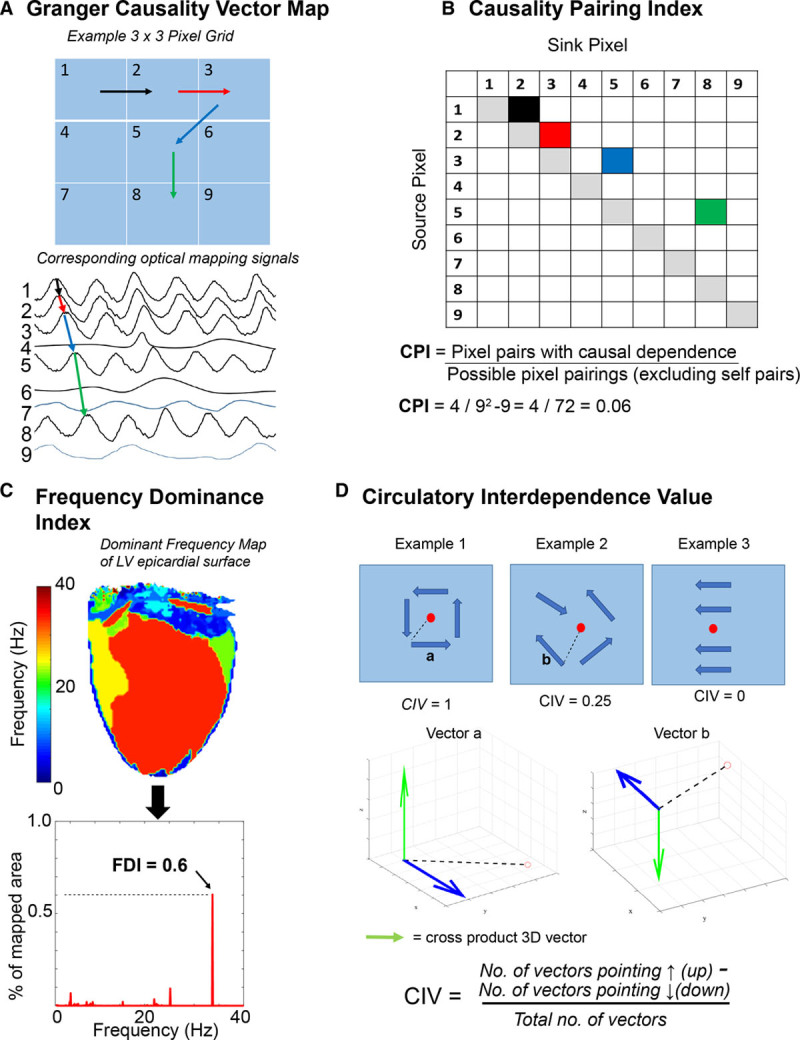
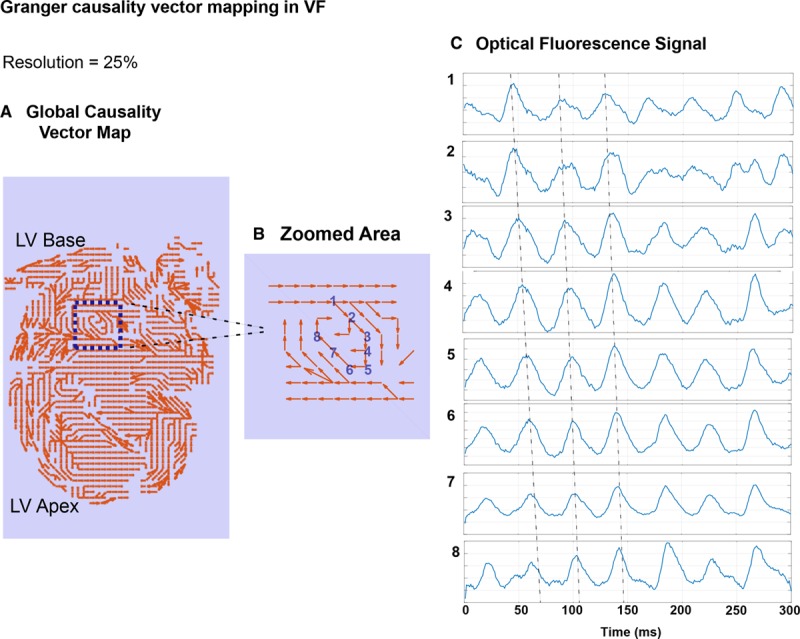
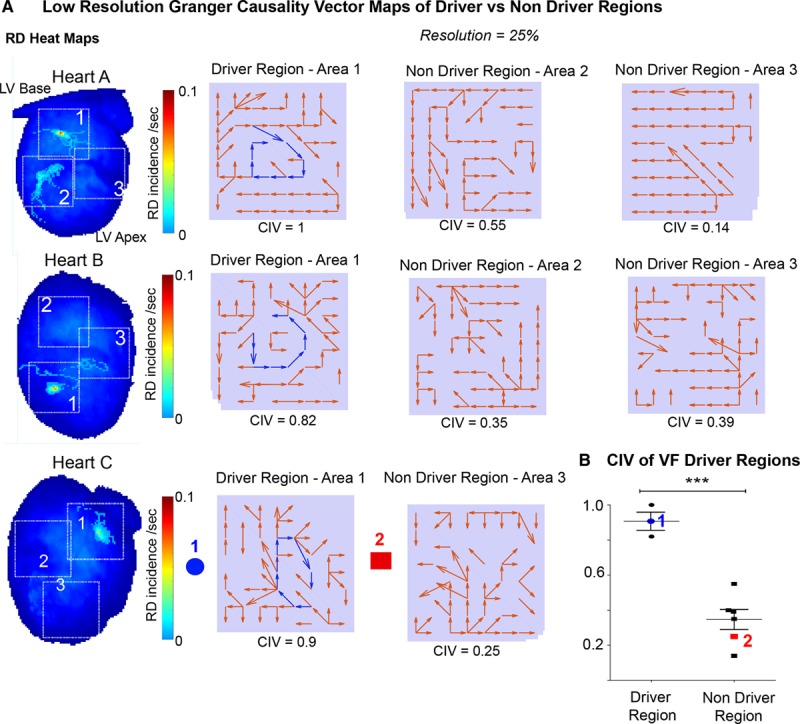
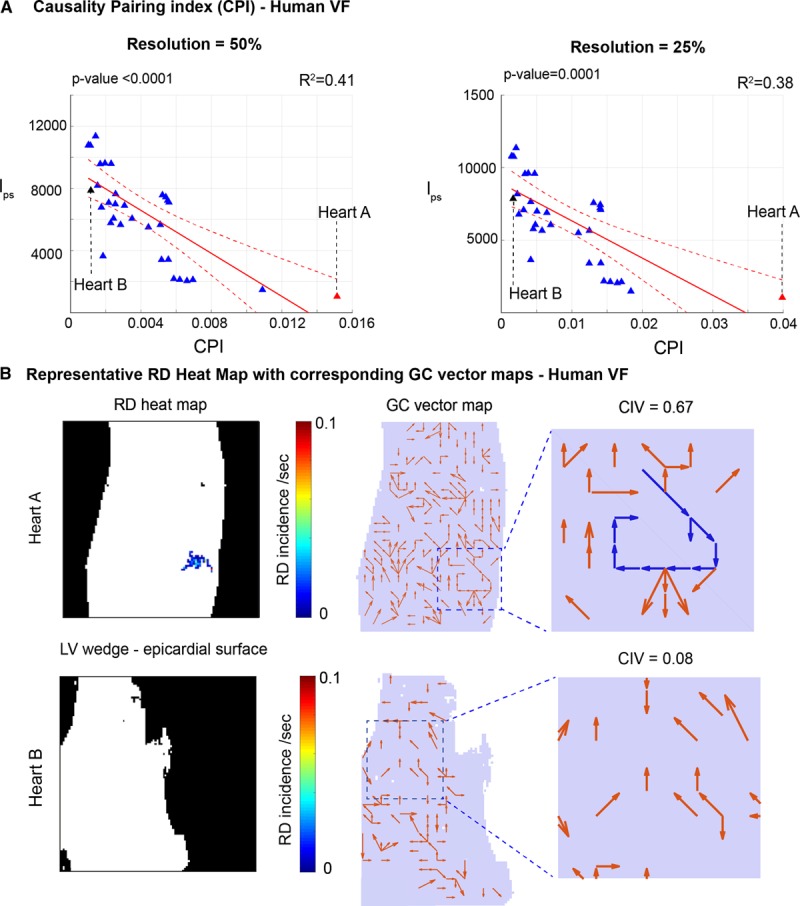
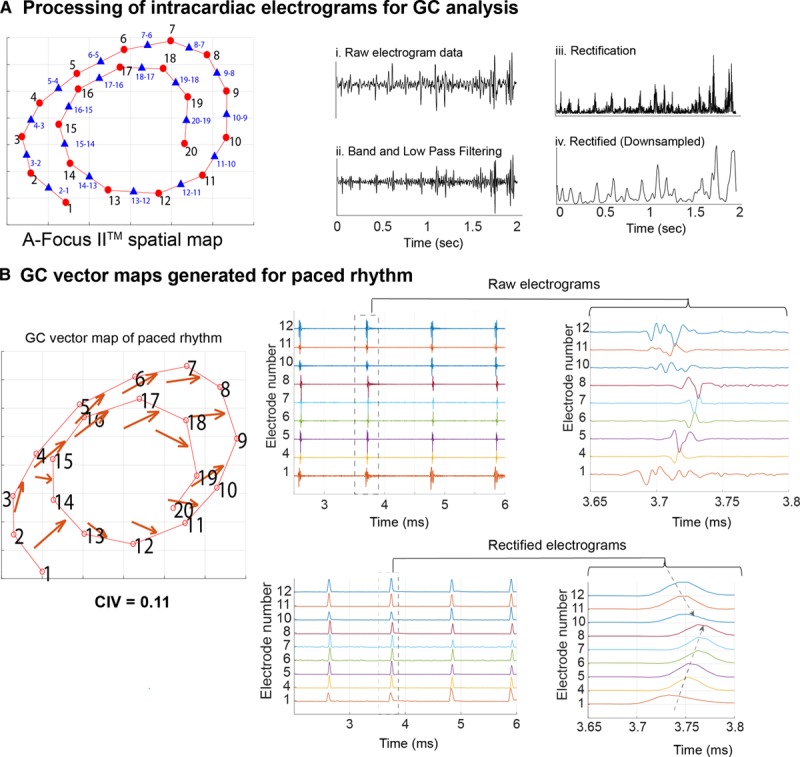
Ventricular fibrillation (VF) optical mapping was performed in Langendorff-perfused Sprague-Dawley rat hearts (n=18), where novel algorithms were developed using GC-based analysis to (1) quantify causal dependence of neighboring signals and plot GC vectors, (2) quantify global organization with the causality pairing index, a measure of neighboring causal signal pairs, and (3) localize rotational drivers (RDs) by quantifying the circular interdependence of neighboring signals with the circular interdependence value. GC-based mapping tools were optimized for low spatial resolution from downsampled optical mapping data, validated against high-resolution phase analysis and further tested in previous VF optical mapping recordings of coronary perfused donor heart left ventricular wedge preparations (n=12), and adapted for sequentially acquired intracardiac electrograms during human persistent atrial fibrillation mapping (n=16).
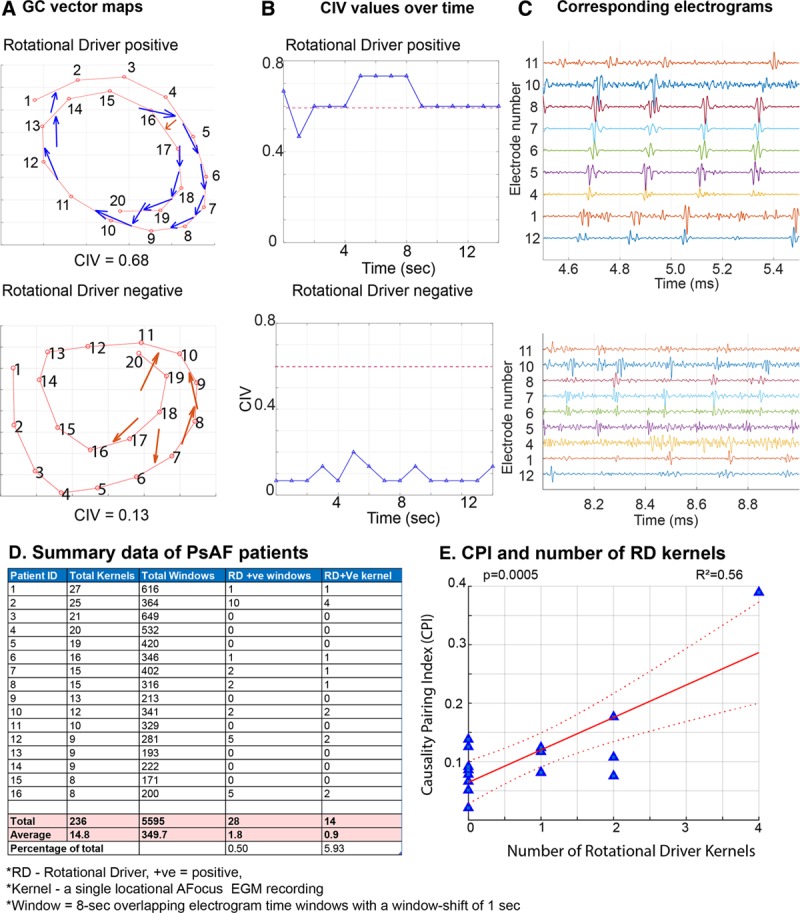
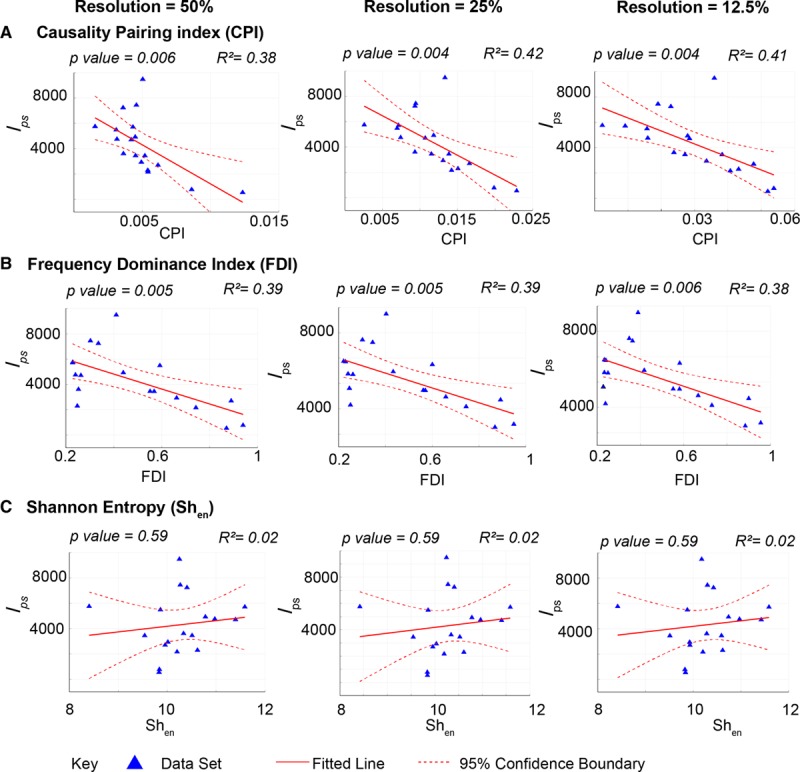
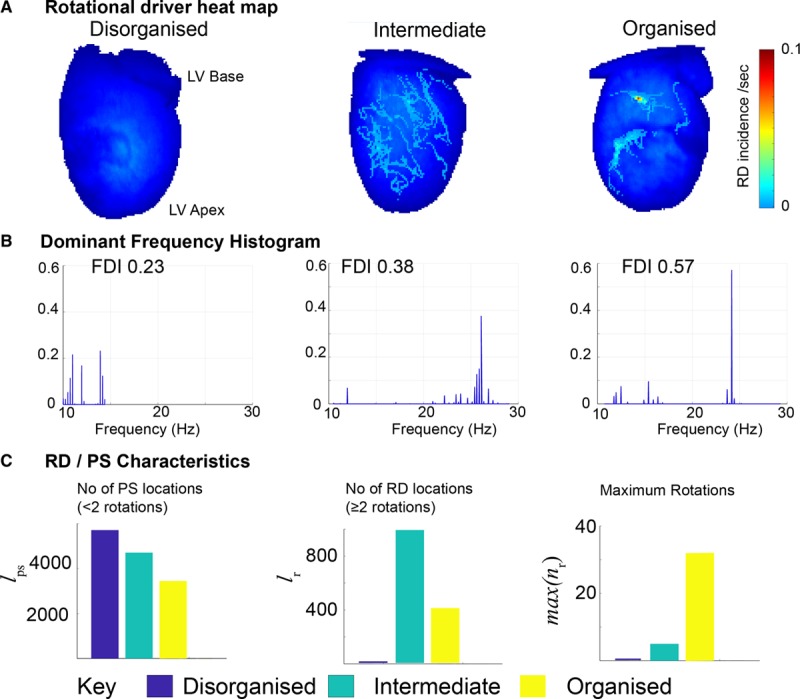
Global VF organization quantified by causality pairing index showed a negative correlation at progressively lower resolutions (50% resolution: =0.006, =0.38, 12.5% resolution, =0.004, =0.41) with a phase analysis derived measure of disorganization, locations occupied by phase singularities. In organized VF with high causality pairing index values, GC vector mapping characterized dominant propagating patterns and localized stable RDs, with the circular interdependence value showing a significant difference in driver versus nondriver regions (0.91±0.05 versus 0.35±0.06, =0.0002). These findings were further confirmed in human VF. In persistent atrial fibrillation, a positive correlation was found between the causality pairing index and presence of stable RDs (=0.0005,=0.56). Fifty percent of patients had RDs, with a low incidence of 0.9±0.3 RDs per patient.
GC-based fibrillation analysis can measure global fibrillation organization, characterize dominant propagating patterns, and map RDs using low spatial resolution sequentially acquired data.
维持心肌颤动的机制仍存在争议,部分原因是缺乏能够以低空间分辨率临床记录准确识别机制的映射工具。Granger 因果关系(GC)分析是一种用于量化复杂时间序列之间因果关系的计量经济学工具,它被开发为一种新型的颤动映射工具,并适用于低空间分辨率的顺序采集数据。
在 Langendorff 灌注的 Sprague-Dawley 大鼠心脏(n=18)中进行心室颤动(VF)光学映射,使用基于 GC 的分析开发了新算法,以(1)量化相邻信号的因果关系,绘制 GC 向量,(2)用因果关系配对指数量化全局组织,这是一种衡量相邻因果信号对的度量,以及(3)通过量化相邻信号的循环相互依存关系,用循环相互依存值量化旋转驱动(RD)。基于 GC 的映射工具针对低空间分辨率进行了优化,从下采样的光学映射数据中获得,与高分辨率相位分析进行了验证,并进一步在以前的冠状动脉灌注供体心脏左心室楔形制剂的 VF 光学映射记录中进行了测试(n=12),并适应了人类持续性心房颤动映射期间顺序采集的心内电图(n=16)。
用因果关系配对指数量化的全局 VF 组织在逐渐降低的分辨率下呈负相关(50%分辨率:=0.006,=0.38,12.5%分辨率,=0.004,=0.41),与相位分析得出的混乱度度量相位奇点的位置相关。在具有高因果关系配对指数值的有序 VF 中,GC 向量映射描述了主导传播模式并定位了稳定的 RD,而循环相互依存值在驱动区与非驱动区之间存在显著差异(0.91±0.05 与 0.35±0.06,=0.0002)。这些发现进一步在人类 VF 中得到了证实。在持续性心房颤动中,因果关系配对指数与稳定 RD 的存在之间存在正相关关系(=0.0005,=0.56)。有 50%的患者存在 RD,每个患者的 RD 发生率较低,为 0.9±0.3。
基于 GC 的颤动分析可以使用低空间分辨率顺序采集的数据测量全局颤动组织,描述主导传播模式,并映射 RD。