National Heart and Lung Institute, Imperial College London, United Kingdom (A. Sau, S.K., J.H., M.B.S., A.A., D.B.K., N.S.P., F.S.N.).
Department of Cardiology, Imperial College Healthcare NHS Trust, London, United Kingdom (A. Sau, J.H., A.A., N.S.P., F.S.N.).
Circ Arrhythm Electrophysiol. 2023 Sep;16(9):e011861. doi: 10.1161/CIRCEP.123.011861. Epub 2023 Aug 17.
Ablation for persistent atrial fibrillation (PsAF) has been performed for over 20 years, although success rates have remained modest. Several adjunctive lesion sets have been studied but none have become standard of practice. We sought to describe how the efficacy of ablation for PsAF has evolved in this time period with a focus on the effect of adjunctive ablation strategies.
Databases were searched for prospective studies of PsAF ablation. We performed meta-regression and trial sequential analysis.
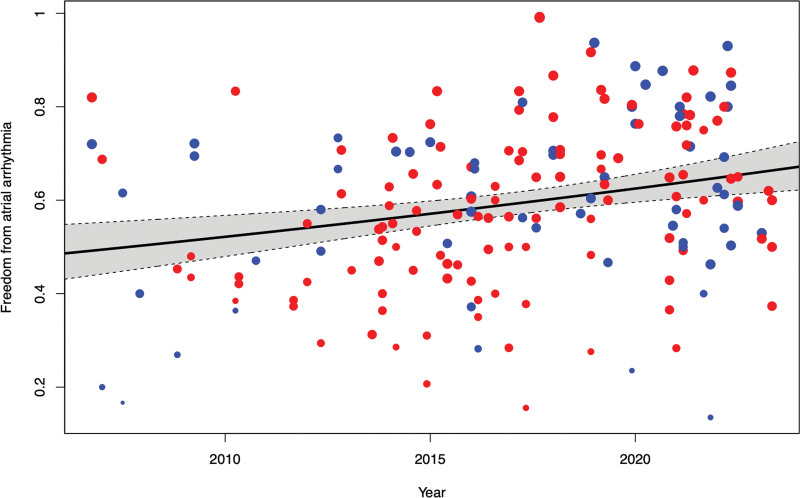
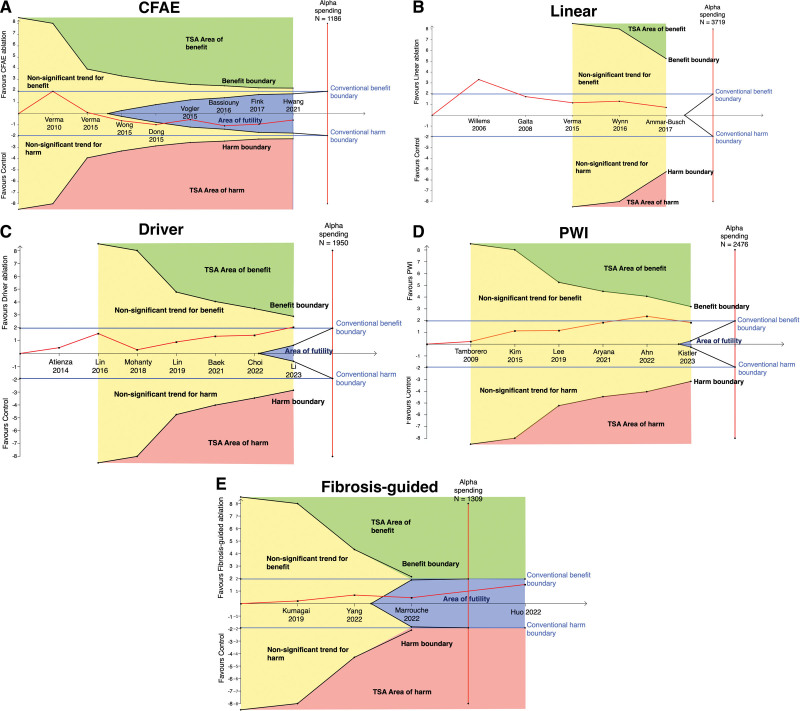
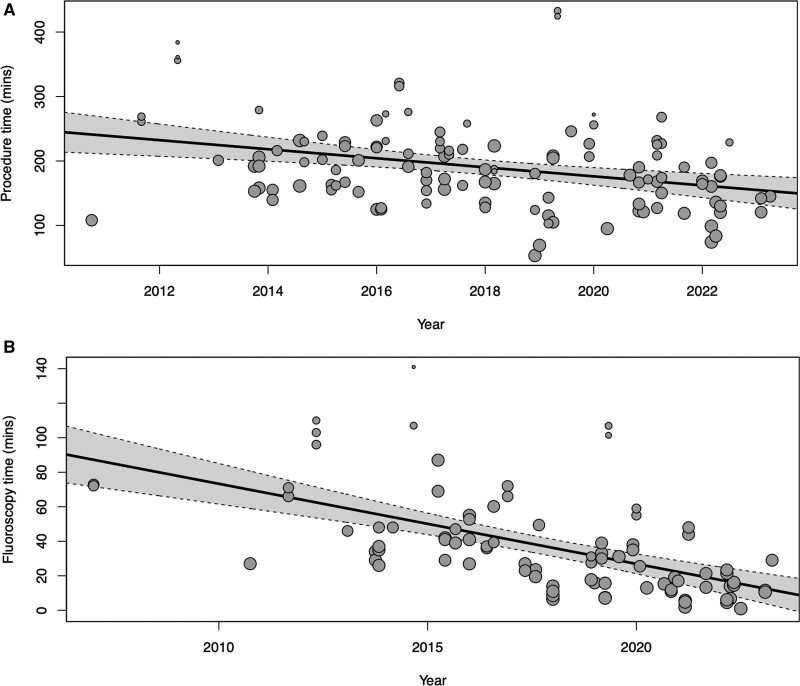
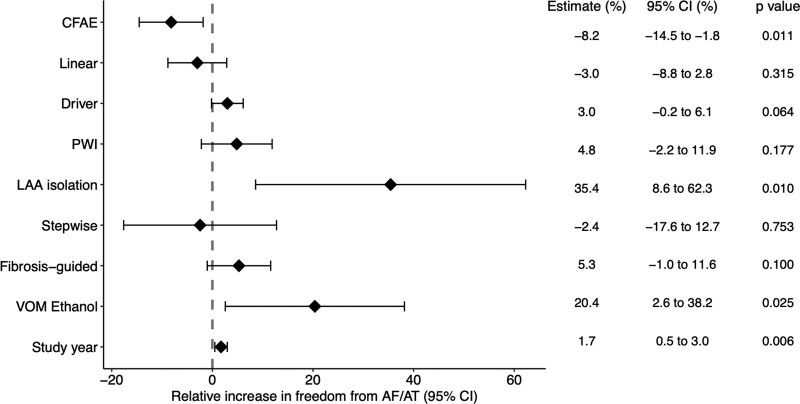
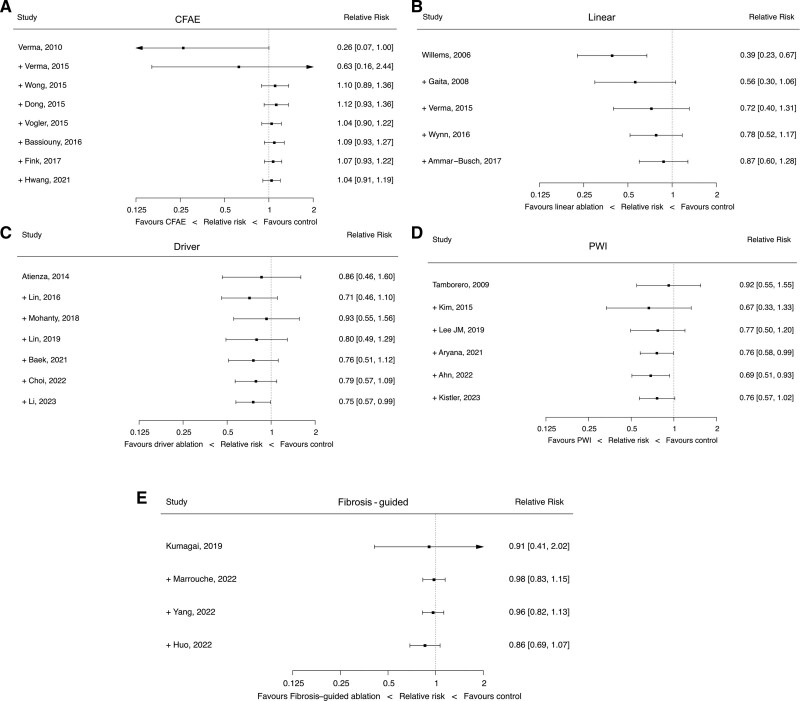
A total of 99 studies (15 424 patients) were included. Ablation for PsAF achieved the primary outcome (freedom of atrial fibrillation/atrial tachycardia rate at 12 months follow-up) in 48.2% (5% CI, 44.0-52.3). Meta-regression showed freedom from atrial arrhythmia at 12 months has improved over time, while procedure time and fluoroscopy time have significantly reduced. Through the use of cumulative meta-analyses and trial sequential analysis, we show that some ablation strategies may initially seem promising, but after several randomized controlled trials may be found to be ineffective. Trial sequential analysis showed that complex fractionated atrial electrogram ablation is ineffective and further study of this treatment would be futile, while posterior wall isolation currently does not have sufficient evidence for routine use in PsAF ablation.
Overall success rates from PsAF ablation and procedure/fluoroscopy times have improved over time. However, no adjunctive lesion set, in addition to pulmonary vein isolation, has been conclusively demonstrated to be beneficial. Through the use of trial sequential analysis, we highlight the importance of adequately powered randomized controlled trials, to avoid reaching premature conclusions, before widespread adoption of novel therapies.
持续性心房颤动(PsAF)的消融治疗已经开展了 20 多年,但成功率仍然不高。已经研究了几种辅助消融策略,但没有一种成为标准的治疗方法。我们旨在描述在此期间,消融治疗 PsAF 的疗效是如何演变的,重点关注辅助消融策略的效果。
检索了前瞻性研究 PsAF 消融治疗的数据库。我们进行了荟萃回归和试验序贯分析。
共纳入 99 项研究(15424 例患者)。消融治疗 PsAF 在 12 个月随访时达到主要结局(心房颤动/房性心动过速无复发率)的比例为 48.2%(95%CI,44.0-52.3)。荟萃回归显示,12 个月时的无房性心律失常率随着时间的推移而提高,而手术时间和透视时间显著减少。通过使用累积荟萃分析和试验序贯分析,我们表明一些消融策略最初可能看起来很有希望,但在进行了几项随机对照试验后,可能会发现它们无效。试验序贯分析表明,复杂碎裂心房电图消融无效,进一步研究该治疗方法将是无益的,而目前后壁隔离术在 PsAF 消融中没有足够的证据支持常规使用。
总体而言,PsAF 消融治疗的成功率和手术/透视时间随着时间的推移有所提高。然而,除了肺静脉隔离术之外,没有任何辅助消融策略被明确证明是有益的。通过使用试验序贯分析,我们强调了进行充分随机对照试验的重要性,以避免在广泛采用新疗法之前过早得出结论。