Institute of Orthopaedics and Musculoskeletal Science, University College London and the Royal National Orthopaedic Hospital, Brockley Hill, Stanmore, Middlesex, London, HA7 4LP, UK.
Department of Radiology and Nuclear Medicine, University Hospital Basel, Basel, Switzerland.
Skeletal Radiol. 2020 Aug;49(8):1221-1229. doi: 10.1007/s00256-020-03391-2. Epub 2020 Feb 17.
To evaluate changes in the knee joints of asymptomatic first-time marathon runners, using 3.0 T MRI, 6 months after finishing marathon training and run.
Six months after their participation in a baseline study regarding their knee joints, 44 asymptomatic novice marathoners (17 males, 27 females, mean age 46 years old) agreed to participate in a repeat MRI investigation: 37 completed both a standardized 4-month-long training programme and the marathon (marathon runners); and 7 dropped out during training (pre-race dropouts). The participants already underwent bilateral 3.0 T MRIs: 6 months before and 2 weeks after their first marathon, the London Marathon 2017. This study was a follow-up assessment of their knee joints. Each knee structure was assessed using validated scoring/grading systems at all time points.
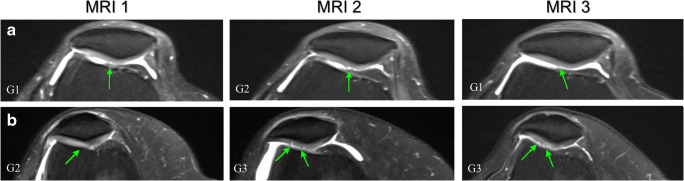
Two weeks after the marathon, 3 pre-marathon bone marrow lesions and 2 cartilage lesions showed decrease in radiological score on MRI, and the improvement was sustained at the 6-month follow-up. New improvements were observed on MRI at follow-up: 5 pre-existing bone marrow lesions and 3 cartilage lesions that remained unchanged immediately after the marathon reduced in their extent 6 months later. No further lesions appeared at follow-up, and the 2-week post-marathon lesions showed signs of reversibility: 10 of 18 bone marrow oedema-like signals and 3 of 21 cartilage lesions decreased on MRI.
The knees of novice runners achieved sustained improvement, for at least 6 months post-marathon, in the condition of their bone marrow and articular cartilage.
使用 3.0T MRI 评估首次参加马拉松训练和跑步后无症状新手马拉松运动员膝关节的变化。
44 名无症状的新手马拉松运动员(17 名男性,27 名女性,平均年龄 46 岁)在参加基线研究 6 个月后,同意进行重复 MRI 检查:37 人完成了标准化的 4 个月训练计划和马拉松(马拉松运动员);7 人在训练期间退出(赛前退出)。参与者已经接受了双侧 3.0T MRI 检查:2017 年伦敦马拉松前 6 个月和比赛后 2 周。这是对他们膝关节的后续评估。在所有时间点,使用经过验证的评分/分级系统评估每个膝关节结构。
马拉松后 2 周,3 个骨髓骨病变和 2 个软骨病变的影像学评分降低,6 个月时的改善仍持续存在。在随访时观察到新的改善:5 个先前存在的骨髓病变和 3 个软骨病变在马拉松后立即没有变化,6 个月后其范围缩小。在随访时没有出现进一步的病变,马拉松后 2 周的病变显示出逆转的迹象:18 个骨髓水肿样信号中的 10 个和 21 个软骨病变中的 3 个在 MRI 上减少。
新手跑步者的膝关节骨髓和关节软骨状况至少在马拉松后 6 个月内持续改善。