Chen Ji-Bin, Chen Dong, Xiao Ya-Ping, Chang Jian-Zhong, Li Te
Department of Orthopedics, Wuhan Hanyang Hospital, Wuhan University of Science and Technology, Wuhan, 430050, China.
Department of Orthopedic Surgery, CR & WISCO General Hospital, Wuhan University of Science and Technology, Wuhan, China.
BMC Musculoskelet Disord. 2020 Feb 17;21(1):108. doi: 10.1186/s12891-020-3130-y.
Arthroscopic closure release includes arthroscopic lateral patella retinaculum releasing (LPRR) either outside synovial membrane (OSM) or through synovial membrane (TSM). At present, there is no research to compare the clinical efficacy of the above two methods for the treatment of lateral patellar compression syndrome (LPCS). So, the goal of this study was to investigate the method and overcome of arthroscopic LPRR either OSM or TSM for the treatment of LPCS.
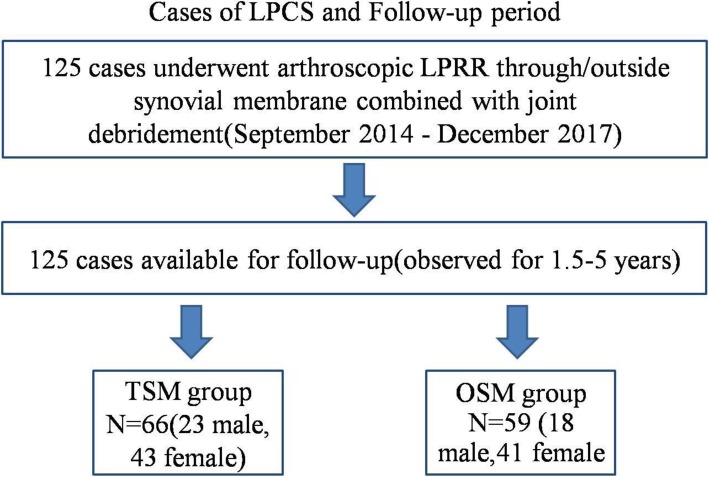
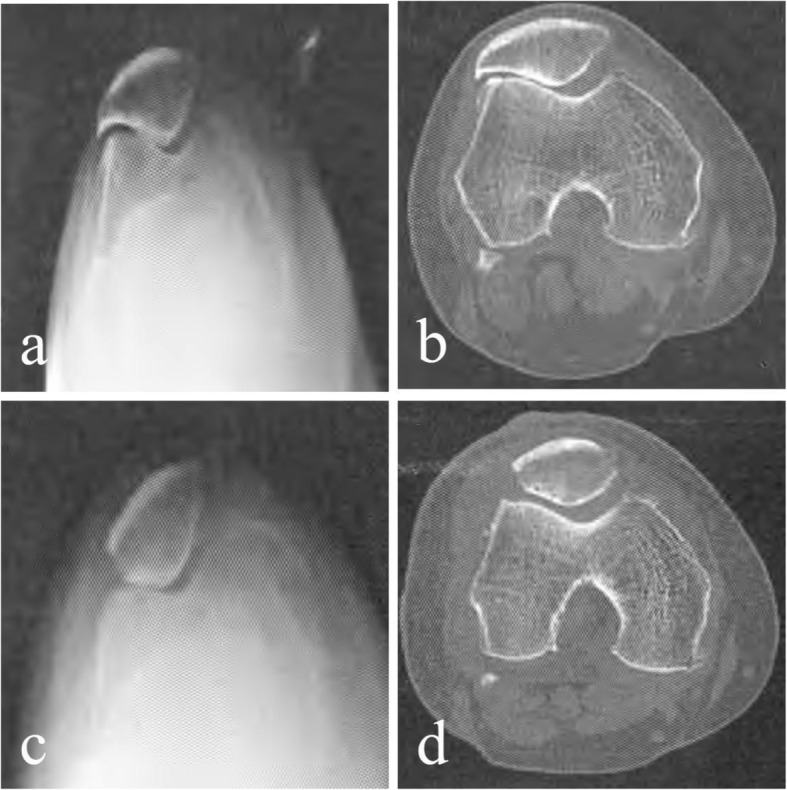
From September 2014 to December 2017, 125 patients of LPCS underwent arthroscopic LPRR either OSM or TSM combined with joint debridement. In the OSM group, knee joint was cleaned first. The surface of lateral patella retinaculum (LPR) was created the chamber for arthroscopic operation to release LPR. Synovial membrane was retained. In the TSM group, knee joint was cleaned first. Then synovial membrane, joint capsule and LPR, and superficial fascia were gradually incised from the joint cavity to subcutaneous tissue. The synovial membrane was cut open. Before and after surgery, Lysholm score, patella medial shift, Kujala score, VAS score and surgical complications were collected for evaluating clinical overcomes.
All patients were followed up for 1.5-5 years. All patients had significant reduction in knee pain and improved function after 1 month and 1 year. The Lysholm score, the distance of patella medial shift, Kujala score, and VAS score in the OSM group and the TSM group were significantly improved in the final follow-up compared with before surgery (All P < 0.001), but these observed targets before surgery and at the last follow-up were compared between the OSM group and the TSM group with no statistical differences. However, the number of occurrences of joint hematoma and adhesion was significantly higher in the TSM group than the OSM group (P = 0.024).
Arthroscopic closing LPRR for the treatment of LPCS can effectively improve the function and symptoms of patellofemoral joint with the advantages of small trauma, rapid recovery and less complications. But, the number of occurrences of hemarthrosis and joint adhesion were significantly higher in the TSM group than in the OSM group.
The trial registration number (IRCT): IRCT20200205046378N1 and date of registration: February 10, 2020 (retrospectively registered).
关节镜下闭合松解术包括在滑膜外(OSM)或经滑膜(TSM)进行关节镜下外侧髌支持带松解(LPRR)。目前,尚无研究比较上述两种方法治疗外侧髌股关节挤压综合征(LPCS)的临床疗效。因此,本研究的目的是探讨关节镜下OSM或TSM行LPRR治疗LPCS的方法及效果。
2014年9月至2017年12月,125例LPCS患者接受了关节镜下OSM或TSM行LPRR联合关节清理术。OSM组,首先清理膝关节。在外侧髌支持带(LPR)表面制造关节镜操作腔以松解LPR。保留滑膜。TSM组,首先清理膝关节。然后从关节腔至皮下组织逐步切开滑膜、关节囊、LPR及浅筋膜。切开滑膜。收集手术前后的Lysholm评分、髌骨内移、Kujala评分、视觉模拟评分(VAS)及手术并发症,以评估临床效果。
所有患者随访1.5 - 5年。所有患者在术后1个月和1年时膝关节疼痛均显著减轻,功能改善。最终随访时,OSM组和TSM组的Lysholm评分、髌骨内移距离、Kujala评分及VAS评分与术前相比均显著改善(均P < 0.001),但术前及末次随访时OSM组与TSM组的上述观察指标比较无统计学差异。然而,TSM组关节血肿及粘连的发生率显著高于OSM组(P = 0.024)。
关节镜下闭合LPRR治疗LPCS可有效改善髌股关节功能及症状,具有创伤小、恢复快、并发症少的优点。但是,TSM组关节积血及关节粘连的发生率显著高于OSM组。
试验注册号(IRCT):IRCT20200205046378N1,注册日期:2020年2月10日(回顾性注册)