Heeke Simon, Hofman Véronique, Ilié Marius, Allegra Maryline, Lespinet Virginie, Bordone Olivier, Benzaquen Jonathan, Boutros Jacques, Poudenx Michel, Lalvée Salomé, Tanga Virginie, Salacroup Carole, Bonnetaud Christelle, Marquette Charles-Hugo, Hofman Paul
Laboratory of Clinical and Experimental Pathology, Pasteur Hospital, Université Côte d'Azur, 30 Avenue de la Voie Romaine, 06000, Nice, France.
Hospital-related Biobank (BB-00033-0025), Pasteur Hospital, Université Côte d'Azur, 30 Avenue de la Voie Romaine, 06000, Nice, France.
J Transl Med. 2020 Feb 17;18(1):87. doi: 10.1186/s12967-020-02259-2.
NGS from plasma samples in non-squamous cell lung carcinoma (NSCC) can aid in the detection of actionable genomic alterations. However, the absolute clinical value of NGS in liquid biopsy (LB) made at baseline is currently uncertain. We assessed the impact of plasma-based NGS using an in-house test and an outsourced test in comparison to a routine molecular pathology workflow.
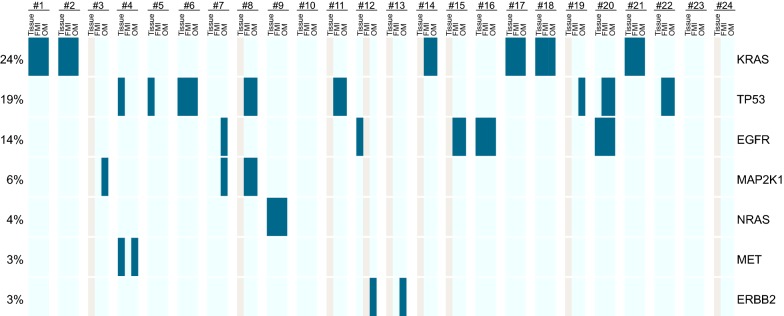
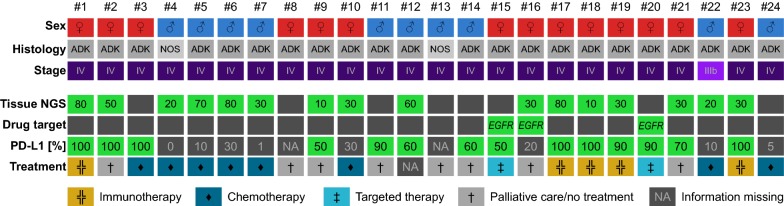
Twenty-four advanced/metastatic treatment-naïve NSCC patients were prospectively included. NGS analyses were conducted both in-house using the Oncomine cfTNA Panel and in an external testing center using the Foundation Liquid assay. NGS analysis and/or specific molecular based assays were conducted in parallel on tissue or cytological samples.
Both LB tests were well correlated. Tissue NGS results were obtained in 67% of patients and demonstrated good correlation with LB assays. Activating EGFR mutations were detected using LB tests in three patients. PD-L1 expression assessed in tissue sections enabled the initiation of pembrolizumab treatment in five patients.
NGS from LB is feasible in routine clinical practice using an in-house or an outsourced test at baseline. However, the impact on therapy selection was limited in this small series of patients and LB was not able to replace tissue-based testing in our hands.
对非鳞状细胞肺癌(NSCC)患者的血浆样本进行二代测序(NGS)有助于检测可指导治疗的基因组改变。然而,基线时进行的液体活检(LB)中NGS的绝对临床价值目前尚不确定。我们通过内部检测和外部检测评估了基于血浆的NGS与常规分子病理学工作流程相比的影响。
前瞻性纳入24例初治的晚期/转移性NSCC患者。使用Oncomine cfTNA Panel进行内部NGS分析,并在外部检测中心使用Foundation Liquid检测法进行检测。同时对组织或细胞学样本进行NGS分析和/或特定的基于分子的检测。
两种液体活检检测结果相关性良好。67%的患者获得了组织NGS结果,且与液体活检检测结果相关性良好。通过液体活检检测在3例患者中检测到了激活型EGFR突变。在组织切片中评估的PD-L1表达使得5例患者开始使用帕博利珠单抗治疗。
在基线时使用内部检测或外部检测,通过液体活检进行NGS在常规临床实践中是可行的。然而,在这一小部分患者中,对治疗选择的影响有限,且在我们的研究中液体活检无法替代基于组织的检测。