Section on Neurobiology of Fear and Anxiety, National Institute of Mental Health, National Institutes of Health Bethesda, Bethesda, MD, USA.
Center for Neuromodulation in Depression and Stress, Department of Psychiatry, University of Pennsylvania Philadelphia, Philadelphia, PA, USA.
Transl Psychiatry. 2020 Feb 17;10(1):68. doi: 10.1038/s41398-020-0751-8.
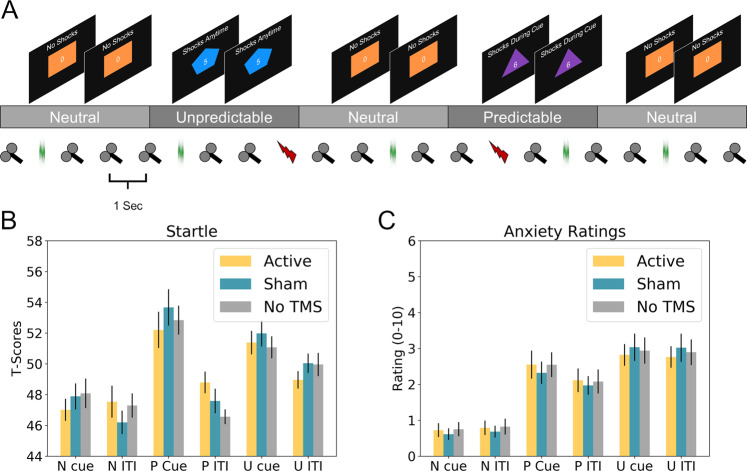
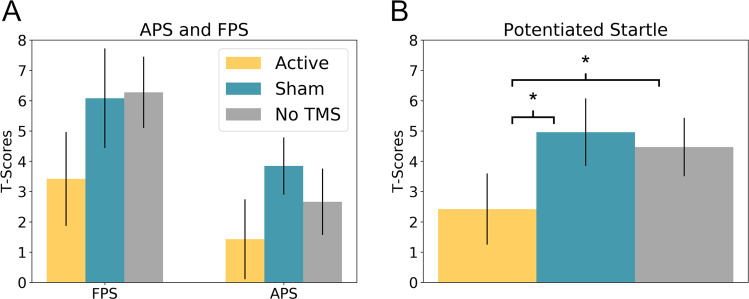
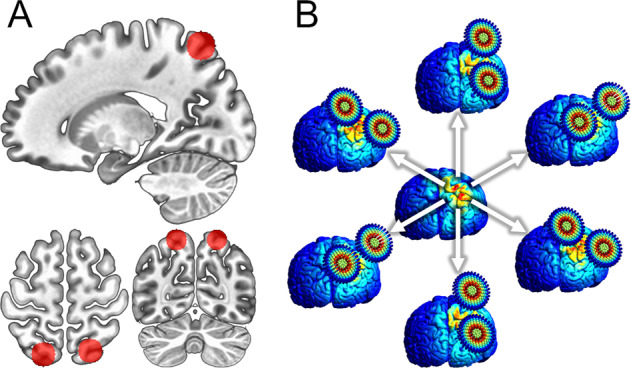
Anxiety disorders are the most prevalent mental disorders, with few effective neuropharmacological treatments, making treatments development critical. While noninvasive neuromodulation can successfully treat depression, few treatment targets have been identified specifically for anxiety disorders. Previously, we showed that shock threat increases excitability and connectivity of the intraparietal sulcus (IPS). Here we tested the hypothesis that inhibitory repetitive transcranial magnetic stimulation (rTMS) targeting this region would reduce induced anxiety. Subjects were exposed to neutral, predictable, and unpredictable shock threat, while receiving double-blinded, 1 Hz active or sham IPS rTMS. We used global brain connectivity and electric-field modelling to define the single-subject targets. We assessed subjective anxiety with online ratings and physiological arousal with the startle reflex. Startle stimuli (103 dB white noise) probed fear and anxiety during the predictable (fear-potentiated startle, FPS) and unpredictable (anxiety-potentiated startle, APS) conditions. Active rTMS reduced both FPS and APS relative to both the sham and no stimulation conditions. However, the online anxiety ratings showed no difference between the stimulation conditions. These results were not dependent on the laterality of the stimulation, or the subjects' perception of the stimulation (i.e. active vs. sham). Results suggest that reducing IPS excitability during shock threat is sufficient to reduce physiological arousal related to both fear and anxiety, and are consistent with our previous research showing hyperexcitability in this region during threat. By extension, these results suggest that 1 Hz parietal stimulation may be an effective treatment for clinical anxiety, warranting future work in anxiety patients.
焦虑障碍是最常见的精神障碍,目前有效的神经药理学治疗方法很少,因此开发治疗方法至关重要。虽然非侵入性神经调节可以成功治疗抑郁症,但针对焦虑障碍的治疗靶点很少。此前,我们发现冲击威胁会增加顶内沟(IPS)的兴奋性和连通性。在这里,我们假设针对该区域的抑制性重复经颅磁刺激(rTMS)会减少诱发的焦虑。受试者接受中性、可预测和不可预测的冲击威胁,同时接受双盲、1Hz 活性或假 IPS rTMS。我们使用全局脑连接和电场建模来定义单个受试者的目标。我们使用在线评分评估主观焦虑,使用惊跳反射评估生理唤醒。惊跳刺激(103dB 白噪声)在可预测(恐惧增强惊跳,FPS)和不可预测(焦虑增强惊跳,APS)条件下探测恐惧和焦虑。与假刺激和无刺激相比,活性 rTMS 降低了 FPS 和 APS。然而,在线焦虑评分在刺激条件之间没有差异。这些结果不依赖于刺激的偏侧性,也不依赖于受试者对刺激的感知(即活性与假刺激)。结果表明,在冲击威胁期间降低 IPS 兴奋性足以减少与恐惧和焦虑相关的生理唤醒,与我们之前的研究结果一致,即该区域在威胁期间存在过度兴奋。由此可见,1Hz 顶叶刺激可能是治疗临床焦虑的有效方法,值得在焦虑症患者中进一步研究。