Department of liver disease, Shanghai Public Health Clinical Center, Fudan University, Shanghai, China, 201508.
Department of Infectious Disease, Shanghai Public Health Clinical Center, Fudan University, Shanghai, China, 201508.
Sci Rep. 2020 Feb 17;10(1):2753. doi: 10.1038/s41598-020-59670-4.
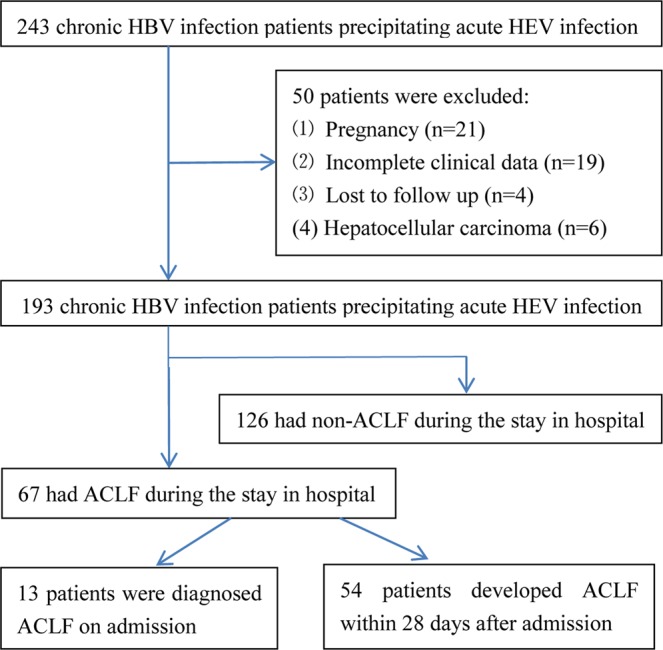
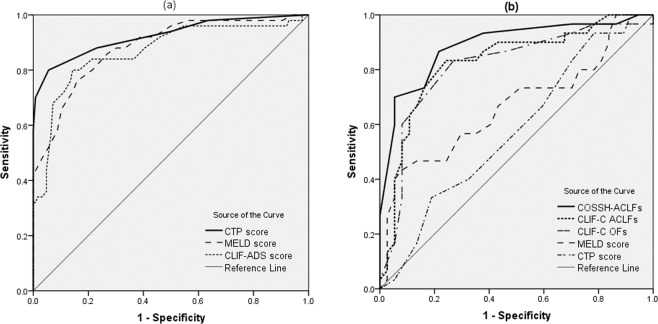
Hepatitis E virus (HEV) infection contributes to a considerable proportion of acute-on-chronic liver failure (ACLF) in patients with chronic hepatitis B virus (HBV) infection. This study aimed to predict the prognosis of chronic HBV infection patients precipitating acute HEV infection. A total of 193 patients were enrolled in this study. The performances of three chronic liver disease prognostic models (CTP score, MELD score, and CLIF-C ADs) were analyzed for predicting the development of ACLF following HEV superimposing chronic HBV infection. Subsequently, the performances of five ACLF prognostic assessment models (CTP score, MELD score, CLIF-C ACLFs, CLIF-C OFs, and COSSH-ACLFs) were analyzed for predicting the outcome of those ACLF patients. Of 193 chronic HBV infection patients precipitating acute HEV infection, 13 patients were diagnosed ACLF on admission, 54 patients developed to ACLF after admission, and 126 patients had non-ACLF during the stay in hospital. For predicting the development of ACLF, CTP score yielded a significantly higher AUROC compared with MELD score and CLIF-C ADs (0.92, 0.88, and 0.86, respectively; all p < 0.05). For predicting the poor prognosis of ACLF patients, the COSSH-ACLFs yielded a significantly higher AUROC compared with CLIF-C ACLFs, CLIF-C OFs, MELD score, and CTP score (0.89, 0.83, 0.81, 0.67, and 0.58, respectively; all p < 0.05). In conclusion, the stepwise application of CTP score and COSSH-ACLFs can predict the prognosis of chronic HBV infection patients precipitating acute HEV infection.
戊型肝炎病毒(HEV)感染是导致慢性乙型肝炎病毒(HBV)感染患者发生慢加急性肝衰竭(ACLF)的重要原因。本研究旨在预测慢性 HBV 感染患者合并急性 HEV 感染后发生 ACLF 的预后。共纳入 193 例患者。分析了三种慢性肝病预后模型(CTP 评分、MELD 评分和 CLIF-C ADs)在预测 HEV 叠加慢性 HBV 感染后发生 ACLF 的表现。随后,分析了五个 ACLF 预后评估模型(CTP 评分、MELD 评分、CLIF-C ACLFs、CLIF-C OFs 和 COSSH-ACLFs)在预测这些 ACLF 患者结局的表现。在 193 例慢性 HBV 感染患者合并急性 HEV 感染中,入院时诊断为 ACLF 的患者有 13 例,入院后发展为 ACLF 的患者有 54 例,住院期间非 ACLF 的患者有 126 例。在预测 ACLF 的发生方面,CTP 评分的 AUROC 显著高于 MELD 评分和 CLIF-C ADs(分别为 0.92、0.88 和 0.86;均 p<0.05)。在预测 ACLF 患者的不良预后方面,COSSH-ACLFs 的 AUROC 显著高于 CLIF-C ACLFs、CLIF-C OFs、MELD 评分和 CTP 评分(分别为 0.89、0.83、0.81、0.67 和 0.58;均 p<0.05)。总之,逐步应用 CTP 评分和 COSSH-ACLFs 可以预测慢性 HBV 感染患者合并急性 HEV 感染的预后。