Chalmers J, Wilkes E, Harris R, Kent L, Kinra S, Aithal G P, Holmes M, Johnson J, Morling J R, Guha I N
NIHR Nottingham Biomedical Research Centre, Nottingham University Hospitals NHS Trust and the University of Nottingham, UK.
Nottingham Digestive Diseases Centre, Nottingham, UK.
Frontline Gastroenterol. 2020 Feb 10;11(2):86-92. doi: 10.1136/flgastro-2019-101177. Epub 2019 Jun 26.
To describe the development of the Nottingham liver disease stratification pathway, present a 12-month evaluation of uptake, stratification results and compare the pathway to current British Society of Gastroenterology (BSG) guidelines.
A referral pathway between primary and secondary care for the detection and risk stratification of liver disease.
Four Nottinghamshire Clinical Commissioning Groups (700,000 population).
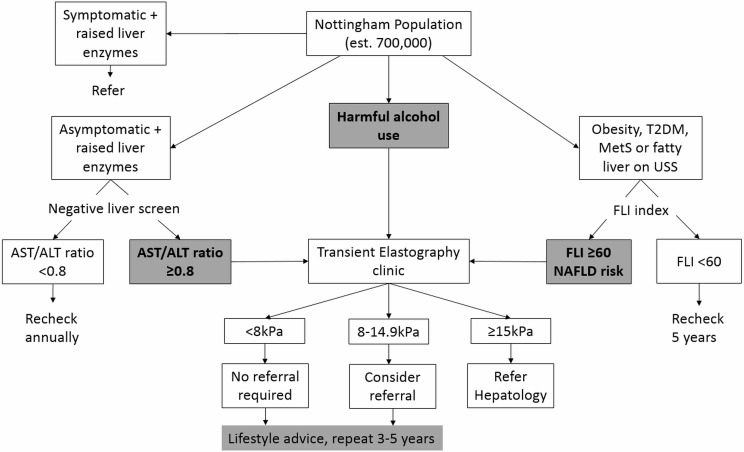
Patients are referred to the pathway with i) raised AST/ALT ratio ii) harmful alcohol use or iii) risk or presence of non-alcoholic fatty liver disease (NAFLD).
Clinic attendance within secondary care for transient elastography (TE) and brief lifestyle intervention. The TE result is reported back to the GP with advice on interpretation and referral guidance.
Pathway uptake, patient characteristics, liver disease stratification results and stakeholder feedback.
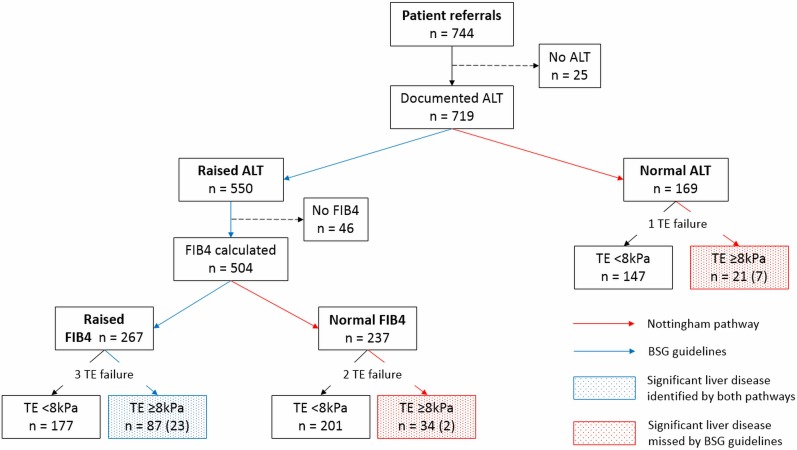
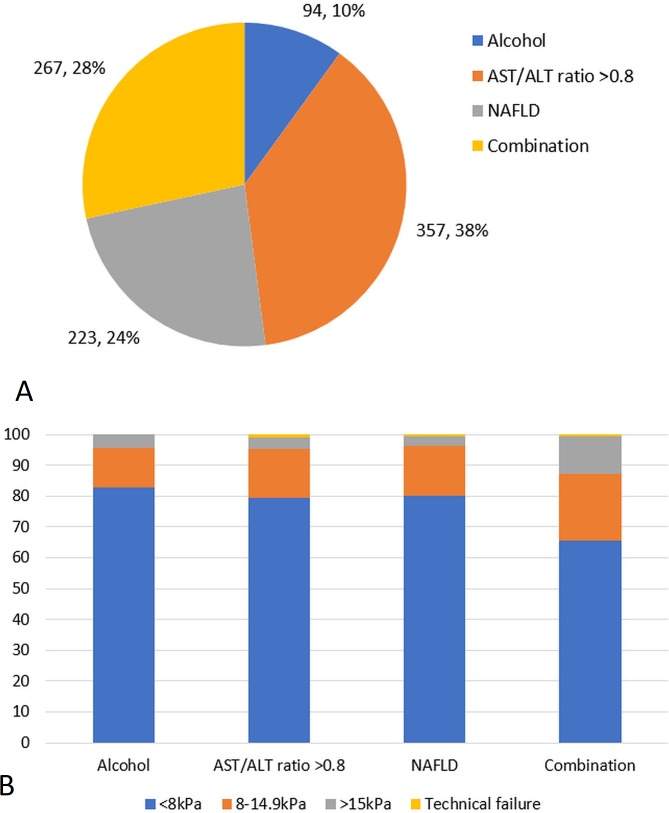
Over the first 12 months 968 patients attended a TE clinic appointment, with raised AST/ALT ratio being the most common single reason for referral (36.9%). Of the total, 222 (22.9%) patients had an elevated liver stiffness (≥8kPa) and in 60 (27.0%) liver stiffness was indicative of advanced chronic liver disease. If a traditional approach based on raised liver enzymes (BSG guidance) had been followed, 38.7% of those with significant liver disease (≥8kPa) would have gone undetected among those referred for either NAFLD or raised AST:ALT.
Targeting patients with risk factors for chronic liver disease and stratifying them using TE can detect significant chronic liver disease above and beyond the approach based on liver enzyme elevation.
描述诺丁汉肝病分层路径的发展情况,呈现对其应用情况、分层结果的12个月评估,并将该路径与英国胃肠病学会(BSG)现行指南进行比较。
初级和二级医疗保健机构之间用于肝病检测和风险分层的转诊路径。
四个诺丁汉郡临床委托小组(70万人口)。
因以下情况被转诊至该路径的患者:i)AST/ALT比值升高;ii)有害饮酒;iii)非酒精性脂肪性肝病(NAFLD)风险或存在NAFLD。
在二级医疗保健机构就诊进行瞬时弹性成像(TE)检查和简短的生活方式干预。TE结果会反馈给全科医生,并提供解读建议和转诊指导。
路径应用情况、患者特征、肝病分层结果及利益相关者反馈。
在最初的12个月里,968名患者参加了TE门诊预约,AST/ALT比值升高是最常见的单一转诊原因(36.9%)。其中,222名(22.9%)患者肝脏硬度升高(≥8kPa),60名(27.0%)患者的肝脏硬度表明存在晚期慢性肝病。如果遵循基于肝酶升高的传统方法(BSG指南),在因NAFLD或AST:ALT升高而转诊的患者中,38.7%患有严重肝病(≥8kPa)的患者将无法被检测出来。
针对有慢性肝病风险因素的患者,并使用TE对其进行分层,能够检测出基于肝酶升高方法之外的严重慢性肝病。