Nethander Maria, Pettersson-Kymmer Ulrika, Vandenput Liesbeth, Lorentzon Mattias, Karlsson Magnus, Mellström Dan, Ohlsson Claes
Centre for Bone and Arthritis Research, Department of Internal Medicine and Clinical Nutrition, Institute of Medicine, Sahlgrenska Academy, University of Gothenburg, Gothenburg, Sweden.
Bioinformatics Core Facility, Sahlgrenska Academy, University of Gothenburg, Gothenburg, Sweden.
J Clin Endocrinol Metab. 2020 Apr 1;105(4):e1344-57. doi: 10.1210/clinem/dgaa082.
It is important to identify patients at highest risk of fractures.
To compare the separate and combined performances of bone-related genetic risk scores (GRSs) for prediction of forearm, hip and vertebral fractures separately, as well as of trabecular and cortical bone microstructure parameters separately.
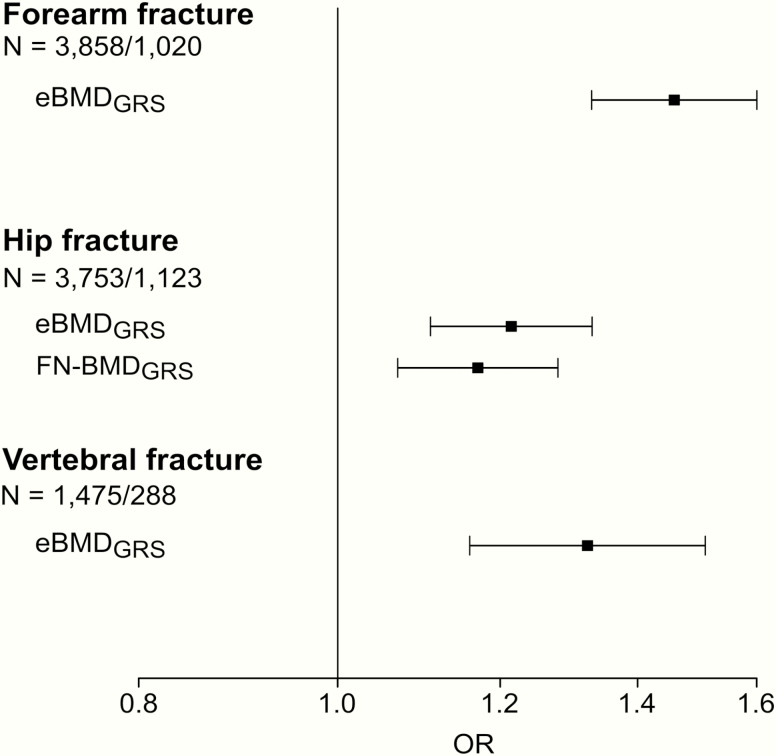
DESIGN, SETTING, AND PARTICIPANTS: Using 1103 single nucleotide polymorphisms (SNPs) independently associated with estimated bone mineral density of the heel (eBMD), we developed a weighted GRS for eBMD and determined its contribution to fracture prediction beyond 2 previously developed GRSs for femur neck BMD (49 SNPs) and lumbar spine BMD (48 SNPs). Associations between these GRSs and forearm (ncases = 1020; ncontrols = 2838), hip (ncases = 1123; ncontrols = 2630) and vertebral (ncases = 288; ncontrols = 1187) fractures were evaluated in 3 Swedish cohorts. Associations between the GRSs and trabecular and cortical bone microstructure parameters (n = 426) were evaluated in the MrOS Sweden cohort.
We found that eBMDGRS was the only significant independent predictor of forearm and vertebral fractures while both FN-BMDGRS and eBMDGRS were significant independent predictors of hip fractures. The eBMDGRS was the major GRS contributing to prediction of trabecular bone microstructure parameters while both FN-BMDGRS and eBMDGRS contributed information for prediction of cortical bone microstructure parameters.
The eBMDGRS independently predicts forearm and vertebral fractures while both FN-BMDGRS and eBMDGRS contribute independent information for prediction of hip fractures. We propose that eBMDGRS captures unique information about trabecular bone microstructure useful for prediction of forearm and vertebral fractures. These findings may facilitate personalized medicine to predict site-specific fractures as well as cortical and trabecular bone microstructure separately.
识别骨折风险最高的患者很重要。
比较骨相关遗传风险评分(GRS)分别预测前臂、髋部和椎体骨折以及分别预测小梁骨和皮质骨微结构参数的单独及联合性能。
设计、设置和参与者:利用与足跟估计骨密度(eBMD)独立相关的1103个单核苷酸多态性(SNP),我们开发了一种用于eBMD的加权GRS,并确定了其对骨折预测的贡献,超出了之前开发的两种用于股骨颈骨密度(49个SNP)和腰椎骨密度(48个SNP)的GRS。在3个瑞典队列中评估了这些GRS与前臂骨折(病例数=1020;对照数=2838)、髋部骨折(病例数=1123;对照数=2630)和椎体骨折(病例数=288;对照数=1187)之间的关联。在瑞典MrOS队列中评估了GRS与小梁骨和皮质骨微结构参数(n=426)之间的关联。
我们发现eBMDGRS是前臂和椎体骨折的唯一显著独立预测因子,而FN-BMDGRS和eBMDGRS都是髋部骨折的显著独立预测因子。eBMDGRS是预测小梁骨微结构参数的主要GRS,而FN-BMDGRS和eBMDGRS都为预测皮质骨微结构参数提供了信息。
eBMDGRS独立预测前臂和椎体骨折,而FN-BMDGRS和eBMDGRS都为预测髋部骨折提供独立信息。我们提出eBMDGRS捕获了有关小梁骨微结构的独特信息,有助于预测前臂和椎体骨折。这些发现可能有助于个性化医疗分别预测特定部位的骨折以及皮质骨和小梁骨的微结构。