Department of Paediatrics, University Hospital of Schleswig-Holstein, University of Lübeck, Ratzeburger Allee 160, D-23538, Lübeck, Germany.
Department of Neonatology, University of Cologne, Cologne, Germany.
Eur J Pediatr. 2020 Aug;179(8):1309-1313. doi: 10.1007/s00431-020-03572-0. Epub 2020 Feb 18.
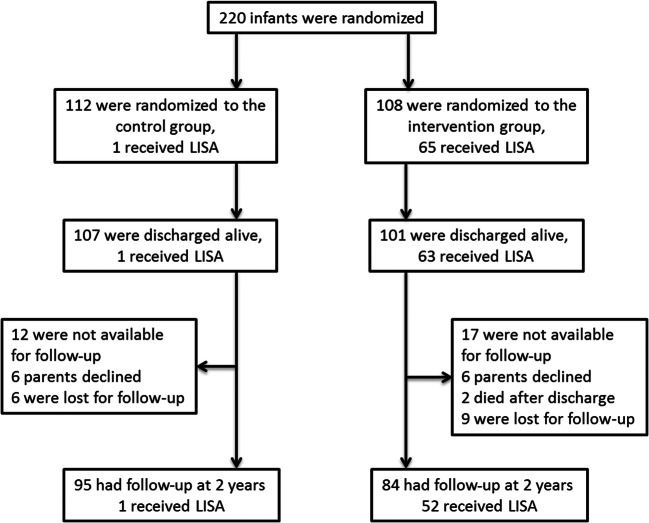
Less invasive surfactant administration (LISA) is a method to deliver surfactant to spontaneously breathing premature infants via a thin catheter. Here we report the two-year outcome from the AMV (avoid mechanical ventilation) study, the first randomized controlled trial on this mode of surfactant delivery. No statistically significant differences in weight, length or neurodevelopmental outcome (Bayley II scores) were found between the LISA intervention group (n = 95) and the control group (n = 84) that received standard treatment.Conclusion: No differences in outcome were observed at 2 years. LISA seems safe in that aspect. What is Known: • LISA is a method that is in increasing use for surfactant delivery to spontaneously breathing infants. LISA reduces the need for mechanical ventilation. What is New: • Outcome data at 2 years from the first randomized study with LISA raise no safety concerns in comparison to a group of infants that received standard treatment.
经鼻给予表面活性物质(LISA)是一种通过细导管将表面活性物质递送给自主呼吸早产儿的方法。在此,我们报告 AMV(避免机械通气)研究的两年结果,这是关于这种表面活性物质递送方式的首个随机对照试验。在 LISA 干预组(n=95)和接受标准治疗的对照组(n=84)之间,体重、身高或神经发育结局(贝利 II 评分)均无统计学显著差异。结论:2 年时观察到的结局无差异。在这方面,LISA 似乎是安全的。已知:•LISA 是一种越来越多地用于向自主呼吸婴儿递送表面活性物质的方法。LISA 减少了对机械通气的需求。新内容:•与接受标准治疗的一组婴儿相比,来自首例 LISA 随机研究的 2 年结局数据没有安全性问题。