Zheng Qiufan, Hong Shaodong, Huang Yan, Zhao Hongyun, Yang Yunpeng, Hou Xue, Zhao Yuanyuan, Ma Yuxiang, Zhou Ting, Zhang Yaxiong, Fang Wenfeng, Zhang Li
Department of Medical Oncology, State Key Laboratory of Oncology in South China, Collaborative Innovation Center for Cancer Medicine, Sun Yat-Sen University Cancer Center, Guangzhou, 510060, Guangdong, China.
Department of Clinical Research, State Key Laboratory of Oncology in South China, Collaborative Innovation Center for Cancer Medicine, Sun Yat-Sen University Cancer Center, Guangzhou, 510060, Guangdong, China.
Clin Transl Med. 2020 Feb 17;9(1):17. doi: 10.1186/s40169-020-0269-y.
Despite the impressive anti-tumor activity of osimertinib in epidermal growth factor receptor (EGFR) T790M-positive non-small cell lung cancer (NSCLC) patients, 30-40% of patients still show limited response. There is therefore a need to identify biomarkers that accurately predict the response to osimertinib therapy. In this study, 54 patients with targeted next-generation sequencing of circulating tumor DNA before osimertinib treatment and known T790M positivity were included. We investigated the predictive value of baseline circulating tumor DNA-derived biomarkers on osimertinib therapy.
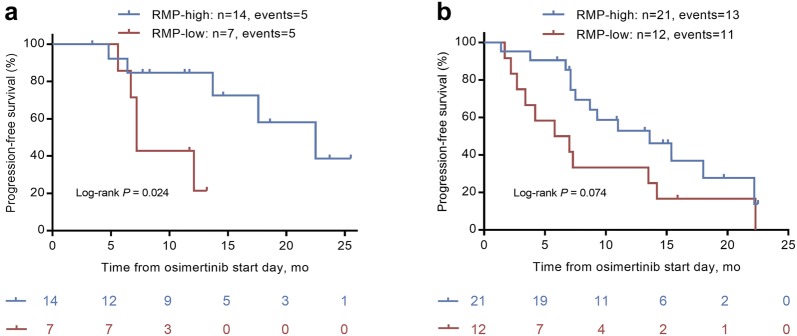
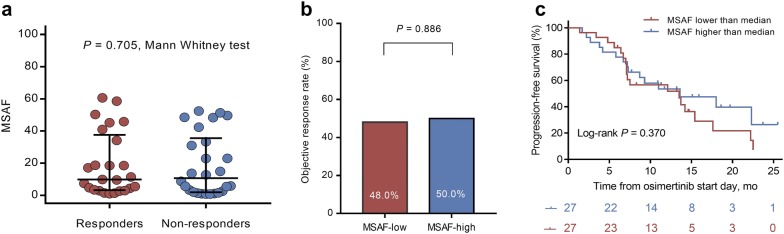
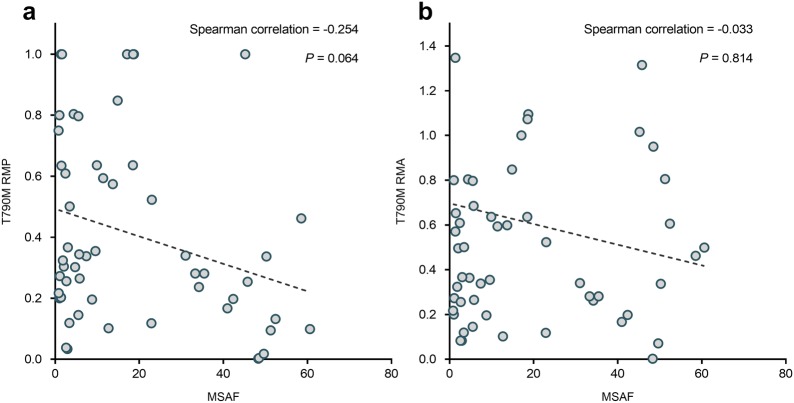
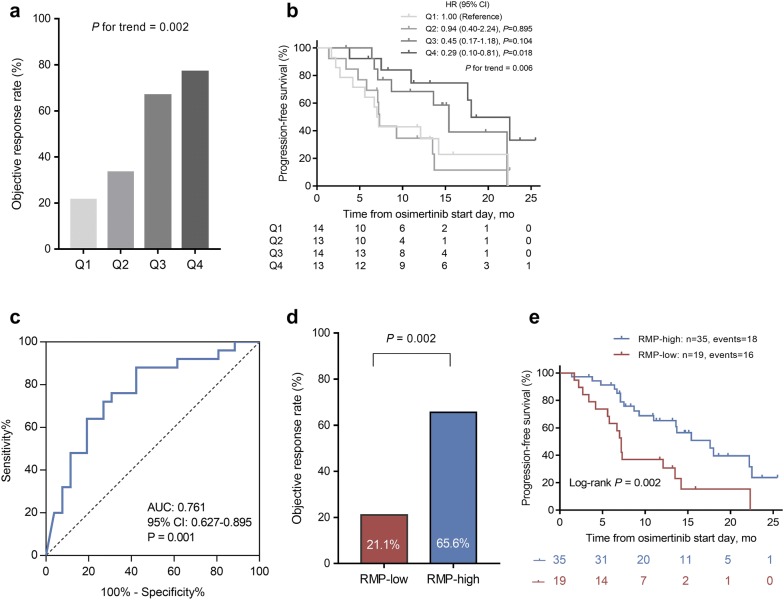
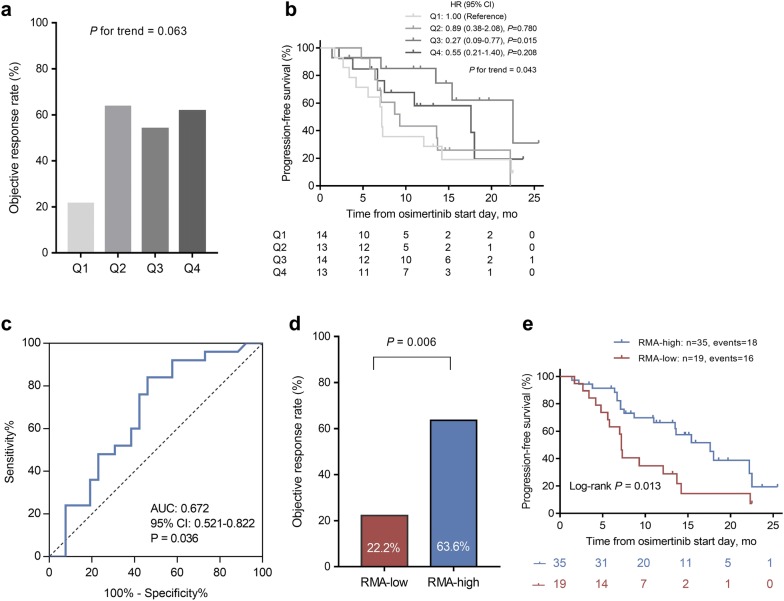
Baseline maximum somatic allele frequency (MSAF) level was not associated with objective response rate (ORR) (P = 0.886) and progression-free survival (PFS) (P = 0.370) of osimertinib treatment. T790M relative mutation purity (RMP, defined here as the ratio of T790M AF to MSAF) quartiles were found to be significantly associated with ORR (P for trend = 0.002) and PFS (P for trend = 0.006), and a cut off value of 0.24 identified two distinct prognostic groups [Hazard ratio (HR) = 0.36 for low T790M RMP, 95% confidence interval (CI) 0.18-0.72, P = 0.004). Additionally, although T790M relative mutation abundance (RMA, defined as T790M AF/EGFR driver AF) quartiles were not significantly associated with ORR (P for trend = 0.063), a cut off value of 0.30 also identified two distinct prognostic groups (HR = 0.43 for low T790M RMA, 95% CI 0.22-0.85, P = 0.015). However, in multivariate analysis, grouping of T790M RMP showed a better predictive value (HR = 0.46, 95% CI 0.20-1.05, P = 0.066) than T790M RMA (HR = 0.71, 95% CI 0.31-1.61, P = 0.409). Moreover, T790M RMP as continuous covariate was independently predictive of PFS (HR = 0.15, 95% CI 0.03-0.79, P =0.025), while T790M RMA was not (HR = 1.14, 95% CI 0.49-2.66, P =0.766). An external validation cohort further confirmed the T790M RMP was significantly associated with PFS of osimertinib therapy.
This study established the independent predictive role of T790M RMP in NSCLC patients receiving osimertinib treatment.
尽管奥希替尼在表皮生长因子受体(EGFR)T790M阳性的非小细胞肺癌(NSCLC)患者中具有令人瞩目的抗肿瘤活性,但仍有30%-40%的患者反应有限。因此,需要鉴定能够准确预测奥希替尼治疗反应的生物标志物。本研究纳入了54例在奥希替尼治疗前进行循环肿瘤DNA靶向二代测序且已知T790M阳性的患者。我们研究了基线循环肿瘤DNA衍生生物标志物对奥希替尼治疗的预测价值。
基线最大体细胞等位基因频率(MSAF)水平与奥希替尼治疗的客观缓解率(ORR)(P = 0.886)和无进展生存期(PFS)(P = 0.370)无关。发现T790M相对突变纯度(RMP,在此定义为T790M等位基因频率与MSAF的比值)四分位数与ORR(趋势P = 0.002)和PFS(趋势P = 0.006)显著相关,截断值0.24确定了两个不同的预后组[低T790M RMP的风险比(HR)= 0.36,95%置信区间(CI)0.18-0.72,P = 0.004]。此外,尽管T790M相对突变丰度(RMA,定义为T790M等位基因频率/EGFR驱动等位基因频率)四分位数与ORR无显著相关性(趋势P = 0.063),截断值0.30也确定了两个不同的预后组(低T790M RMA的HR = 0.43,95% CI 0.22-0.85,P = 0.015)。然而,在多变量分析中,T790M RMP分组显示出比T790M RMA更好的预测价值(HR = 0.46,95% CI 0.20-1.05,P = 0.066)(HR = 0.71,95% CI 0.31-1.61,P = 0.409)。此外,T790M RMP作为连续协变量可独立预测PFS(HR = 0.15,95% CI 0.03-0.79,P = 0.025),而T790M RMA则不能(HR = 1.14,95% CI 0.49-2.66,P = 0.766)。一个外部验证队列进一步证实T790M RMP与奥希替尼治疗的PFS显著相关。
本研究确立了T790M RMP在接受奥希替尼治疗的NSCLC患者中的独立预测作用。