Division of Pulmonary and Critical Care, Department of Internal Medicine, Saint Paul's Hospital, Taoyuan, Taiwan.
Department of Thoracic Medicine, Chang Gung Memorial Hospital, and College of Medicine, Chang Gung University, 199 Tun-Hwa North Road, Taipei, Taiwan.
BMC Pulm Med. 2020 Feb 18;20(1):45. doi: 10.1186/s12890-020-1080-7.
Bronchiectasis is a chronic infectious respiratory disease with diverse causes and ethnic or geographic differences. However, few large-scale studies of its etiology have been conducted in Asia. This study aimed to determine the etiology and clinical features of bronchiectasis in Taiwan.
This longitudinal cohort study investigated the etiology and clinical features of newly diagnosed non-cystic fibrosis bronchiectasis patients from January 2002 to December 2016. The clinical, functional and microbiological data of patients were retrieved from the Chang Gung Research Database, which includes seven medical facilities throughout Taiwan. The index date was the date of the first bronchiectasis diagnosis. Known diseases that were diagnosed before the index date were regarded as etiologies of bronchiectasis.
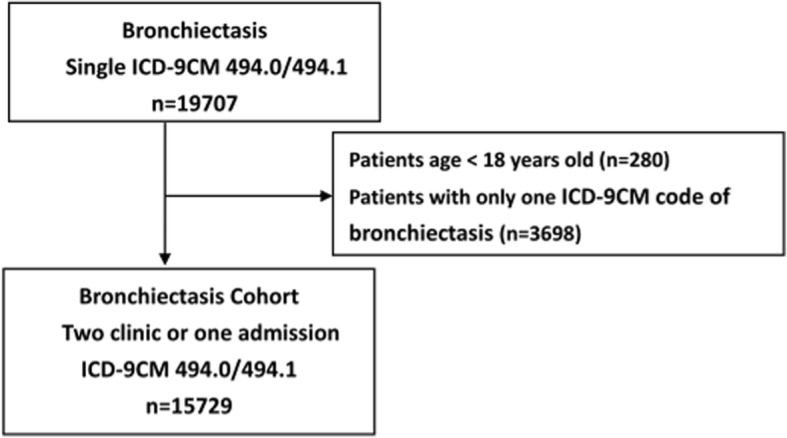
The cohort comprised 15,729 adult patients with bronchiectasis. Idiopathic (32%) was the most common cause, followed by post-pneumonia (24%). Other causes included post-tuberculosis (12%), chronic obstructive pulmonary disease (14%), asthma (10%), gastroesophageal reflux disease (2%) and rheumatic diseases (2%). At diagnosis, 8487 patients had sputum culture. Pseudomonas aeruginosa (5.3%) was the most common bacteria, followed by non-tuberculosis mycobacteria (3.6%), Haemophilus influenzae (3.4%) and Klebsiella pneumoniae (3.1%), but 6155 (72.1%) had negative sputum cultures. Patients with post-tuberculosis had a higher sputum isolation rate of non-tuberculosis mycobacteria than P. aeruginosa. Patients with post-tuberculosis and post-pneumonia bronchiectasis had a higher frequency of chronic lung infection than other groups (p < 0.05). Clinical characteristics, such as gender, lung function, comorbidities and microbiology, were significantly different between idiopathic and known etiologies.
Idiopathic, post-infection and tuberculosis constitute major bronchiectasis etiologies in Taiwan. Clinical characteristics and sputum microbiology were distinct among separate etiology phenotypes.
支气管扩张症是一种病因多样、具有种族或地域差异的慢性传染性呼吸系统疾病。然而,亚洲地区对其病因的大规模研究较少。本研究旨在确定台湾支气管扩张症的病因和临床特征。
本纵向队列研究调查了 2002 年 1 月至 2016 年 12 月期间新诊断的非囊性纤维化支气管扩张症患者的病因和临床特征。从涵盖台湾 7 家医疗设施的长庚研究数据库中检索患者的临床、功能和微生物学数据。索引日期为首次支气管扩张症诊断日期。索引日期之前诊断的已知疾病被视为支气管扩张症的病因。
该队列包括 15729 例成人支气管扩张症患者。特发性(32%)是最常见的病因,其次是肺炎后(24%)。其他病因包括肺结核后(12%)、慢性阻塞性肺疾病(14%)、哮喘(10%)、胃食管反流病(2%)和风湿性疾病(2%)。诊断时,8487 例患者进行了痰培养。铜绿假单胞菌(5.3%)是最常见的细菌,其次是非结核分枝杆菌(3.6%)、流感嗜血杆菌(3.4%)和肺炎克雷伯菌(3.1%),但 6155 例(72.1%)的痰培养结果为阴性。肺结核后患者的非结核分枝杆菌痰分离率高于铜绿假单胞菌。肺结核后和肺炎后支气管扩张症患者的慢性肺部感染频率高于其他组(p<0.05)。特发性和已知病因患者的临床特征(如性别、肺功能、合并症和微生物学)有显著差异。
特发性、感染后和结核是台湾支气管扩张症的主要病因。不同病因表型的临床特征和痰微生物学有显著差异。