Neurology, Virginia Commonwealth University, Richmond, Virginia, USA
Neurology, University of Virginia, Charlottesville, Virginia, USA.
BMJ Open. 2020 Feb 17;10(2):e034355. doi: 10.1136/bmjopen-2019-034355.
To examine the relationship between visit-to-visit systolic blood pressure (SBP) variability and patient-reported outcome measure of disability in multiple sclerosis (MS) patients.
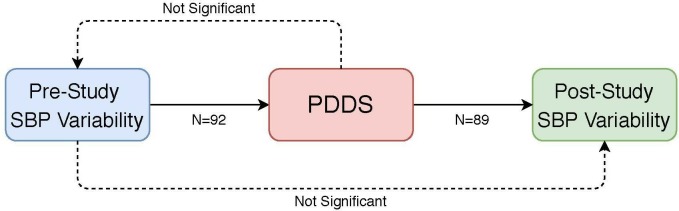
A retrospective cohort study of individuals with MS who completed a patient-determined disease steps (PDDS) scale between 2011 and 2015 at an MS specialty clinic.
Individuals with MS for whom both a completed PDDS scale and ≥3 SBP measures within the prior 12 months of the survey were available.
Participants were grouped into three classes of disability (no or mild (PDDS 0-1), moderate (2-3), severe (4-7)). SBP variability was calculated as within-subject SD using all SBP measures taken during the past 12 months. SBP variability was analysed by Tertile groups.
Ninety-two subjects were included in this analysis. Mean PDDS score was 2.22±1.89. Compared with subjects in Tertile 1 (lowest variability), the odds of being in a higher disability group was 3.5 times higher (OR=3.48; 95% CI: 1.08 to 11.25; p=0.037) in Tertile 2 and 5.2 times higher (OR=5.19; 95% CI: 1.53 to 17.61; p=0.008) in Tertile 3 (highest variability), independent of mean SBP, age, sex, race/ethnicity, body mass index and comorbidities (p for trend=0.008). Mean PDDS scores were 1.52±1.18 in Tertile 1, 2.73±1.02 in Tertile 2 and 2.42±0.89 in Tertile 3 after adjusting for the same covariates.
Our results show a significant gradient relationship between SBP variability and MS-related disability. More research is needed to determine the underlying pathophysiological relationship between SBP variability and MS disability progression.
探讨多发性硬化症(MS)患者的随访收缩压(SBP)变异性与患者报告的残疾测量结果之间的关系。
对 2011 年至 2015 年间在 MS 专科诊所完成患者确定疾病步骤(PDDS)量表的 MS 患者进行回顾性队列研究。
完成 PDDS 量表且在调查前 12 个月内有≥3 次 SBP 测量值的 MS 患者。
将参与者分为残疾程度三个等级(无或轻度(PDDS 0-1)、中度(2-3)、重度(4-7))。采用所有过去 12 个月内的 SBP 测量值的个体内标准差(SD)计算 SBP 变异性。使用三分位数组分析 SBP 变异性。
本分析共纳入 92 例患者。平均 PDDS 评分为 2.22±1.89。与三分位 1 组(最低变异性)相比,三分位 2 组(OR=3.48;95%CI:1.08 至 11.25;p=0.037)和三分位 3 组(OR=5.19;95%CI:1.53 至 17.61;p=0.008)的患者处于更高残疾等级的几率分别高 3.5 倍和 5.2 倍,而与平均 SBP、年龄、性别、种族/民族、体重指数和合并症无关(p 趋势=0.008)。调整相同协变量后,三分位 1、2 和 3 的平均 PDDS 评分分别为 1.52±1.18、2.73±1.02 和 2.42±0.89。
我们的结果表明 SBP 变异性与 MS 相关残疾之间存在显著的梯度关系。需要进一步研究以确定 SBP 变异性与 MS 残疾进展之间的潜在病理生理关系。