Lowe Ronald, Makowka Steven, Manzella Kevin, Warunek Stephen, Al-Jewair Thikriat
Dental Student, School of Dental Medicine, State University of New York at Buffalo, Buffalo, NY, USA.
Research Specialist, University at Buffalo, School of Dental Medicine, State University of New York at Buffalo, Buffalo, NY, USA.
J Clin Exp Dent. 2020 Feb 1;12(2):e154-e160. doi: 10.4317/jced.56579. eCollection 2020 Feb.
To determine the mechanical properties of the NiTi Memoria® Leaf Spring Activated Expander (NiTi MLSAE) in two forms, unaltered (unbent) and altered (bent) to mimic clinical use.
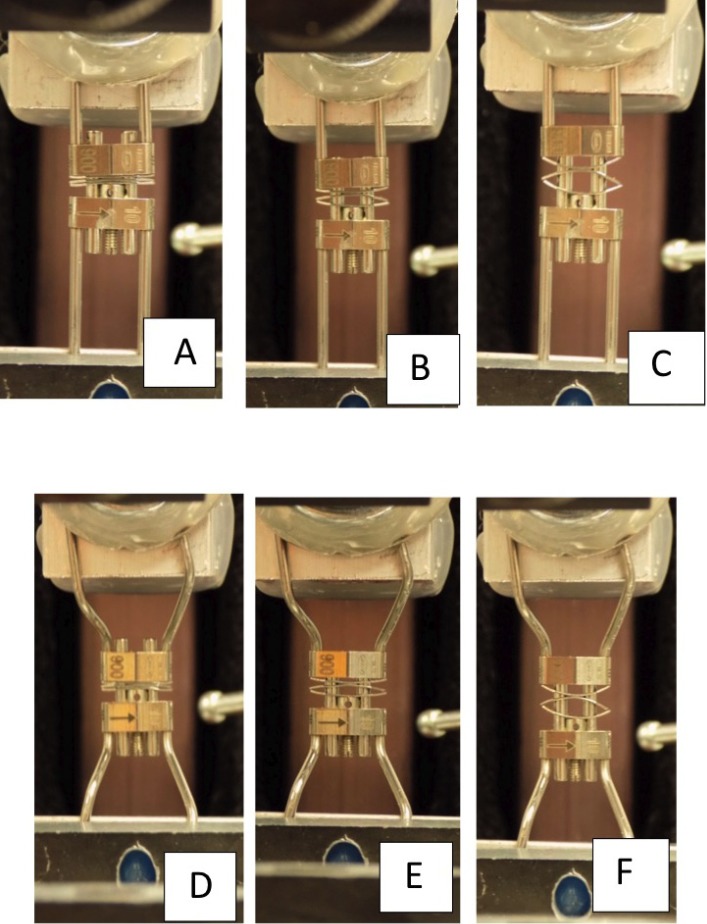
This pilot study was conducted using eight NiTi MLSAE expanders (American Tooth Industries, Oxnard, California) representing four force magnitudes: 10mm 500g, 10mm 900g, 6mm 450g and 6mm 900g models. Two experiments were performed: the first tested the expanders in their unbent form and the second tested them after they were bent by one experienced technician. All expanders were adapted to a standard three dimensional printed maxillary study model. A Dillion Quantrol 500N (110lbf) load cell and a custom-made fixturing apparatus was used to determine the amount of expansive forces delivered. Prior to testing, the ligation compressing the NiTi MLSAE leaves was cut to allow the appliances to expand to their original form. Emperor™ (force) Software was used to measure the expansion forces.
The average expansion forces generated by the expanders were: unaltered = 897.4g (8.8N) and bent = 877.0g (8.6N) for the 10mm 900g model, unaltered = 489.5g (4.8N) and bent = 479.3g (4.7N) for the 10mm 500g model, unaltered = 458.9g (4.5N) and bent = 438.5g (4.3N) for the 6mm 450g model, and unaltered = 805.6g (7.9N) and bent = 785.2g (7.7N) for the 6mm 900g model.
Regardless of whether the expander was straight or bent, the forces generated by the 10mm 900g, 10mm 500g and 6mm 450g Ni-Ti MLSAEs correlated with the benchmark study conducted by the manufacturer. However, the forces generated by the 6mm 900g Ni-Ti MLSAE were less than the data published by the manufacturer. Binding was observed when the expanders were manipulated to mimic clinical use, and this may account for the reported lower expansion force. Maxillary expansion, NiTi, posterior crossbite, malocclusion, maxillary transverse discrepancy.
确定两种形式的镍钛记忆合金叶片弹簧激活扩弓器(NiTi MLSAE)的力学性能,一种是未改变(未弯曲)的,另一种是为模拟临床使用而改变(弯曲)的。
本前瞻性研究使用了八个NiTi MLSAE扩弓器(美国牙齿工业公司,加利福尼亚州奥克斯纳德),代表四种力值:10mm 500g、10mm 900g、6mm 450g和6mm 900g型号。进行了两项实验:第一项实验测试未弯曲形式的扩弓器,第二项实验测试由一名经验丰富的技术人员弯曲后的扩弓器。所有扩弓器均适配于标准的三维打印上颌研究模型。使用Dillion Quantrol 500N(110lbf)测力传感器和定制的固定装置来确定所施加的扩张力大小。在测试前,切断压缩NiTi MLSAE叶片的结扎丝,以使矫治器能够扩张至其原始形状。使用Emperor™(力)软件来测量扩张力。
扩弓器产生的平均扩张力如下:对于10mm 900g型号,未改变的为897.4g(8.8N),弯曲后的为877.0g(8.6N);对于10mm 500g型号,未改变的为489.5g(4.8N),弯曲后的为479.3g(4.7N);对于6mm 450g型号,未改变的为458.9g(4.5N),弯曲后的为438.5g(4.);对于6mm 900g型号,未改变的为805.6g(7.9N),弯曲后的为785.2g(7.7N)。
无论扩弓器是直的还是弯曲的,10mm 900g、10mm 500g和6mm 450g的镍钛MLSAE产生的力与制造商进行的基准研究相关。然而,6mm 型号的镍钛MLSAE产生的力小于制造商公布的数据。当对扩弓器进行操作以模拟临床使用时观察到了束缚现象,这可能是所报道的扩张力较低的原因。上颌扩弓、镍钛合金、后牙反合、错牙合、上颌横向差异