Miyazaki Motoyasu, Matsuo Koichi, Uchiyama Masanobu, Nakamura Yoshihiko, Sakamoto Yuya, Misaki Momoko, Tokura Kaoko, Jimi Shiro, Okamura Keisuke, Adachi Sen, Yamamoto Tomohiko, Shirai Kazuyuki, Urata Hidenori, Imakyure Osamu
1Department of Pharmacy, Fukuoka University Chikushi Hospital, Fukuoka Japan; 1-1-1, Zokumyoin, Chikushino-shi, Fukuoka, 818-8502 Japan.
2Department of Emergency and Critical Care Medicine, Faculty of Medicine, Fukuoka University, Fukuoka, Japan; 7-45-1, Nanakuma, Jonan-ku, Fukuoka, 814-0180 Japan.
J Pharm Health Care Sci. 2020 Feb 11;6:2. doi: 10.1186/s40780-020-0157-z. eCollection 2020.
Inappropriate dosing of direct oral anticoagulants (DOACs) has been associated with clinical safety and efficacy; however, little is known about clinical data associated with an inappropriate DOAC dosing in Japan. In addition, there is no report in which the appropriateness of DOAC dosing between prescription for inpatients and for outpatients was examined. In this study, we aimed to investigate the prevalence and factors associated in the inappropriate dosing of DOACs in patients with atrial fibrillation (AF).
The retrospective cohort study was conducted at a single Japanese university hospital. Both inpatients and outpatients, who were diagnosed with AF and for whom treatment with either dabigatran, rivaroxaban, apixaban, or edoxaban was initiated between April 1, 2014 and March 31, 2018, were enrolled in the study. Appropriateness of DOAC dosing was assessed according to the manufacturer's labeling recommendations (dose reduction criteria) of each DOAC. Inappropriate reduced dose, namely, underdosing, was defined as prescription of a reduced dose of DOAC despite the patient not meeting the dose reduction criteria. Inappropriate standard dose, namely, overdosing, was defined as prescription of a standard dose of DOAC despite the patient meeting the dose reduction criteria. Inappropriate DOAC dosing was defined as a deviation of the recommended dose (both underdosing and overdosing).
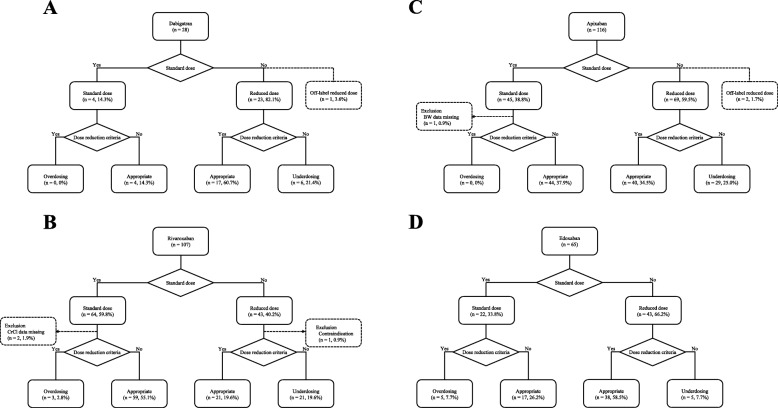
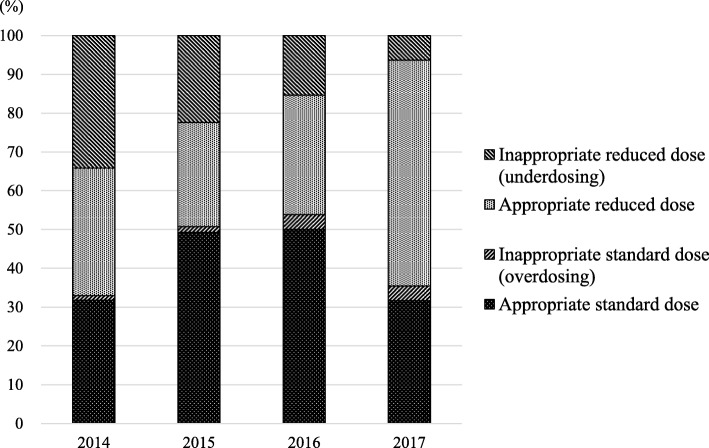
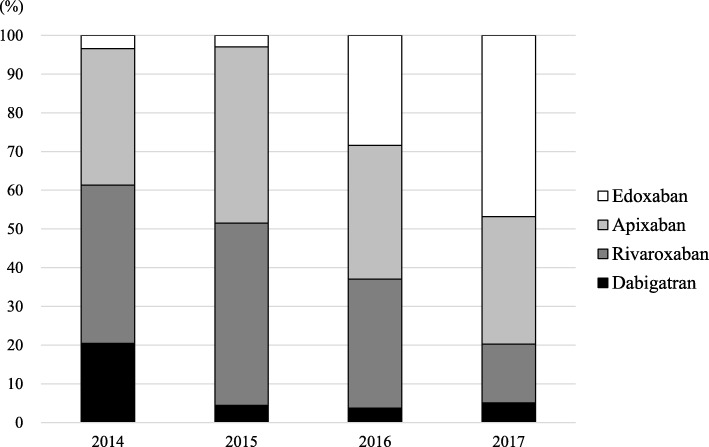
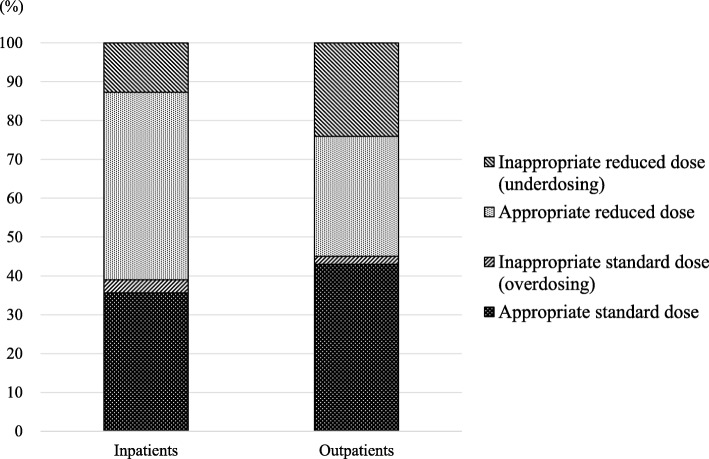
A total of 316 patients (dabigatran, 28; rivaroxaban, 107; apixaban, 116; and edoxaban, 65) were included, with a median (interquartile range) age of 75 (66-81) years and 62.3% male. DOACs were prescribed at an appropriate standard dose in 39.2% of patients, an appropriate reduced dose in 36.7%, an inappropriate standard dose in 2.5%, and an inappropriate reduced dose in 19.3%. Multivariate analysis revealed that the inappropriate dosing of DOACs was significantly associated with prescriptions for outpatients (vs. inpatients; odds ratio [OR] 2.87, 95% confidence interval [CI] 1.53-5.62, < 0.001) and those with higher HAS-BLED scores (OR 1.87, 95% CI 1.42-2.51, p < 0.001).
Our results demonstrated that the inappropriate dosing of DOACs occurred in approximately 20% of AF patients, and was more frequent in outpatients (vs. inpatients) and in those with a higher risk of bleeding. It is recommended that pharmacists play a greater role in assisting in the prescription process to help physicians make better decisions.
直接口服抗凝剂(DOACs)的剂量不当与临床安全性和有效性相关;然而,在日本,关于DOAC剂量不当的临床数据知之甚少。此外,尚无研究报告对住院患者和门诊患者DOAC处方剂量的合理性进行比较。在本研究中,我们旨在调查房颤(AF)患者中DOAC剂量不当的发生率及其相关因素。
本研究为一项在日本某大学医院开展的回顾性队列研究。纳入2014年4月1日至2018年3月31日期间被诊断为房颤且开始接受达比加群、利伐沙班、阿哌沙班或依度沙班治疗的住院患者和门诊患者。根据各DOAC制造商的标签推荐(剂量降低标准)评估DOAC剂量的合理性。不当降低剂量,即剂量不足,定义为患者不符合剂量降低标准但仍开具了降低剂量的DOAC。不当标准剂量,即剂量过量,定义为患者符合剂量降低标准但仍开具了标准剂量的DOAC。不当DOAC剂量定义为推荐剂量的偏差(包括剂量不足和剂量过量)。
共纳入316例患者(达比加群28例、利伐沙班107例、阿哌沙班116例、依度沙班65例),中位年龄(四分位间距)为75(66 - 81)岁,男性占62.3%。39.2%的患者DOAC处方剂量为适当标准剂量,36.7%为适当降低剂量,2.5%为不当标准剂量,19.3%为不当降低剂量。多因素分析显示,DOAC剂量不当与门诊患者处方(相对于住院患者;比值比[OR] 2.87,95%置信区间[CI] 1.53 - 5.62,P < 0.001)以及HAS - BLED评分较高的患者(OR 1.87,95% CI 1.42 - 2.51,P < 0.001)显著相关。
我们的研究结果表明,约20%的房颤患者存在DOAC剂量不当的情况,在门诊患者(相对于住院患者)以及出血风险较高的患者中更为常见。建议药剂师在协助处方过程中发挥更大作用,以帮助医生做出更好的决策。