Cleveland Lauren P, Seward Michael W, Simon Denise, Rifas-Shiman Sheryl L, Lewis Kristina H, Bennett-Rizzo Carin, Halperin Florencia, McManus Katherine D, Block Jason P
Division of Chronic Disease Research Across the Lifecourse (CoRAL), Department of Population Medicine, Harvard Pilgrim Health Care Institute, Harvard Medical School, Boston, MA, United States.
Division of Public Health Sciences, Wake Forest University School of Medicine, Winston-Salem, NC, United States.
Prev Med Rep. 2020 Jan 25;17:101061. doi: 10.1016/j.pmedr.2020.101061. eCollection 2020 Mar.
Deposit contracts, where participants "bet" on achieving a goal and get their money back only if successful, have been shown to be effective for short-term weight-loss. This pilot study examined their effect on weight-loss maintenance.
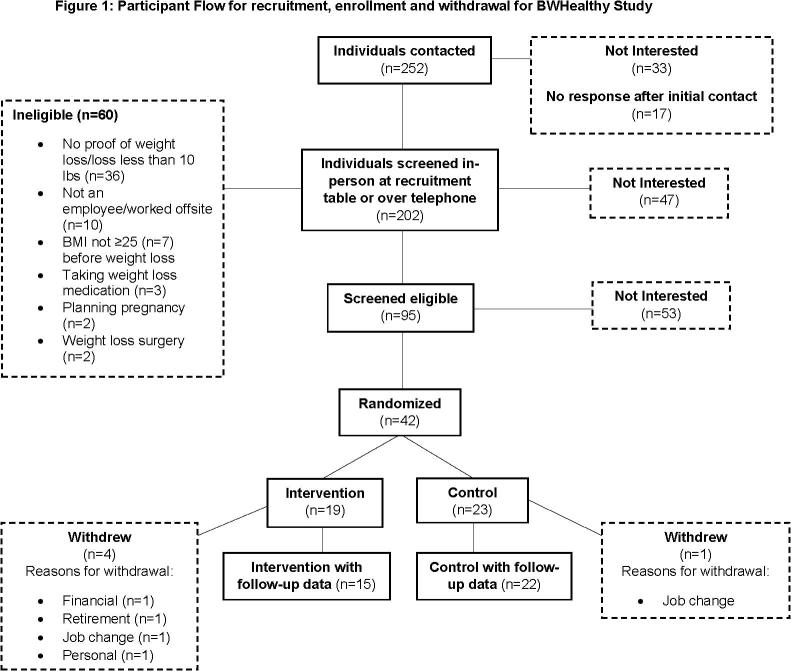
From 2016 to 2018, we conducted a pilot, 50-week randomized controlled trial among 42 hospital employees (19 intervention and 23 control), in Boston, Massachusetts, who lost ≥10 lb (4.5 kg) in the two years prior to enrollment. Participants were recruited primarily in-person. Both control and intervention participants were asked to attend a weigh in weekly and received weekly email communication. Intervention participants also entered into a deposit contract to maintain baseline weight within ≤2 lb (0.9 kg). We examined weight change from baseline to 50 weeks (primary outcome) and maintenance of baseline weight at 50 weeks (secondary outcome; binary - yes v. no). Participants completed baseline and follow-up surveys and received incentives for completion.
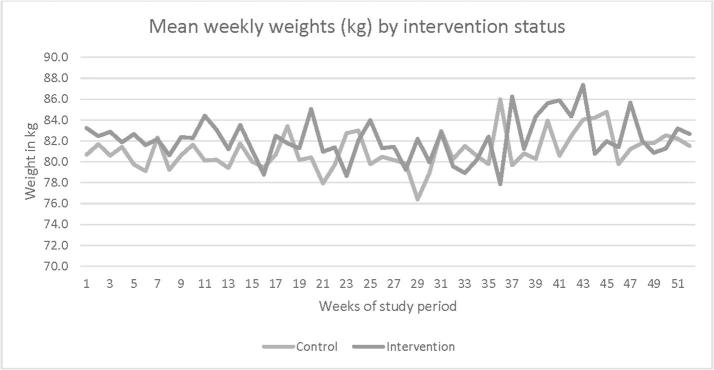
At baseline, mean (SD) weight was 83.2 (15.5 kg) among intervention and 80.7 (14.5 kg) among control participants. After 50 weeks, intervention participants had slightly less but non-significant weight gain (adjusted β -1.12 kg; 95% CI -5.28, 3.05) than control participants; 73.7% of intervention v. 39.1% of control participants met their weight-loss maintenance goal by study end (adjusted OR 4.78; 95% CI 1.01, 22.71).
A deposit contract was not associated with differences in weight but led to more participants meeting their weight-loss maintenance goals; a deposit contract for weight-loss maintenance should be tested in a full-scale intervention. Most intervention participants viewed the deposit contract as acceptable.
存款合同机制要求参与者“押注”能否实现一个目标,只有成功才能拿回自己的钱,研究表明这种机制在短期减肥方面有效。本初步研究探讨了其对维持体重减轻的效果。
2016年至2018年,我们在马萨诸塞州波士顿对42名医院员工(19名干预组和23名对照组)进行了一项为期50周的初步随机对照试验,这些员工在入组前两年内体重减轻了≥10磅(4.5千克)。主要通过面对面招募参与者。对照组和干预组参与者均被要求每周称一次体重,并每周收到电子邮件沟通。干预组参与者还签订了一份存款合同,以将体重维持在比基线体重多≤2磅(0.9千克)的范围内。我们研究了从基线到50周的体重变化(主要结局)以及在50周时维持基线体重的情况(次要结局;二元变量——是与否)。参与者完成了基线和随访调查,并因完成调查而获得激励。
在基线时,干预组参与者的平均(标准差)体重为83.2(15.5千克),对照组为80.7(14.5千克)。50周后,干预组参与者的体重增加略少但无显著差异(调整后的β为-1.12千克;95%置信区间为-5.28,3.05);到研究结束时,73.7%的干预组参与者与39.1%的对照组参与者达到了体重减轻维持目标(调整后的比值比为4.78;95%置信区间为1.01,22.71)。
存款合同机制与体重差异无关,但能使更多参与者达到体重减轻维持目标;减肥维持的存款合同机制应在全面干预中进行测试。大多数干预组参与者认为存款合同机制是可以接受的。