Newland Ben, Ehret Fanny, Hoppe Franziska, Eigel Dimitri, Pette Dagmar, Newland Heike, Welzel Petra B, Kempermann Gerd, Werner Carsten
Leibniz Institute of Polymer Research Dresden, Max Bergmann Center of Biomaterials Dresden, 01069, Dresden, Germany.
School of Pharmacy and Pharmaceutical Sciences, Cardiff University, CF10 3NB, Cardiff, UK.
MethodsX. 2020 Jan 23;7:100805. doi: 10.1016/j.mex.2020.100805. eCollection 2020.
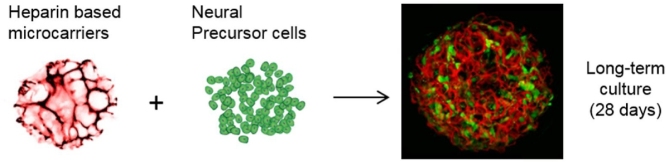
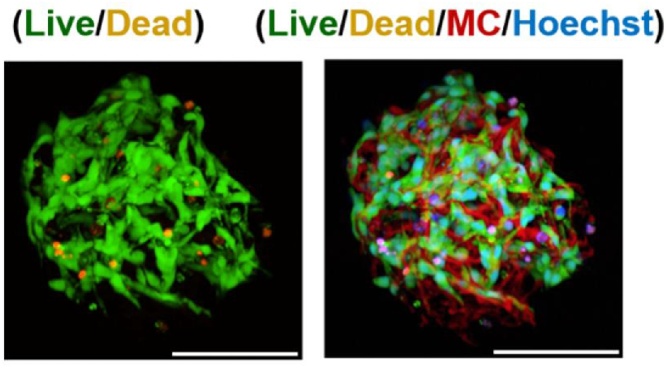
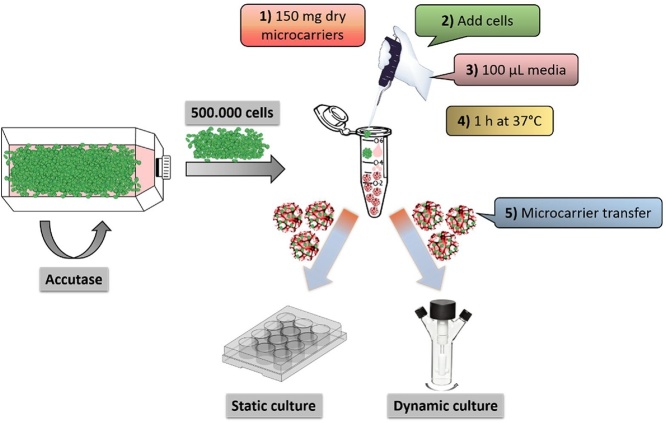
Neural precursor cells have been much studied to further our understanding of the far-reaching and controversial question of adult neurogenesis. Currently, differentiation of primary neural precursor cells from the mouse dentate gyrus via 2-dimentional culture yields low numbers of neurons, a major hindrance to the field of study. 3-dimentional "neurosphere" culture allows better 3D cell-cell contact, but control over cell differentiation is poor because nutrition and oxygen restrictions at the core of the sphere causes spontaneous differentiation, predominantly to glial cells, not neurons. Our group has developed macroporous scaffolds, which overcome the above-mentioned problems, allowing long-term culture of neural stem cells, which can be differentiated into a much higher yield of neurons. Herein we describe a method for culturing neural precursor cells on RGD peptide functionalized-heparin containing cryogel scaffolds, either in standard non-adherent well-plates (static culture) or in spinner flasks (dynamic culture). This method includes: •The synthesis and characterization of heparin based microcarriers.•A "static" 3D culture method for that does not require spinner flask equipment.•"Dynamic" culture in which cell loaded microcarriers are transferred to a spinner flask.
神经前体细胞已被广泛研究,以加深我们对成人神经发生这一影响深远且颇具争议问题的理解。目前,通过二维培养从小鼠齿状回中分离原代神经前体细胞,所产生的神经元数量较少,这是该研究领域的一个主要障碍。三维“神经球”培养能实现更好的三维细胞间接触,但由于球体核心处的营养和氧气限制会导致自发分化,主要分化为胶质细胞而非神经元,因此对细胞分化的控制较差。我们团队开发了大孔支架,克服了上述问题,能够对神经干细胞进行长期培养,且可分化出产量更高的神经元。在此,我们描述一种在RGD肽功能化的含肝素冷冻凝胶支架上培养神经前体细胞的方法,该方法可在标准非贴壁孔板(静态培养)或旋转瓶(动态培养)中进行。此方法包括:•基于肝素的微载体的合成与表征。•一种无需旋转瓶设备的“静态”三维培养方法。•将负载细胞的微载体转移至旋转瓶中的“动态”培养方法。