Leibniz-Institut für Polymerforschung Dresden e.V., Max Bergmann Center of Biomaterials Dresden, Hohe Straße 6, D-01069 Dresden, Germany.
School of Pharmacy and Pharmaceutical Sciences, Cardiff University, King Edward VII Avenue, Cardiff CF10 3NB, U.K.
ACS Chem Neurosci. 2021 Apr 7;12(7):1178-1188. doi: 10.1021/acschemneuro.1c00005. Epub 2021 Mar 23.
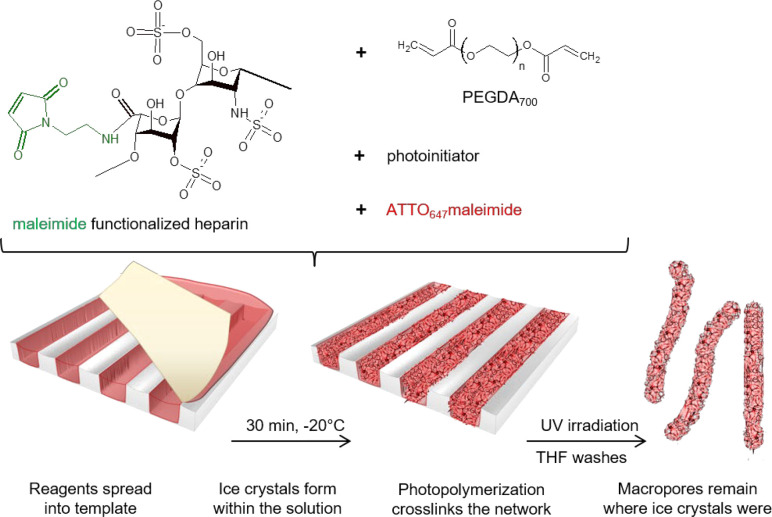
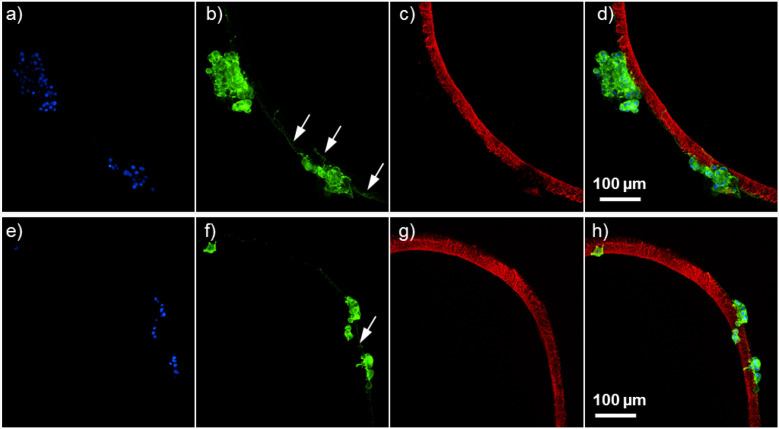
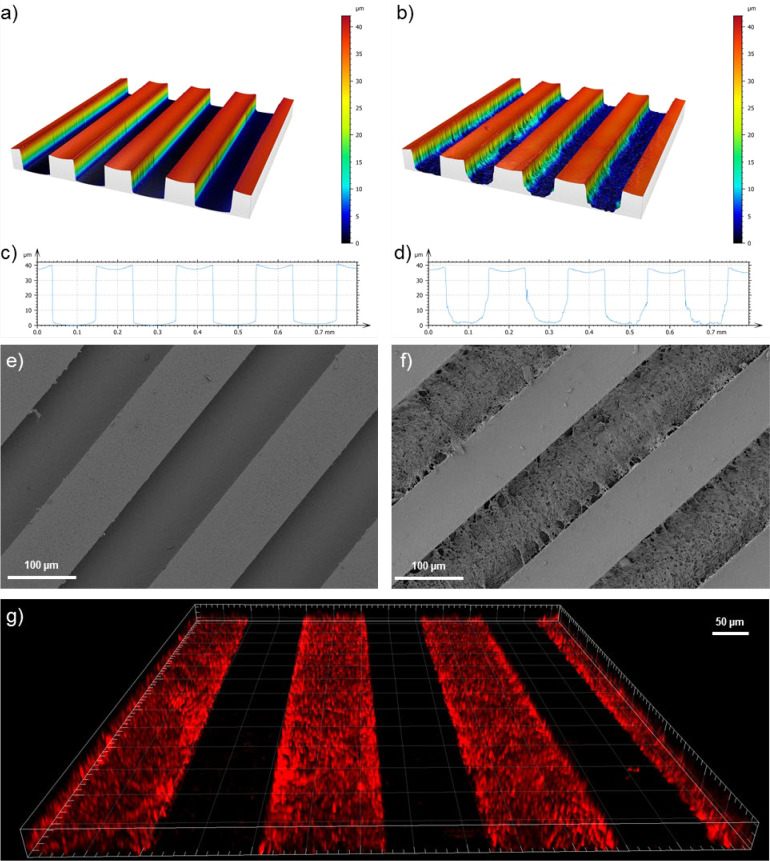
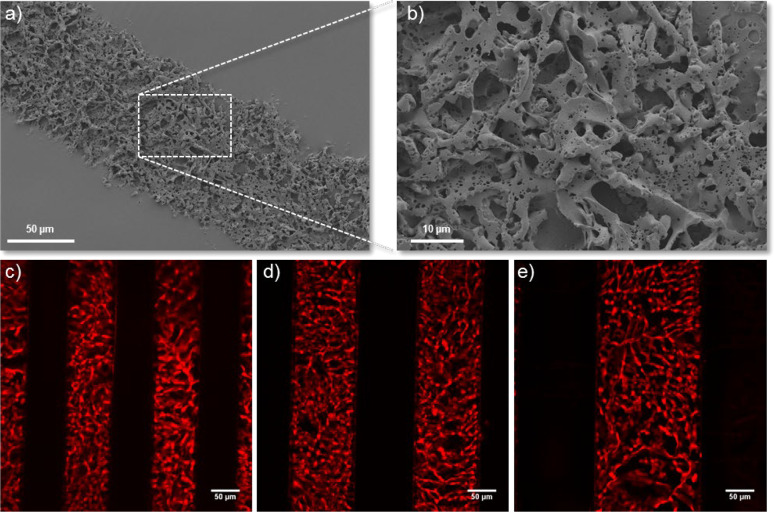
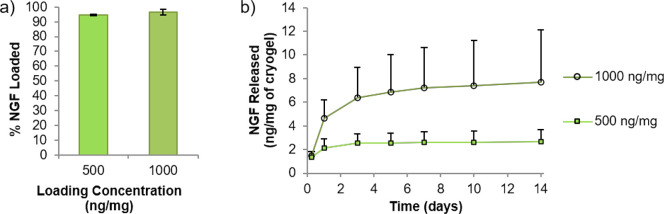
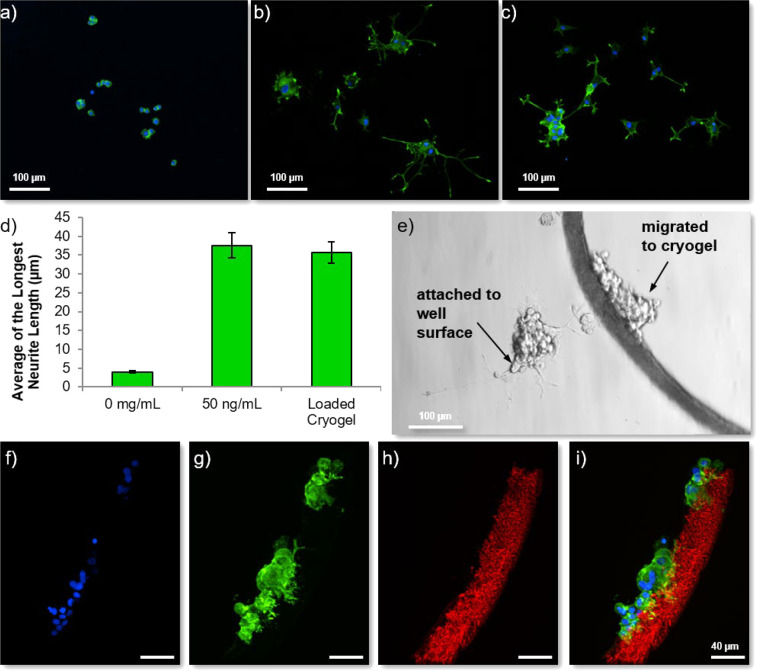
Glycosaminoglycan-based hydrogels hold great potential for applications in tissue engineering and regenerative medicine. By mimicking the natural extracellular matrix processes of growth factor binding and release, such hydrogels can be used as a sustained delivery device for growth factors. Since neural networks commonly follow well-defined, high-aspect-ratio paths through the central and peripheral nervous system, we sought to create a fiber-like, elongated growth factor delivery system. Cryogels, with networks formed at subzero temperatures, are well-suited for the creation of high-aspect-ratio biomaterials, because they have a macroporous structure making them mechanically robust (for ease of handling) yet soft and highly compressible (for interfacing with brain tissue). Unlike hydrogels, cryogels can be synthesized in advance of their use, stored with ease, and rehydrated quickly to their original shape. Herein, we use solvent-assisted microcontact molding to form sacrificial templates, in which we produced highly porous cryogel microscale scaffolds with a well-defined elongated shape via the photopolymerization of poly(ethylene glycol) diacrylate and maleimide-functionalized heparin. Dissolution of the template yielded cryogels that could load nerve growth factor (NGF) and release it over a period of 2 weeks, causing neurite outgrowth in PC12 cell cultures. This microscale template-assisted synthesis technique allows tight control over the cryogel scaffold dimensions for high reproducibility and ease of injection through fine gauge needles.
基于糖胺聚糖的水凝胶在组织工程和再生医学中有很大的应用潜力。通过模拟生长因子结合和释放的天然细胞外基质过程,此类水凝胶可用作生长因子的持续释放装置。由于神经网络通常沿着明确的、高纵横比的路径穿过中枢和周围神经系统,我们试图创建一种纤维状、细长的生长因子输送系统。在亚低温下形成网络的冷冻凝胶非常适合制造高纵横比生物材料,因为它们具有大孔结构,使其具有机械强度(便于处理),但又柔软且高度可压缩(与脑组织相适应)。与水凝胶不同,冷冻凝胶可以在使用前预先合成,易于储存,并迅速水合回其原始形状。在此,我们使用溶剂辅助微接触成型来形成牺牲模板,通过光聚合聚乙二醇二丙烯酸酯和马来酰亚胺功能化肝素,在模板中制备了具有明确的细长形状的高度多孔冷冻凝胶微尺度支架。模板的溶解得到了可以负载神经生长因子(NGF)并在 2 周内释放的冷冻凝胶,从而导致 PC12 细胞培养中的神经突生长。这种微尺度模板辅助合成技术可以对冷冻凝胶支架的尺寸进行严格控制,以实现高重现性和通过细规格针进行注射的便利性。