Maziarz Richard T, Waller Edmund K, Jaeger Ulrich, Fleury Isabelle, McGuirk Joseph, Holte Harald, Jaglowski Samantha, Schuster Stephen J, Bishop Michael R, Westin Jason R, Mielke Stephan, Teshima Takanori, Bachanova Veronika, Foley Stephen R, Borchmann Peter, Salles Gilles A, Zhang Jie, Tiwari Ranjan, Pacaud Lida B, Ma Qiufei, Tam Constantine S
Center for Hematologic Malignancies, Oregon Health and Science University (OHSU) Knight Cancer Institute, Portland, OR.
Bone Marrow and Stem Cell Transplant Center, Winship Cancer Institute of Emory University, Atlanta, GA.
Blood Adv. 2020 Feb 25;4(4):629-637. doi: 10.1182/bloodadvances.2019001026.
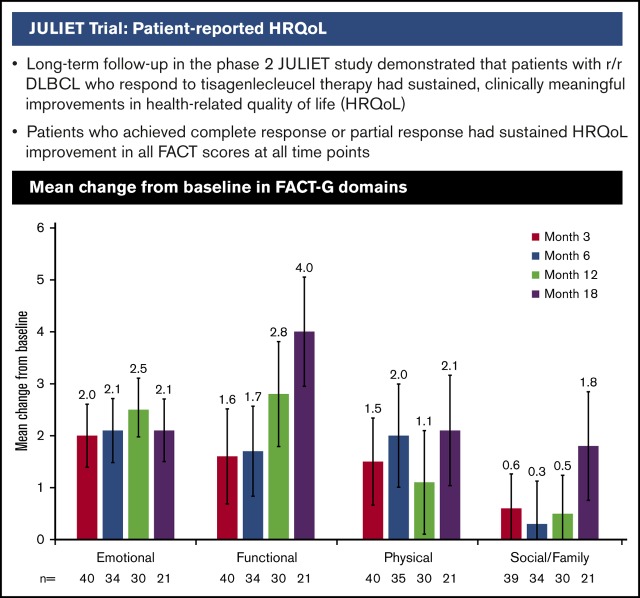
The JULIET phase 2 trial evaluated a single infusion of tisagenlecleucel in adult patients with relapsed/refractory (r/r) diffuse large B-cell lymphoma (DLBCL). The objective of the current analysis was to evaluate patient-reported health-related quality of life (HRQoL) with a median follow-up of 19.3 months among patients infused with a single dose of tisagenlecleucel. Patients enrolled were ≥18 years of age with r/r DLBCL after ≥2 lines of therapy and had either undergone a failed autologous stem cell transplant or were ineligible for the procedure. Two validated HRQoL instruments, Functional Assessment of Cancer Therapy-Lymphoma (FACT-Lym) and Short Form-36 (SF-36) Health Survey, were used to measure HRQoL at baseline and months 3, 6, 12, and 18. At data cutoff (21 May 2018), 115 patients had received tisagenlecleucel infusion. Among the 99 patients evaluated, overall response rate was 54%, and 40% of patients achieved complete response (CR). Initially, 108 patients completed the HRQoL assessments at baseline, including 57 patients who eventually achieved CR or partial response (PR). Further, 30 and 21 patients in clinical response who completed assessments at baseline also completed assessments at months 12 and 18, respectively. Patients who achieved CR or PR sustained HRQoL improvement in all FACT scores at all time points. SF-36 instruments showed improvement above the minimal clinically important differences on 5 of 8 subscales. Long-term follow-up in the phase 2 JULIET study demonstrated that patients with r/r DLBCL who respond to tisagenlecleucel therapy had sustained, clinically meaningful improvements in HRQoL. This trial was registered at www.clinicaltrials.gov as #NCT02445248.
JULIET 2期试验评估了在复发/难治性(r/r)弥漫性大B细胞淋巴瘤(DLBCL)成年患者中单次输注替沙格赛定。本次分析的目的是评估在单次输注替沙格赛定的患者中,中位随访19.3个月时患者报告的健康相关生活质量(HRQoL)。入组患者年龄≥18岁,接受过≥2线治疗后患有r/r DLBCL,且自体干细胞移植失败或不符合该手术条件。使用两种经过验证的HRQoL工具,即癌症治疗功能评估-淋巴瘤(FACT-Lym)和简明健康调查问卷36(SF-36),在基线以及第3、6、12和18个月测量HRQoL。在数据截止(2018年5月21日)时,115例患者接受了替沙格赛定输注。在评估的99例患者中,总体缓解率为54%,40%的患者达到完全缓解(CR)。最初,108例患者在基线时完成了HRQoL评估,其中57例患者最终达到CR或部分缓解(PR)。此外,在基线时完成评估且有临床缓解的30例和21例患者也分别在第12个月和第18个月完成了评估。达到CR或PR的患者在所有时间点的所有FACT评分中HRQoL均持续改善。SF-36工具在8个分量表中的5个上显示出高于最小临床重要差异的改善。JULIET 2期研究的长期随访表明,对替沙格赛定治疗有反应的r/r DLBCL患者在HRQoL方面有持续的、具有临床意义的改善。该试验在www.clinicaltrials.gov上注册,编号为#NCT02445248。